
Agent to Agent Testing Platform vs Prefactor
Side-by-side comparison to help you choose the right tool.

Agent to Agent Testing Platform
Validate AI agents across chat, voice, and phone interactions to ensure compliance, security, and performance.
Last updated: February 28, 2026

Prefactor
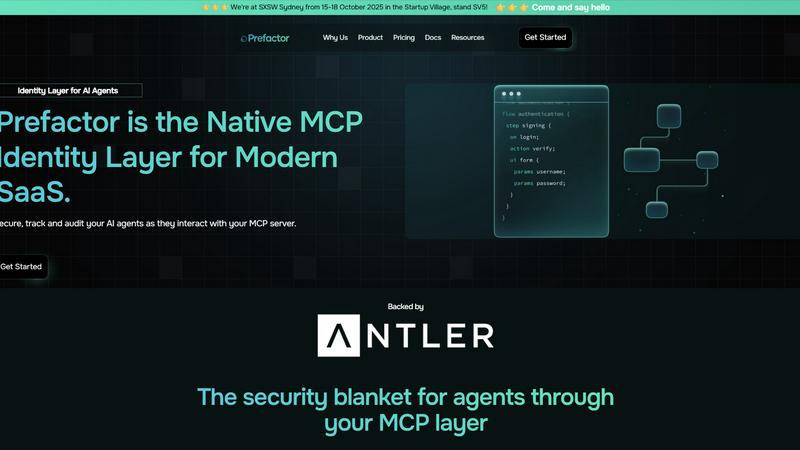
Prefactor is the essential control plane for governing AI agents securely at production scale.
Last updated: March 1, 2026
Visual Comparison
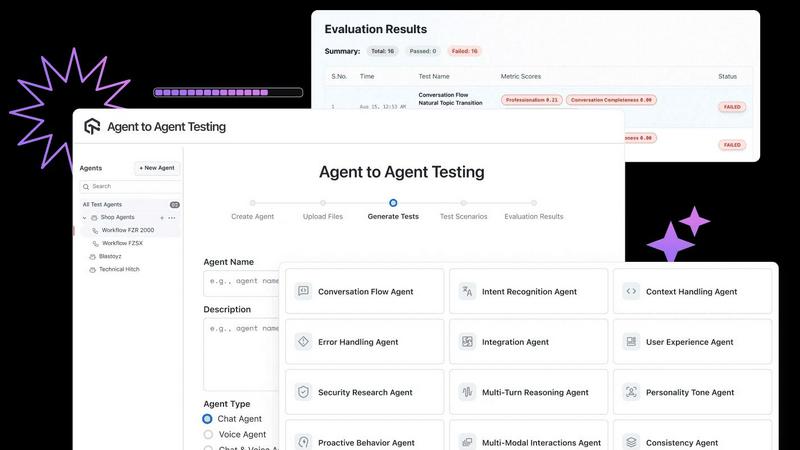
Agent to Agent Testing Platform
Prefactor
Feature Comparison
Agent to Agent Testing Platform
Automated Scenario Generation
This feature enables the platform to create diverse test scenarios automatically. It simulates chat, voice, hybrid, or phone interactions, ensuring that AI agents are tested against a wide array of real-world situations. This helps in identifying potential flaws that could affect user experience.
True Multi-Modal Understanding
Agent to Agent Testing Platform goes beyond text-based interactions. Users can define detailed requirements or upload various inputs—such as images, audio, and video—to assess the expected outputs of the agents under test. This capability mirrors real-world scenarios, enhancing the testing process.
Diverse Persona Testing
With this feature, users can leverage a variety of personas to mimic different end-user behaviors and needs. By simulating interactions with personas such as International Caller or Digital Novice, organizations can ensure that their AI agents perform effectively across a diverse user base.
Autonomous Testing at Scale
This feature provides a comprehensive analysis of the AI agent from the perspective of synthetic end-users. It evaluates key metrics including effectiveness, accuracy, empathy, and professionalism. This ensures that the AI maintains consistent intent and tone across various interactions.
Prefactor
Real-Time Agent Monitoring & Dashboard
Gain complete operational visibility across your entire agent infrastructure from a single dashboard. This isn't just about uptime; it's about seeing every agent action as it happens. Track which agents are active, what tools and data they're accessing, and pinpoint exactly where failures or anomalous behavior emerge—all before they cascade into full-blown incidents. It answers the critical question everyone from engineers to executives asks: "What is this agent doing right now?"
Compliance-Ready Audit Trails
Forget sifting through cryptic API logs that mean nothing to your compliance officer. Prefactor's audit logs are its killer feature, translating raw technical events into clear, business-context narratives. When compliance or security asks "what did the agent do and why?", you can generate audit-ready reports in minutes, not weeks. Every action is recorded in language stakeholders actually understand, built to withstand rigorous regulatory scrutiny.
Identity-First Access Control
Prefactor brings the mature governance principles of human identity management to your AI workforce. Every agent gets a unique, first-class identity. Every action it takes is authenticated, and every permission to access tools or data is explicitly scoped and enforced through policy-as-code. This foundational layer ensures you know exactly who (which agent) did what and had permission to do it.
Emergency Kill Switches & Cost Tracking
Maintain ultimate control with the ability to instantly deactivate any agent across your fleet—a non-negotiable for production safety. Coupled with this is granular cost tracking across compute providers. Prefactor lets you identify expensive execution patterns and optimize spending, turning agent operations from a black-box cost center into a manageable, efficient part of your infrastructure.
Use Cases
Agent to Agent Testing Platform
Quality Assurance for Customer Support Bots
Enterprises can use this platform to rigorously test their customer support chatbots, ensuring that they handle multi-turn conversations effectively while maintaining a high level of user satisfaction.
Voice Assistant Validation
Companies developing voice assistants can utilize the platform to simulate realistic voice interactions, ensuring that their AI agents respond appropriately and contextually across multiple scenarios.
Multimodal Interaction Testing
Organizations looking to deploy AI agents capable of handling various input forms—text, voice, and images—can leverage the platform's multi-modal understanding feature to validate performance across these channels.
Risk Assessment and Compliance Testing
The platform's regression testing capabilities allow companies to assess the risks associated with their AI agents. This ensures that potential policy violations and critical issues are identified and addressed before deployment.
Prefactor
Scaling Agent Pilots in Regulated Finance
A Fortune 500 bank's AI team has multiple agent pilots for loan processing and fraud detection. While the tech works, security and compliance block production deployment due to a lack of audit trails and access controls. Prefactor provides the governed control plane, giving each agent an identity, logging all actions in business terms, and enabling policy-based access, finally allowing them to move from pilot to approved production.
Managing AI Agents in Healthcare Operations
A healthcare technology company uses agents to automate patient intake and records matching. The strict requirements of HIPAA and need for detailed access logs make deployment daunting. Prefactor implements identity-first control and generates compliance-ready audit trails that clearly document every agent interaction with protected health information, satisfying legal and regulatory teams.
Governing Autonomous Agents in Critical Infrastructure
A mining or energy company employs agents for autonomous monitoring and reporting of equipment. The "fail-safe" requirement is extreme. Prefactor's real-time dashboard provides the necessary visibility to monitor agent health, while the emergency kill switch offers an instant shutdown capability, ensuring agents can be governed safely in high-stakes physical environments.
Centralizing Control for Multi-Framework AI Teams
A product team uses LangChain for some workflows, CrewAI for others, and custom frameworks for specific tasks. Managing security and visibility across this heterogeneous stack is a nightmare. Prefactor integrates across these frameworks, providing a single pane of glass for monitoring, audit, and policy enforcement, unifying governance regardless of the underlying agent technology.
Overview
About Agent to Agent Testing Platform
Agent to Agent Testing Platform is an innovative AI-native quality assurance framework specifically designed to validate the behavior of AI agents in real-world environments. As AI systems grow more autonomous, traditional quality assurance models that cater to static software become inadequate. This platform transcends basic prompt-level checks, offering comprehensive evaluations of multi-turn conversations across various interfaces, including chat, voice, and phone. Its main value proposition lies in ensuring that enterprises can thoroughly validate the functionality and reliability of their AI agents before deploying them in production. With a focus on uncovering long-tail failures and edge cases, this platform becomes an essential tool for organizations looking to enhance the performance and security of their AI solutions.
About Prefactor
Let's be brutally honest: the AI agent space is flooded with frameworks that make building a slick demo laughably easy. The real, gut-wrenching challenge begins when you try to push those agents into a real, regulated enterprise environment. That's where the dream meets the compliance, security, and operational reality wall. Prefactor isn't just another tool in your AI stack; it's the essential, non-negotiable control plane built specifically for this nightmare scenario. If your product or engineering team is running multiple agent pilots but hitting a brick wall with security reviews and compliance sign-offs, Prefactor is your definitive solution. It transforms chaotic, opaque automations into governed, transparent assets by giving every single AI agent a first-class, auditable identity. Its core genius is providing elegant trust: it finally aligns security, product, engineering, and compliance teams around one source of truth. By managing access through policy-as-code, automating permissions in CI/CD pipelines, and delivering full visibility over every action, Prefactor turns risky agent experiments into compliant, scalable operations. This is the critical infrastructure that bridges the infamous gap from a compelling POC to governed, trustworthy production, especially for industries like banking, healthcare, and mining where "move fast and break things" is a recipe for disaster.
Frequently Asked Questions
Agent to Agent Testing Platform FAQ
What types of AI agents can be tested with this platform?
The Agent to Agent Testing Platform supports testing for various AI agents, including chatbots, voice assistants, and phone caller agents, across multiple scenarios.
How does the platform ensure comprehensive testing?
The platform employs automated scenario generation, which creates diverse test cases that simulate real-world interactions. This approach helps uncover long-tail failures and edge cases that manual testing might miss.
Can I customize test scenarios?
Yes, users can access a library of hundreds of predefined scenarios or create custom scenarios tailored to their specific testing requirements, ensuring relevant assessments of their AI agents.
What metrics does the platform evaluate?
The platform evaluates several key metrics, including bias, toxicity, hallucinations, effectiveness, and empathy. This comprehensive analysis helps organizations optimize their AI agents' performance and user experience.
Prefactor FAQ
What exactly is an "AI Agent Control Plane"?
Think of it like the control tower at a major airport. Individual AI agent frameworks (LangChain, CrewAI, etc.) are the planes—they do the actual work. The control plane is the essential layer of infrastructure that manages the traffic: it gives each "plane" (agent) a unique identity, dictates its permissions (flight path), monitors its every move in real-time, and maintains a perfect log of all activity. It's the system that brings order, safety, and governance to autonomous operations.
How does Prefactor work with existing AI agent frameworks?
Prefactor is designed to be framework-agnostic. It provides SDKs and integrations that work seamlessly with popular frameworks like LangChain, CrewAI, and AutoGen, as well as custom-built agents. You can deploy it alongside your existing agents, often in just hours. It doesn't replace your framework; it adds the critical production-grade governance layer that these frameworks typically lack.
Is Prefactor only for large, regulated enterprises?
While its features are absolutely essential for regulated industries (finance, healthcare, etc.), any team moving multiple AI agents from demo to real-world production will benefit. If you care about knowing what your agents are doing, controlling their access, having audit trails, and managing costs, Prefactor provides the enterprise-ready infrastructure so you don't have to build it from scratch.
What is MCP and how does Prefactor relate to it?
Model Context Protocol (MCP) is becoming a standard way for AI agents to connect to tools and data sources. Prefactor's whitepaper "MCP in Production" addresses the critical gap: while MCP enables connectivity, teams are "flying blind" in production without governance. Prefactor acts as the control plane for MCP-enabled agents, providing the essential visibility, audit, and security controls needed to use MCP safely at scale.
Alternatives
Agent to Agent Testing Platform Alternatives
Agent to Agent Testing Platform is a pioneering AI-native quality assurance framework designed to validate agent behavior across various communication channels, including chat, voice, and multimodal systems. As organizations increasingly adopt autonomous AI systems, traditional QA models struggle to keep pace with the dynamic nature of these technologies, prompting users to seek alternatives that better fit their specific needs. Common reasons for exploring alternatives include pricing concerns, feature gaps, integration capabilities, or the need for more tailored solutions to meet unique operational demands. When selecting an alternative, it's crucial to consider aspects such as scalability, usability, the comprehensiveness of testing methods, and the ability to provide insights into agent behavior and compliance.
Prefactor Alternatives
Prefactor is the essential control plane for governing AI agents in production at scale. It belongs to the emerging category of AI governance and security platforms, specifically designed to bring order and compliance to the chaotic world of autonomous AI agents. Users often look for alternatives for a few key reasons. Some find their needs are simpler and don't require such a comprehensive governance layer, while others may have specific platform requirements or budget constraints that lead them to explore other options in the market. When evaluating any solution in this space, you should look for core capabilities that enable trust at scale. This includes robust identity management for non-human entities, real-time visibility into agent actions, and policy-driven controls that integrate seamlessly into your existing engineering and security workflows. The goal is to move from risky experiments to governed operations.