CCAPI vs Kling 5
Side-by-side comparison to help you choose the right tool.

CCAPI
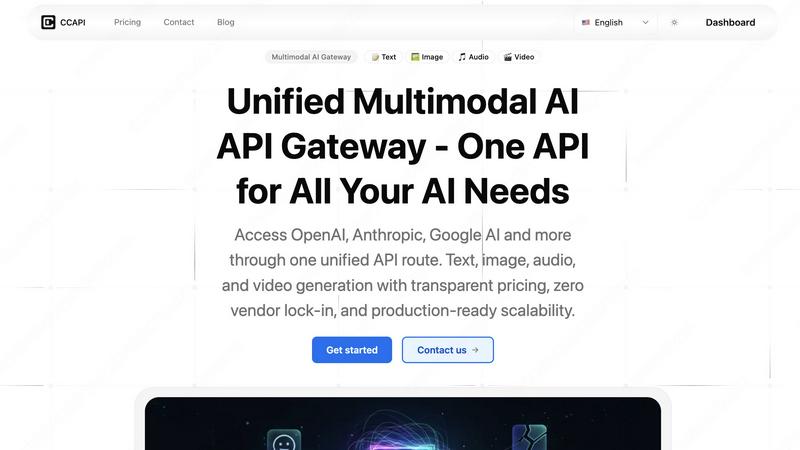
CCAPI instantly connects you to all major AI models through one reliable, always-on gateway.
Last updated: February 28, 2026

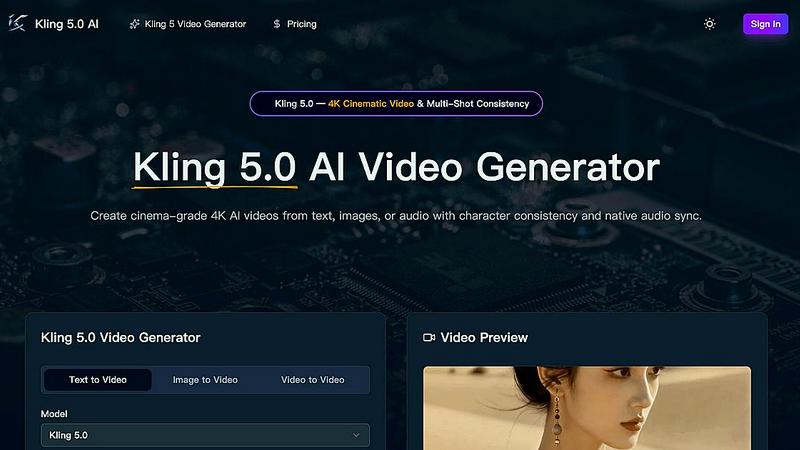
Kling 5.0 is my top pick for creating stunning, 4K cinematic AI videos with perfectly consistent characters.
Last updated: April 13, 2026
Visual Comparison
CCAPI
Kling 5
Feature Comparison
CCAPI
Unified Multimodal Gateway
CCAPI consolidates access to the entire spectrum of generative AI—text, image, audio, and video—through one consistent API structure. Instead of integrating separately with OpenAI for chat, Stability AI for images, and Suno for audio, you make all your calls to api.ccapi.ai. This dramatically reduces integration complexity, standardizes error handling, and future-proofs your app. You can switch from generating a story with Claude to creating a soundtrack for it with ElevenLabs using the same SDK and authentication flow.
Intelligent Auto-Failover & Smart Routing
This is the engine that makes CCAPI indispensable for production applications. The system continuously monitors the health and latency of all connected providers. When a request to, say, OpenAI times out or returns an error, CCAPI's router instantly (in ~120ms) retries the request using an alternative provider like Anthropic or Google AI. This happens seamlessly behind the scenes, ensuring your end-users never experience downtime. It effectively turns multiple single points of failure into a robust, always-on AI pipeline.
OpenAI-Compatible Endpoint
Adoption is frictionless. CCAPI speaks the same language as the OpenAI API. For most developers, integration is as simple as changing the baseURL in their existing OpenAI SDK client from https://api.openai.com/v1 to https://api.ccapi.ai/v1. Your existing code for chat completions, function calling, and streaming works immediately. This design philosophy respects developer time and eliminates costly migration projects, letting you leverage a superior infrastructure layer in minutes.
Transparent Pay-As-You-Go Billing
CCAPI cuts through the nonsense of platform credits and mandatory subscriptions. You deposit real USD (e.g., $100) which becomes your usable balance, and you only pay for what you consume across any model. The platform provides a detailed usage dashboard with real-time metrics on costs, latency, and success rates per provider. This transparency ensures you know exactly where every dollar is going and can optimize for cost or performance without any financial gimmicks.
Kling 5
4K Cinematic Video Generation
This is the headline act. Kling 5 generates videos up to 15 seconds long in true 4K resolution. But it's not just about pixels; it's about the cinematic language. The AI understands complex lighting, atmospheric effects, and realistic textures, rendering outputs that have a professional, filmic look and feel right out of the gate. The difference in quality compared to standard 1080p AI video is immediately noticeable and game-changing for professional use.
Omni Subject Library for Character Consistency
This is, hands down, my favorite feature and Kling 5's killer app. The Omni Subject Library allows you to "lock" a character's facial features, proportions, and style across multiple shots and camera angles. This means you can create episodic content, product series, or brand campaigns where your protagonist looks identical in every scene. It solves the single biggest headache in AI video production and opens up possibilities for serialized storytelling.
Native Audio Generation & Multilingual Lip-Sync
Kling 5 doesn't just make silent movies. It generates synchronized audio—dialogue, ambient sound, Foley effects—alongside the video in a single pass. Even more impressively, it delivers phoneme-level lip-sync in five languages (English, Chinese, Japanese, Korean, Spanish). The audio feels native to the scene, with mouth movements that accurately match the spoken words and even convey matched emotion, adding a massive layer of authenticity.
Advanced Physics Simulation Engine
Where many AI videos fall into the "uncanny valley," Kling 5 excels with its physics engine. It simulates natural movement for water, fabric, fire, and human anatomy with startling realism. This attention to the physical behavior of materials is what separates a good AI video from a believable one. It's perfect for creating dynamic nature scenes, flowing costumes, or any scenario where realistic motion is critical to immersion.
Use Cases
CCAPI
Building Resilient Production AI Applications
For any startup or enterprise running customer-facing AI features, downtime is unacceptable. CCAPI is the reliability layer that ensures your chatbot, content generator, or moderation tool stays operational even if a major provider like OpenAI has an outage. By automatically failing over to backup models, it guarantees service continuity, protecting your user experience and your business's reputation without requiring you to build complex fallback logic.
Rapid AI Model Prototyping and Evaluation
Developers and researchers can test and compare the latest models from different labs (like GLM-5 vs. DeepSeek V4) through a single interface without managing numerous API keys and SDKs. This is perfect for running benchmarks, A/B testing model outputs for a specific task, or simply experimenting with the newest model release like Kling 3.0 for video, all with instant access and no waitlists.
Cost and Performance Optimization
With access to pricing and latency data across many providers, you can programmatically route requests based on your priorities. You might send simple queries to a cost-effective model like DeepSeek V4 and reserve premium models like Claude 4.6 for complex reasoning tasks. CCAPI's dashboard gives you the insights needed to design these routing rules, optimizing your application's performance and monthly AI spend simultaneously.
Consolidating Multi-Modal AI Workflows
If your application needs to generate a product description (text), a marketing image, a voiceover (audio), and a short promotional clip (video), doing this natively would require four different integrations. CCAPI enables all these modalities from one platform. You can orchestrate complex, multi-step generative workflows using a unified toolchain, simplifying backend code and data pipeline management significantly.
Kling 5
Social Media Content & Short-Form Video
For influencers, brands, and marketers, Kling 5 is a content machine. Imagine generating a week's worth of unique, eye-catching 4K clips for TikTok, Instagram Reels, or YouTube Shorts in an afternoon. Describe your concept, select the 9:16 aspect ratio, and you have professional-grade vertical video ready to post, complete with synced audio and trending cinematic styles.
Prototyping for Film & Animation
Independent filmmakers and animators can use Kling 5 to rapidly prototype scenes, test storyboards, and visualize complex shots before a single real-world camera rolls. The multi-shot consistency feature is invaluable for pre-visualizing sequences with the same character, while the cinematic camera control (zoom, pan, tilt) allows for precise shot planning.
Explainer Videos & Product Marketing
Marketing teams can create stunning product demos and explainer videos without expensive production. Upload an image of your product, and Kling 5 can animate it with elegant motion. Use character consistency to create a branded spokesperson who can explain features across a whole video series, all while maintaining a polished, corporate-friendly 4K aesthetic.
Educational Content & Concept Visualization
Educators and trainers can bring complex concepts to life. Need to show the water cycle, a historical event, or a scientific process? Describe it in text, and Kling 5 will generate a clear, engaging visual representation with realistic physics. It transforms abstract ideas into concrete, memorable video segments that enhance learning and retention.
Overview
About CCAPI
CCAPI is the developer's definitive gateway to the fragmented world of artificial intelligence. In an ecosystem where new models from OpenAI, Anthropic, Google, and a dozen other labs drop weekly, managing API keys, endpoints, and fallback logic is a full-time job. CCAPI eliminates that chaos. It's a unified, multimodal API that aggregates over seven major AI providers—including the latest from ByteDance, Kuaishou, and MiniMax—under a single, OpenAI-compatible endpoint. Built for engineers who value resilience and simplicity, it allows you to access cutting-edge text, image, audio, and video generation models through one call. Its killer feature is smart routing: if your primary provider fails or is rate-limited, CCAPI automatically fails over to a backup in about 120ms, guaranteeing a 99.9% success rate for your requests. You get instant access to models like GPT-5.2, Claude 4.6, and the newest video generators like Kling 3.0 without a waitlist, all while your application gains enterprise-grade uptime. It’s the infrastructure layer that lets you focus on building your product, not babysitting API connections.
About Kling 5
Let's cut to the chase: Kling 5 isn't just another AI video tool; it's the one that finally makes professional-grade video creation feel like a superpower for the rest of us. Forget the clunky, uncanny-valley outputs of older models. Kling 5.0 is a revolutionary AI video generator designed to produce stunning, cinematic 4K clips from a simple text prompt, uploaded image, or even audio. What truly sets it apart, and why I'm so bullish on it, is its obsessive focus on cinematic quality and consistency. It's built for creators, marketers, filmmakers, and businesses who need broadcast-ready content without the broadcast-level budget or technical crew. The core value proposition is breathtakingly simple: describe your vision in plain language, and in seconds, you have a video with realistic physics, multi-shot character consistency, and native audio sync. This isn't about replacing human creativity; it's about turbocharging it, removing the technical barriers so you can focus on the story. For anyone serious about video content in 2024, ignoring Kling 5 would be a strategic mistake.
Frequently Asked Questions
CCAPI FAQ
How does the automatic failover work?
When you send a request to CCAPI, its intelligent router first sends it to your configured or default model provider. If that request fails (e.g., network error, 5xx status code, rate limit) or exceeds a latency threshold, the system immediately and automatically retries the same request with a different, available provider. This switch happens in approximately 120 milliseconds, making the failure largely imperceptible to your end-users and ensuring a 99.9% success rate for your API calls.
Is there a lock-in period or subscription fee?
Absolutely not. CCAPI operates on a pure pay-as-you-go model. You add funds to your account in real USD, and your balance is deducted only for the API calls you make. There are no monthly subscriptions, minimum spends, or hidden fees. You can stop using the service at any time, and any remaining balance is yours to use or can be addressed according to their terms.
Can I use my own API keys with CCAPI?
Yes, through the Custom Providers feature. This allows you to bring your own API keys from services like OpenAI or Anthropic and configure them within your CCAPI dashboard. You can then route requests through CCAPI's smart routing and monitoring infrastructure using your own keys, giving you the benefits of failover and unified logging while managing your own direct billing with the provider.
What SDKs and languages are supported?
Because CCAPI provides an OpenAI-compatible endpoint, it works with any SDK or HTTP client that can call a REST API. This includes the official OpenAI Python and Node.js libraries, LangChain, LlamaIndex, and even simple cURL commands. You simply replace the OpenAI base URL with CCAPI's. If your tool can talk to OpenAI, it can talk to CCAPI.
Kling 5 FAQ
What is the maximum video length Kling 5 can generate?
Based on the provided interface, Kling 5 can generate videos with a duration setting, with the example showing a 5-second option. The descriptive text states it can create videos "up to 15 seconds" in length. This is ideal for short-form content, scenes, and clips. For longer narratives, you would sequence multiple consistent 15-second generations together.
How does the character consistency feature actually work?
The feature is powered by the Omni Subject Library. You first generate or define a character. Kling 5 then creates a unique "subject lock" for that character, storing their specific facial features, proportions, and style. In any subsequent video generation, you can reference this locked subject, and the AI will ensure the character appears identical, even across different shots, angles, and actions.
Can I use Kling 5 for commercial projects?
Absolutely. The platform is designed for professional use. The output is broadcast-ready 4K quality, making it suitable for commercial marketing, social media campaigns, paid advertising, and even elements within larger film or television projects. Always check the specific Terms of Service for the latest licensing details.
What languages are supported for lip-sync?
Kling 5.0's native audio generation supports lip-sync at the phoneme level in five key languages: English, Chinese, Japanese, Korean, and Spanish. This means the AI doesn't just overlay sound; it animates the mouth shapes to precisely match the spoken words in these languages, creating a highly realistic and synchronized result.
Alternatives
CCAPI Alternatives
CCAPI is a unified multimodal AI API gateway, a developer tool that acts as a single access point to multiple AI models from providers like OpenAI, Anthropic, and Google. It simplifies building AI-powered features by handling the complexity of different APIs, authentication, and formats under one route. Developers often seek alternatives for various reasons. Cost is a major factor, as pricing structures can differ significantly. Others might need a specific feature CCAPI lacks, prefer a different user experience, or require a platform that aligns with a particular cloud provider or development stack. When evaluating other options, consider your primary needs. Look at the breadth of model providers supported, the simplicity of the unified interface, and the robustness of features like fallback routing and consistent error handling. The best choice depends on your project's scale, required AI modalities, and budget.
Kling 5 Alternatives
Kling 5.0 is a prominent player in the rapidly evolving AI video generator space. It promises to democratize video creation by turning text prompts into professional-looking clips, a category that has exploded in popularity for marketers, educators, and content creators. However, no single tool is a perfect fit for everyone, and users often explore alternatives for a variety of reasons. Common motivations include budget constraints, as premium AI video tools can be costly. Others might seek different creative styles, more granular control over the output, or specific features like advanced lip-syncing or longer video generation. Platform compatibility, such as needing a mobile app or a specific integration, also drives the search for other options. When evaluating alternatives, look beyond just the price tag. Consider the core AI model's quality and style, the flexibility of the editing suite, and the learning curve. Your ideal choice should align with your primary use case, whether it's rapid social media clips, detailed explainer videos, or something more narrative-driven.