CCAPI vs TrafficClaw
Side-by-side comparison to help you choose the right tool.

CCAPI
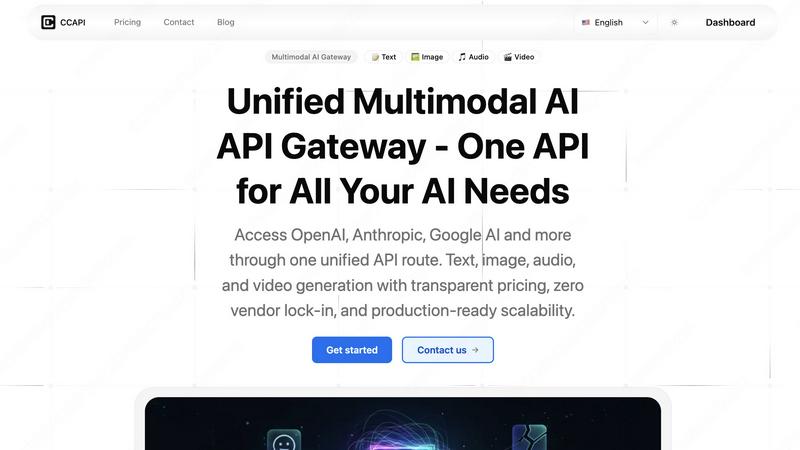
CCAPI instantly connects you to all major AI models through one reliable, always-on gateway.
Last updated: February 28, 2026

TrafficClaw
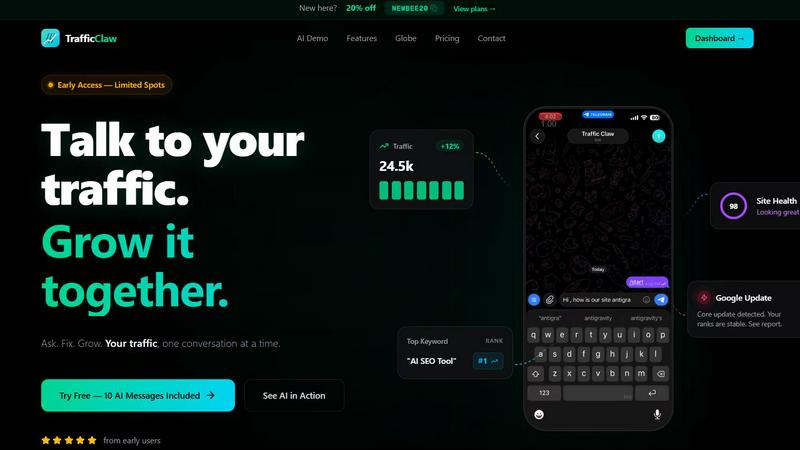
TrafficClaw is an AI analyst that talks to your SEO data to deliver actionable growth insights, not generic advice.
Last updated: April 13, 2026
Visual Comparison
CCAPI
TrafficClaw
Feature Comparison
CCAPI
Unified Multimodal Gateway
CCAPI consolidates access to the entire spectrum of generative AI—text, image, audio, and video—through one consistent API structure. Instead of integrating separately with OpenAI for chat, Stability AI for images, and Suno for audio, you make all your calls to api.ccapi.ai. This dramatically reduces integration complexity, standardizes error handling, and future-proofs your app. You can switch from generating a story with Claude to creating a soundtrack for it with ElevenLabs using the same SDK and authentication flow.
Intelligent Auto-Failover & Smart Routing
This is the engine that makes CCAPI indispensable for production applications. The system continuously monitors the health and latency of all connected providers. When a request to, say, OpenAI times out or returns an error, CCAPI's router instantly (in ~120ms) retries the request using an alternative provider like Anthropic or Google AI. This happens seamlessly behind the scenes, ensuring your end-users never experience downtime. It effectively turns multiple single points of failure into a robust, always-on AI pipeline.
OpenAI-Compatible Endpoint
Adoption is frictionless. CCAPI speaks the same language as the OpenAI API. For most developers, integration is as simple as changing the baseURL in their existing OpenAI SDK client from https://api.openai.com/v1 to https://api.ccapi.ai/v1. Your existing code for chat completions, function calling, and streaming works immediately. This design philosophy respects developer time and eliminates costly migration projects, letting you leverage a superior infrastructure layer in minutes.
Transparent Pay-As-You-Go Billing
CCAPI cuts through the nonsense of platform credits and mandatory subscriptions. You deposit real USD (e.g., $100) which becomes your usable balance, and you only pay for what you consume across any model. The platform provides a detailed usage dashboard with real-time metrics on costs, latency, and success rates per provider. This transparency ensures you know exactly where every dollar is going and can optimize for cost or performance without any financial gimmicks.
TrafficClaw
AI Chat Analyst
This is the heart of TrafficClaw and, in my opinion, its killer feature. You interact with a conversational AI that has direct, read-only access to your connected Google Analytics 4 and Search Console data. You ask natural language questions like "Why are my conversions down?" or "Show me my top underperforming pages," and it doesn't just spit out a chart. It analyzes the correlation between your traffic, keyword rankings, and user behavior to deliver a written "verdict" with evidence and concrete next steps. It feels less like using software and more like consulting a sharp, data-obsessed colleague who works at light speed.
SEO Intelligence Suite
Moving beyond basic rank tracking, TrafficClaw's SEO tools are built for proactive growth. It automatically hunts for keyword gaps your competitors rank for but you don't, alerts you to content decay (pages that are losing traffic over time), and detects keyword cannibalization—where your own pages compete against each other, confusing Google. Crucially, it includes optimization for AI search (like Gemini), helping you structure content for the next frontier of search. It turns SEO from a maintenance task into a growth engine.
Real-Time Analytics & Live Globe
Forget refreshing GA4. TrafficClaw provides a consolidated, real-time dashboard showing current visitors, traffic trends, bounce rates, and referrers. The standout is the embeddable 3D globe, which visually plots your live visitors on a world map with a cute animal alias and activity feed. It's not just eye candy; it's a powerful, immediate way to see geographic engagement and visitor flow, and you can embed it on your own site with a single line of code—no extra tracking scripts needed.
Integrated Site Audit & Content Tools
This feature closes the loop between insight and action. The built-in site auditor goes deep on page-level performance, grading Core Web Vitals and offering auto-fix suggestions for technical SEO. Then, the content tools help you execute. Need to target a discovered keyword gap? Use the AI blog writer and schema generator. Found a page that needs bolstering? The internal linking optimizer provides smart suggestions. It’s a seamless workflow from diagnosis to remedy.
Use Cases
CCAPI
Building Resilient Production AI Applications
For any startup or enterprise running customer-facing AI features, downtime is unacceptable. CCAPI is the reliability layer that ensures your chatbot, content generator, or moderation tool stays operational even if a major provider like OpenAI has an outage. By automatically failing over to backup models, it guarantees service continuity, protecting your user experience and your business's reputation without requiring you to build complex fallback logic.
Rapid AI Model Prototyping and Evaluation
Developers and researchers can test and compare the latest models from different labs (like GLM-5 vs. DeepSeek V4) through a single interface without managing numerous API keys and SDKs. This is perfect for running benchmarks, A/B testing model outputs for a specific task, or simply experimenting with the newest model release like Kling 3.0 for video, all with instant access and no waitlists.
Cost and Performance Optimization
With access to pricing and latency data across many providers, you can programmatically route requests based on your priorities. You might send simple queries to a cost-effective model like DeepSeek V4 and reserve premium models like Claude 4.6 for complex reasoning tasks. CCAPI's dashboard gives you the insights needed to design these routing rules, optimizing your application's performance and monthly AI spend simultaneously.
Consolidating Multi-Modal AI Workflows
If your application needs to generate a product description (text), a marketing image, a voiceover (audio), and a short promotional clip (video), doing this natively would require four different integrations. CCAPI enables all these modalities from one platform. You can orchestrate complex, multi-step generative workflows using a unified toolchain, simplifying backend code and data pipeline management significantly.
TrafficClaw
Diagnosing Sudden Traffic Drops
This is the classic, hair-pulling scenario TrafficClaw was made for. Instead of manually cross-referencing GA4 events, Search Console impressions, and Google update logs, you simply ask the AI, "Why did my traffic drop 40% on March 15th?" Within seconds, it can analyze your data and deliver a verdict like, "A core update rolled out that day. While your overall ranks are stable, you lost position 3 for your top keyword 'cloud hosting reviews' to a competitor's newer guide, causing a 12k impression drop. Recommended fix: Update your post with a more comprehensive comparison table."
Uncovering Hidden Keyword Opportunities
You're stuck thinking you've targeted all relevant keywords. TrafficClaw's SEO intelligence continuously scours your niche to find "keyword gaps"—high-potential terms your site could rank for but currently doesn't. You can ask the AI, "What are my top 5 keyword gap opportunities?" and get a list of specific, data-backed terms with search volume and difficulty, allowing you to strategically plan your next content piece or page update.
Preventing Content Cannibalization
You've written multiple blog posts on similar topics, and now they're mysteriously underperforming. TrafficClaw automatically detects when your pages are competing for the same keywords and alerts you. The AI can then advise on how to consolidate or differentiate the content, ensuring you have one strong page to rank instead of several weak ones that split authority. It solves a complex, often invisible SEO problem effortlessly.
Real-Time Campaign & Launch Monitoring
When you launch a new product, feature, or marketing campaign, you want immediate feedback. With the real-time dashboard and globe, you can watch live visitor spikes, see which countries are engaging first, and monitor referral sources the moment they happen. You can ask the AI, "How is traffic from my LinkedIn campaign today performing vs. direct traffic?" for instant, comparative analysis without waiting for data to process.
Overview
About CCAPI
CCAPI is the developer's definitive gateway to the fragmented world of artificial intelligence. In an ecosystem where new models from OpenAI, Anthropic, Google, and a dozen other labs drop weekly, managing API keys, endpoints, and fallback logic is a full-time job. CCAPI eliminates that chaos. It's a unified, multimodal API that aggregates over seven major AI providers—including the latest from ByteDance, Kuaishou, and MiniMax—under a single, OpenAI-compatible endpoint. Built for engineers who value resilience and simplicity, it allows you to access cutting-edge text, image, audio, and video generation models through one call. Its killer feature is smart routing: if your primary provider fails or is rate-limited, CCAPI automatically fails over to a backup in about 120ms, guaranteeing a 99.9% success rate for your requests. You get instant access to models like GPT-5.2, Claude 4.6, and the newest video generators like Kling 3.0 without a waitlist, all while your application gains enterprise-grade uptime. It’s the infrastructure layer that lets you focus on building your product, not babysitting API connections.
About TrafficClaw
Let's be brutally honest: modern analytics are a mess. You've got Google Analytics 4 with its labyrinthine interface, Search Console with its pretty-but-passive graphs, and a dozen other tools that show you the "what" but never the "why." When your traffic plummets, you're left piecing together clues like a digital detective with no leads. TrafficClaw is the antidote to this frustration. It's not another dashboard to stare at; it's an AI analyst you can actually talk to. You connect your GA4 and Search Console accounts (a 30-second, read-only process), and then you just ask questions in plain English. "Why did my traffic drop last Tuesday?" "What's my top opportunity for more organic traffic?" "Is a Google update affecting me?" Instead of generic blog post advice, you get a specific, actionable verdict backed by your own live data. It's built for founders, marketers, and developers who are tired of data guesswork and want to have a direct conversation with their analytics to drive real, intelligent growth. The core promise is simple yet revolutionary: stop analyzing and start asking.
Frequently Asked Questions
CCAPI FAQ
How does the automatic failover work?
When you send a request to CCAPI, its intelligent router first sends it to your configured or default model provider. If that request fails (e.g., network error, 5xx status code, rate limit) or exceeds a latency threshold, the system immediately and automatically retries the same request with a different, available provider. This switch happens in approximately 120 milliseconds, making the failure largely imperceptible to your end-users and ensuring a 99.9% success rate for your API calls.
Is there a lock-in period or subscription fee?
Absolutely not. CCAPI operates on a pure pay-as-you-go model. You add funds to your account in real USD, and your balance is deducted only for the API calls you make. There are no monthly subscriptions, minimum spends, or hidden fees. You can stop using the service at any time, and any remaining balance is yours to use or can be addressed according to their terms.
Can I use my own API keys with CCAPI?
Yes, through the Custom Providers feature. This allows you to bring your own API keys from services like OpenAI or Anthropic and configure them within your CCAPI dashboard. You can then route requests through CCAPI's smart routing and monitoring infrastructure using your own keys, giving you the benefits of failover and unified logging while managing your own direct billing with the provider.
What SDKs and languages are supported?
Because CCAPI provides an OpenAI-compatible endpoint, it works with any SDK or HTTP client that can call a REST API. This includes the official OpenAI Python and Node.js libraries, LangChain, LlamaIndex, and even simple cURL commands. You simply replace the OpenAI base URL with CCAPI's. If your tool can talk to OpenAI, it can talk to CCAPI.
TrafficClaw FAQ
Is my Google data safe with TrafficClaw?
Absolutely. TrafficClaw uses secure, read-only Google OAuth to connect to your GA4 and Search Console. This means the tool can only view your data; it cannot edit, delete, or modify anything in your Google accounts. Your data is not sold or used to train public AI models. It remains yours, and you can revoke access at any time directly from your Google account security settings.
How is this different from ChatGPT or other AI chatbots?
Generic AI chatbots give generic advice based on public internet knowledge. TrafficClaw's AI Analyst is specialized and connected. It bases every single response on the private, live data from your specific website. When you ask "why did my traffic drop?", it's analyzing your traffic graphs, your keyword rankings, and your user behavior to give you a unique, actionable verdict, not a list of possible reasons from a blog.
What's included in the free trial?
The free trial includes 10 AI messages. This allows you to fully connect your GA4 and Search Console accounts and ask a series of substantive questions to experience the core "ask and get a verdict" functionality. You also get access to the dashboard and can explore the features to see how it would work with your real data before committing to a paid plan.
Can I use TrafficClaw on multiple websites?
Yes. During the connection process, TrafficClaw auto-detects all the GA4 properties and Search Console sites associated with your Google account. You can manage and analyze data from multiple websites within a single TrafficClaw dashboard, asking specific questions about each site. This makes it an efficient tool for agencies or developers managing several client or project sites.
Alternatives
CCAPI Alternatives
CCAPI is a unified multimodal AI API gateway, a developer tool that acts as a single access point to multiple AI models from providers like OpenAI, Anthropic, and Google. It simplifies building AI-powered features by handling the complexity of different APIs, authentication, and formats under one route. Developers often seek alternatives for various reasons. Cost is a major factor, as pricing structures can differ significantly. Others might need a specific feature CCAPI lacks, prefer a different user experience, or require a platform that aligns with a particular cloud provider or development stack. When evaluating other options, consider your primary needs. Look at the breadth of model providers supported, the simplicity of the unified interface, and the robustness of features like fallback routing and consistent error handling. The best choice depends on your project's scale, required AI modalities, and budget.
TrafficClaw Alternatives
TrafficClaw is an AI assistant for SEO and analytics, a tool that lets you ask plain-English questions about your traffic data and get actionable answers. It connects to sources like GA4 and Search Console to move beyond static graphs and provide context. This places it in the growing category of conversational analytics and AI-driven SEO platforms. People look for alternatives for various reasons. Perhaps the pricing doesn't fit a startup budget, or a specific required data source isn't supported. Some users might need deeper, more traditional reporting dashboards, while others prioritize different workflow integrations. It's a natural part of finding the right tool-to-task fit. When evaluating alternatives, focus on the core promise: actionable insight from your data. Consider the depth of data source connections, the intelligence and specificity of the AI's answers, and how well it integrates into your existing workflow. The goal is to stop guessing and start understanding.