
Deeploy vs iGPT
Side-by-side comparison to help you choose the right tool.

Deeploy
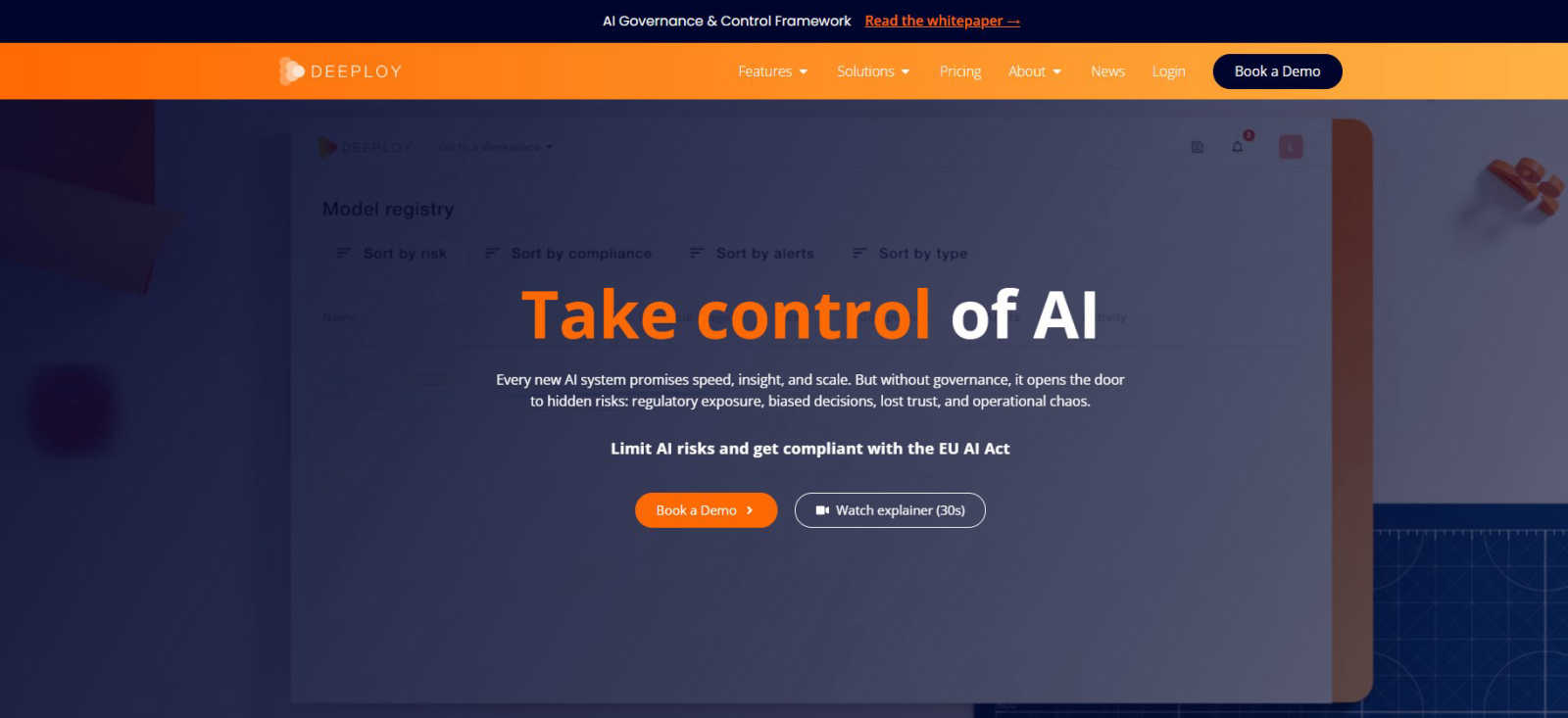
Deeploy empowers organizations to govern AI with real-time monitoring, compliance, and centralized control for risk.
Last updated: March 1, 2026

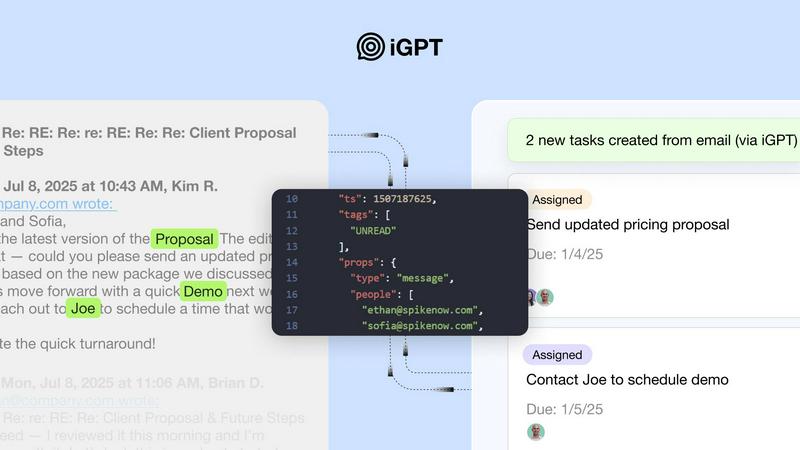
iGPT instantly gives AI agents trusted context from messy email data.
Last updated: March 1, 2026
Visual Comparison
Deeploy
iGPT
Feature Comparison
Deeploy
AI Discovery and Onboarding
With Deeploy's AI discovery and onboarding feature, organizations can achieve complete visibility across their AI landscape. This functionality allows users to discover, onboard, and manage every AI system from a single interface, connecting seamlessly with any MLOps or GenAI platform. It eliminates blind spots, providing centralized control without the pain of migration, ensuring that organizations can manage their AI systems efficiently.
Control Frameworks
Deeploy simplifies compliance by offering guided workflows that help organizations navigate complex AI regulations confidently. Users can choose from default control frameworks such as ISO 42001 or NIST AI RMF, or build custom frameworks tailored to their specific needs. This feature allows organizations to classify AI system risk in minutes and establish accountability through structured approval processes.
Control Implementation
Turning governance frameworks into enforceable controls is made effortless with Deeploy. This feature provides engineers with clear, actionable requirements, accelerating compliance by up to 90% through templates and auto-collected evidence. By automating repetitive tasks with AI-powered assessments, Deeploy ensures that governance is not only effective but also practical for engineering teams.
Real-Time Monitoring
Deeploy's real-time monitoring feature enables organizations to prevent AI incidents before they escalate. Users receive instant alerts for model drift or performance drops, allowing proactive identification of errors and anomalies. This feature also incorporates tracing and guardrails to protect the outputs of large language models (LLMs), ensuring that organizations maintain oversight and control over their AI systems.
iGPT
Unified Intelligence Endpoint
This is iGPT's killer feature. Instead of managing a complex pipeline of vector databases, chunking logic, and multi-step prompt chains, you send one natural language request. The API handles retrieval, context shaping, and reasoning in a single, elegant pipeline, returning responses ready for automation in ~200ms. It’s a developer experience masterpiece that replaces weeks of integration work with a single curl command.
Deep Email & Attachment Processing
iGPT doesn't just skim subject lines. It deeply indexes entire email conversations, automatically reconstructing threads across time and participants. More impressively, it processes attachments—PDFs, spreadsheets, documents—extracting text, data, and structure to understand the full context of a conversation. This holistic view is what separates real intelligence from simple keyword matching.
Enterprise-Grade Security & Compliance
In a world rightfully paranoid about data leaks, iGPT's security model is a standout. It operates on a zero data retention policy, processing each inference in memory without storing inputs, prompts, or outputs. Combined with OAuth-only processing, granular Role-Based Access Control (RBAC), and a full audit trail, it allows enterprises to leverage powerful AI without the compliance nightmare.
Context Engineering Framework (CEF)
This is the secret sauce behind the quality of responses. iGPT's CEF automatically optimizes context windows for your LLM, applying hybrid retrieval (semantic + keyword + filters) that is scored and reranked in one call. It delivers cited answers linked directly back to source emails and files, providing not just an answer but the verifiable evidence behind it, eliminating the need for manual prompt tuning.
Use Cases
Deeploy
Compliance Management
Organizations can utilize Deeploy to streamline their compliance management processes, ensuring adherence to regulations such as the EU AI Act. The platform’s guided workflows simplify the classification of AI system risks and help establish necessary accountability measures.
AI Performance Monitoring
With real-time monitoring, enterprises can leverage Deeploy to track the performance of their AI systems continuously. This use case is crucial for identifying potential compliance risks or performance issues before they impact end users, thereby maintaining operational integrity.
Centralized AI Oversight
Deeploy provides a centralized system for organizations to manage their AI landscape, eliminating the chaos of scattered AI initiatives. This use case is essential for enterprises with multiple AI models and vendors, ensuring that all systems are monitored and governed effectively.
Enhanced Explainability
For organizations that prioritize transparency, Deeploy's explainability features are invaluable. This use case allows teams to understand the reasoning behind AI outputs, facilitating better human oversight and enabling feedback loops that enhance the overall effectiveness of AI systems.
iGPT
Autonomous Email Assistants
Build agents that do more than just draft replies. With full conversational and attachment context, these assistants can prioritize inboxes, summarize critical threads, suggest actions, and even auto-generate tasks or calendar invites—all while understanding the nuanced history and relationships between participants.
Customer Support Copilots
Revolutionize support by instantly rebuilding a customer's entire story. iGPT can analyze long, messy email chains, track tone shifts, and cross-reference attached documents (like invoices or error logs) to give support agents a complete, chronological history in seconds, drastically reducing resolution time and improving customer satisfaction.
Workflow & CRM Automation
Automatically extract decisive momentum from communication chaos. Transform email threads into structured tasks, approvals, deadlines, and CRM updates. Flag stalled deals or pending decisions by analyzing communication patterns and extracting key details like owners, dates, and commitments directly from the conversation.
Compliance & Audit Trail Generation
For regulated industries, iGPT is a game-changer. It creates a verifiable, citable audit trail by tracing feedback, approvals, contractual terms, and operational rationale directly back to the original email and attachment source. This turns unstructured inboxes into a searchable, compliant record of decision-making.
Overview
About Deeploy
Deeploy is a cutting-edge AI governance software that centralizes oversight, compliance, and monitoring of AI systems within organizations. In a landscape where AI initiatives are becoming increasingly complex, Deeploy serves as a comprehensive solution, ensuring organizations can adhere to emerging regulations such as the EU AI Act. Designed for enterprises that utilize multiple AI models, vendors, and systems, Deeploy provides features that facilitate flexible onboarding, real-time explainability, human feedback mechanisms, and audit trails. By harnessing the transformative potential of AI while minimizing associated risks, Deeploy empowers users to scale their AI operations confidently. The platform offers a centralized control framework, enabling organizations to gain complete visibility and control over their AI landscape, ultimately enhancing trust in AI technologies.
About iGPT
In the chaotic world of enterprise software, email remains the final frontier—a messy, unstructured battleground where most AI tools spectacularly fail. iGPT is the definitive, purpose-built solution to this problem. It's not just another API wrapper; it's an intelligence layer that transforms the raw, nuanced data of email threads and attachments into structured, actionable, and trustworthy context for AI agents and automated workflows. Think of it as the critical middleware that finally allows your systems to understand the human conversations where real business decisions are made. Its core proposition is breathtakingly simple: a single, unified API call that obliterates the entire fragile, labor-intensive stack of parsing, chunking, indexing, and endless prompt engineering typically required to work with email. Built with uncompromising enterprise-grade security—featuring zero data retention, full audit trails, and granular RBAC—iGPT empowers developers to deploy confident, context-aware agents for sales, support, and operations without ever sacrificing compliance or control. If you're serious about building the next generation of autonomous workflows, this is the non-negotiable tool you've been waiting for.
Frequently Asked Questions
Deeploy FAQ
How does Deeploy ensure compliance with AI regulations?
Deeploy uses guided workflows and default control frameworks to help organizations navigate complex AI regulations like the EU AI Act. This structured approach simplifies compliance management and risk classification.
Can Deeploy integrate with existing MLOps platforms?
Yes, Deeploy is designed to connect seamlessly with any MLOps or GenAI platform, providing centralized visibility and control without the need for painful migrations or extensive reconfigurations.
What types of organizations can benefit from Deeploy?
Deeploy is particularly beneficial for enterprises that operate multiple AI models, vendors, and systems. It caters to organizations across various industries looking to enhance their AI governance and compliance measures.
How does real-time monitoring work in Deeploy?
Deeploy’s real-time monitoring feature continuously tracks the performance of AI systems, providing instant alerts for any model drift or performance drops. This proactive approach allows organizations to address potential issues before they affect users.
iGPT FAQ
How does iGPT handle data privacy and security?
iGPT is architected for the enterprise with a foundational commitment to privacy. It employs a strict zero data retention policy, meaning your emails, prompts, and outputs are never stored post-processing. All inferences run in memory. It uses OAuth for authentication and enforces granular Role-Based Access Control (RBAC) on every request. Furthermore, your data is never used to train or improve any models.
What makes iGPT different from using a generic LLM API on email text?
A generic LLM API sees raw, messy text. iGPT provides deep, structured context. It automatically reconstructs email threads, processes attachments, and uses its Context Engineering Framework (CEF) to perform hybrid retrieval and optimal context shaping before the LLM even sees the query. This results in faster, more accurate, and fully cited answers without you building and maintaining a complex retrieval pipeline.
What types of email sources and attachments can it connect to?
iGPT is designed to connect to standard enterprise email sources. It deeply indexes emails from connected accounts. For attachments, it has robust processing capabilities for common business documents including PDFs, Word documents, Excel spreadsheets, and PowerPoint presentations, extracting both text and structural data to inform its understanding.
Is there a way to test iGPT before committing?
Absolutely. iGPT offers a comprehensive live playground where you can connect test data sources, experiment with different CEF quality tiers, and make real API calls to see the results. They even provide $10 in free credits to get started, with no credit card required, which is a fantastic and low-risk way to evaluate its power firsthand.
Alternatives
Deeploy Alternatives
Deeploy is an innovative AI governance software designed to facilitate the oversight and compliance of AI systems within organizations. As companies increasingly adopt AI technologies, they often find themselves navigating complex regulatory landscapes and the need for effective management tools. This is where users commonly seek alternatives, driven by factors such as pricing, specific features tailored to their unique requirements, or compatibility with existing platforms. When evaluating alternatives to Deeploy, it's essential to consider what features are critical for your organization. Look for solutions that provide comprehensive visibility into your AI landscape, robust compliance frameworks, and user-friendly interfaces. The right alternative should not only meet your current needs but also adapt to the evolving AI governance landscape.
iGPT Alternatives
iGPT is a specialized business intelligence tool designed to solve a very specific enterprise problem: giving AI agents structured, secure context from messy email data. It acts as an intelligence layer, transforming chaotic email threads and attachments into actionable insights for automated workflows. Users often look for alternatives for a few key reasons. Budget is a primary driver, as specialized enterprise tools command a premium. Others might seek a broader platform that bundles email parsing with other functions, or they may have simpler needs that don't require iGPT's deep, security-first architecture for complex agentic systems. When evaluating any alternative, focus on its core competency with unstructured email data. Can it truly understand threaded conversations and attachment contents in real-time? Crucially, scrutinize its security posture and data handling policies. The best tool is one that delivers reliable context without becoming a compliance liability.