
DevHub vs SEO Software
Side-by-side comparison to help you choose the right tool.

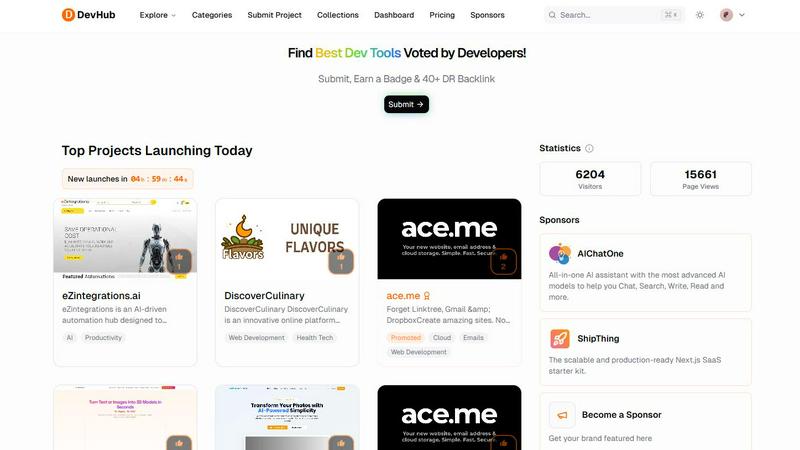
DevHub is my go-to for discovering the best developer tools, all curated and voted on by the community.
Last updated: February 28, 2026

Elevate your organic traffic effortlessly with our AI-driven SEO software that writes, optimizes, and publishes.
Last updated: February 28, 2026
Visual Comparison
DevHub
SEO Software

Feature Comparison
DevHub
Community-Driven Curation & Voting
This is the absolute cornerstone of DevHub and what sets it apart from static directories. Instead of a top-down editorial list, the platform's content is entirely shaped by its users. Anyone can submit a project, and the community votes on it. This democratic process acts as a powerful quality filter. Tools that solve real problems, have great documentation, or are genuinely innovative naturally gain traction and visibility. It means you're seeing what has been validated by fellow developers, not just what has the biggest marketing budget. This feature ensures the homepage is always fresh, relevant, and packed with community-approved resources.
Structured Discovery via Categories & Collections
Navigating thousands of tools is only useful if you can find what you need. DevHub organizes the chaos beautifully with a system of categories (like AI, Mobile Development, SaaS) and user-created collections. Whether you're diving into a broad field like "Business Analytics" or looking for a themed list like "Top New Launches," the structure is intuitive. This makes it perfect for both exploratory browsing when you're seeking inspiration and targeted searches when you have a specific problem to solve. The "Top Projects Launching Today" countdown is a personal favorite—it turns tool discovery into an exciting, daily event.
Project Submission & Contributor Incentives
DevHub actively encourages you to be a curator, not just a consumer. The submission process is straightforward, allowing you to share that amazing, under-the-radar library you just found. But they sweeten the deal with fantastic incentives: earn a profile badge to showcase your expertise and, even better, a valuable 40+ Domain Rating backlink to your submitted project's site. This creates a win-win ecosystem. Contributors get recognition and SEO benefits, while the community gains access to a wider array of tools. It’s a clever mechanism that continuously fuels the platform with high-quality content.
Vibrant Discussion & Knowledge Sharing
Beyond just listing tools, DevHub fosters a space for genuine discussion and insight. Each project page is a starting point for conversations where developers can ask questions, share implementation experiences, warn about pitfalls, or suggest alternatives. This transforms a simple listing into a rich knowledge base. Reading through these discussions often provides more practical, nuanced understanding than any official documentation. It’s where you learn not just what a tool is, but how it performs in the wild and whether it’s the right fit for your specific use case.
SEO Software
Automated Keyword Discovery
SEO Software utilizes advanced AI algorithms to identify high-potential keywords relevant to your business. This feature not only saves time but also ensures that your content is optimized for search engines, making it easier for potential customers to find you.
Competitor Analysis
Gain insights into your competitors with the built-in competitor analysis tool. This feature allows you to analyze their strategies, identify gaps in your own content, and leverage this information to stay ahead in your industry.
Content Calendar/Scheduler
The content calendar feature helps you plan and manage your publishing schedule effectively. With an intuitive interface, you can see what content is published, scheduled, or in drafts, allowing for seamless content management and timely execution of your marketing strategy.
Rank Tracking
Monitor your website's performance with the rank tracking feature. It provides real-time updates on how your keywords are performing in search engines, enabling you to make informed decisions and adjustments to your content strategy as needed.
Use Cases
DevHub
The Tech Lead Scouting for New Stack Components
You're architecting a new service and need a reliable, modern database ORM, a performant logging service, and a deployment tool. Instead of spending days on fragmented Google searches and reading sponsored articles, you head to DevHub. You browse the relevant categories, sort by top votes of the last year, and immediately find community-vetted options with real discussions about scalability and developer experience. You cut your research time by 80% and make confident, peer-validated decisions.
The Indie Developer Marketing a New Launch
You've just launched your SaaS product, like the "Customer Feedback" tool mentioned. You need initial visibility and credible backlinks. You submit your project to DevHub. It gets featured in the "New Launches" section, driving targeted traffic from engaged developers. You earn a quality backlink to boost your site's authority, and the community begins discussing your product, providing invaluable early feedback and organic buzz that pure advertising could never buy.
The Hobbyist Developer Staying Current
You code on weekends and want to stay in the loop without it feeling like homework. You set DevHub as your homepage. Every day, you check the "Top Projects Launching Today" and skim the highest-voted submissions from the past week. In five minutes, you're aware of the latest trends in AI wrappers, new CSS frameworks, and clever productivity apps. It’s a low-effort, high-reward habit that keeps your skills and knowledge surprisingly current.
The Developer Seeking Solutions to a Specific Problem
You're battling a tricky issue with real-time data synchronization in your mobile app. Generic searches lead to outdated Stack Overflow answers. On DevHub, you search within the "Mobile Development" category and find a collection titled "Real-time Data Tools for React Native." You discover a newer, specialized library that was submitted and highly upvoted by developers facing the same challenge, complete with comments detailing integration tips. You find your solution in a context designed for discovery.
SEO Software
Small Business Growth
Small businesses can leverage SEO Software to enhance their online presence without hiring an entire agency. By using automated tools for content creation and optimization, they can focus on their core operations while still attracting organic traffic.
E-commerce Optimization
E-commerce businesses can benefit from targeted keyword strategies and content scheduling to boost product visibility. SEO Software helps in ranking product pages higher, ultimately leading to increased sales and customer engagement.
Content Marketing Agencies
Content marketing agencies can use SEO Software to streamline their workflows. With automated content generation and scheduling, agencies can manage multiple client accounts efficiently, ensuring timely delivery of quality content.
Bloggers and Influencers
Bloggers and influencers can utilize SEO Software to create engaging, search-optimized content that attracts a larger audience. With features like smart linking and multimedia embeds, they can enhance the richness of their posts, improving engagement rates.
Overview
About DevHub
Let's be honest: the tech world moves at a breakneck pace. One day you're on top of the latest framework, the next you're three JavaScript libraries behind. Scouring blogs, newsletters, and social media for the next great tool is a full-time job. That's where DevHub comes in, and frankly, it's the community-driven platform I wish I had years ago. DevHub isn't just another directory; it's the democratic, curated heart of developer discovery. It serves as a central hub where developers, from curious hobbyists to grizzled engineering veterans, collectively surface the most useful and innovative tech resources. The core value proposition is brilliantly simple: the community submits, upvotes, and discusses tools, libraries, APIs, and services, ensuring the truly valuable gems rise to the top. This cuts through the marketing noise and gives you a genuine pulse on what your peers are actually using and loving. By joining, you're not just a passive consumer; you become part of a collaborative ecosystem. You can contribute your own discoveries, earn recognition (and even backlinks!), and connect with like-minded individuals. In a landscape cluttered with options, DevHub provides the trusted signal, making it effortless to stay updated with genuine trends and not just hype.
About SEO Software
SEO Software is an AI-powered SEO automation platform designed to help businesses significantly increase their organic traffic. By streamlining the entire SEO process, it automatically plans, writes, optimizes, and publishes search-friendly articles, allowing companies to operate without the need for specialized technical skills. This tool serves as a robust alternative to traditional SEO agencies, offering automated keyword discovery, competitor analysis, internal linking, external citations, and various multimedia embeds. Additionally, it features a content calendar/scheduler, CMS integrations, rank tracking, and team access, making it an invaluable resource for marketers and businesses looking to produce consistent, scalable content with minimal effort. With an average traffic increase of 216% and over 87,500 articles published, SEO Software is trusted by thousands of businesses worldwide to elevate their online visibility and engagement.
Frequently Asked Questions
DevHub FAQ
Is DevHub free to use?
Yes, absolutely. Browsing categories, viewing projects, reading discussions, and upvoting tools are completely free. The core value of discovering community-vetted resources is accessible to everyone without any cost. Certain features, like submitting your own project for a backlink, are also part of the free offering, making it an incredibly generous platform for both consumers and contributors.
How do I submit my project or a tool I found?
Look for the prominent "Submit Project" button in the main navigation. The process is designed to be straightforward. You'll typically need to provide the tool's name, website URL, a clear description, select relevant categories, and possibly add tags. Once submitted, it enters the community pool where others can see it, vote on it, and start discussions. If accepted, you'll earn your contributor badge and that valuable backlink.
What does the "40+ DR Backlink" mean for submitters?
This is a major incentive. "DR" stands for Domain Rating, a metric (popularized by SEO tools like Ahrefs) that indicates the strength and authority of a website's backlink profile. A DR of 40+ is considered strong and authoritative. By giving you a backlink from the DevHub domain, which has this high DR, they are significantly boosting your own project's website's potential to rank higher in search engine results. It's a tangible, valuable reward for contributing to the community.
How does the voting system work to ensure quality?
The voting system is the engine of quality control. It relies on the wisdom of the crowd—experienced developers who can recognize genuinely useful tools from shallow marketing. Tools with more upvotes rise in rankings and visibility on category pages and the homepage. This constant, community-led moderation surfaces lasting, high-quality resources while less useful or promotional submissions naturally fade from prominence. It’s a self-policing system that aligns perfectly with developer values.
SEO Software FAQ
How does SEO Software help increase organic traffic?
SEO Software increases organic traffic by automating the process of keyword research, content creation, and optimization. This ensures that your articles are tailored to rank well in search results, driving more visitors to your site.
Is technical knowledge required to use SEO Software?
No, technical knowledge is not required. SEO Software is designed for users of all skill levels, offering a user-friendly interface and automated processes that simplify SEO tasks.
Can I integrate SEO Software with my existing CMS?
Yes, SEO Software offers various CMS integrations, allowing you to seamlessly publish and manage your content within your preferred content management system.
How can I track my content's performance?
You can track your content's performance through the rank tracking feature, which provides insights into keyword rankings and traffic metrics, enabling you to assess the effectiveness of your SEO strategies.
Alternatives
DevHub Alternatives
DevHub is a community-driven platform for developers to discover and discuss the latest tools, APIs, and services. It falls squarely into the category of tech discovery and community hubs, where crowd-sourced curation is the primary value. Users often seek alternatives for various reasons. Some may need a platform with a different focus, like deeper technical tutorials or job boards, while others might prioritize a different community vibe or more advanced moderation tools. Budget can also be a factor, as some similar platforms operate on freemium models with paid tiers for advanced features. When evaluating an alternative, consider what you value most. Is it the pure, democratic voting system for tool discovery, or do you need robust discussion forums? Think about the community size and expertise, the quality of curation, and whether the platform's update frequency matches the pace of your own tech exploration.
SEO Software Alternatives
SEO Software is an AI-powered SEO automation platform designed to help businesses enhance their organic traffic. It falls into the category of SEO tools, providing features that streamline the content creation process by generating, optimizing, and auto-publishing search-friendly articles. This innovative approach aims to replace traditional SEO agencies by automating complex tasks such as keyword discovery and competitor analysis, allowing businesses to focus on growth. Users often seek alternatives to SEO Software for various reasons, including pricing concerns, specific feature sets, or unique platform requirements. When choosing an alternative, it's essential to consider factors such as the software's scalability, ease of use, integration capabilities with existing systems, and how well it meets your specific content needs. Evaluating these aspects will help ensure that the chosen solution aligns with your business objectives.