diffray vs Local Tools
Side-by-side comparison to help you choose the right tool.

diffray
Diffray uses 30 specialized AI agents to catch real bugs in your code, not just nitpicks.
Last updated: February 28, 2026

Local Tools
Local Tools is your curated directory for thousands of powerful, private tools that run instantly in your browser with no installs or uploads.
Last updated: April 4, 2026
Visual Comparison
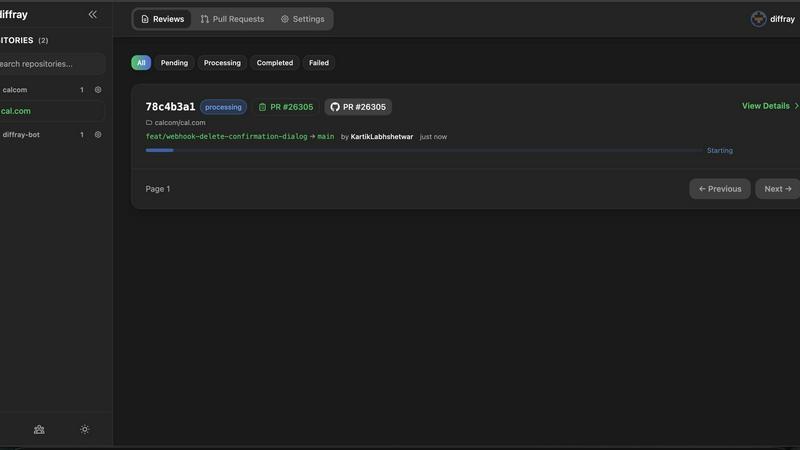
diffray
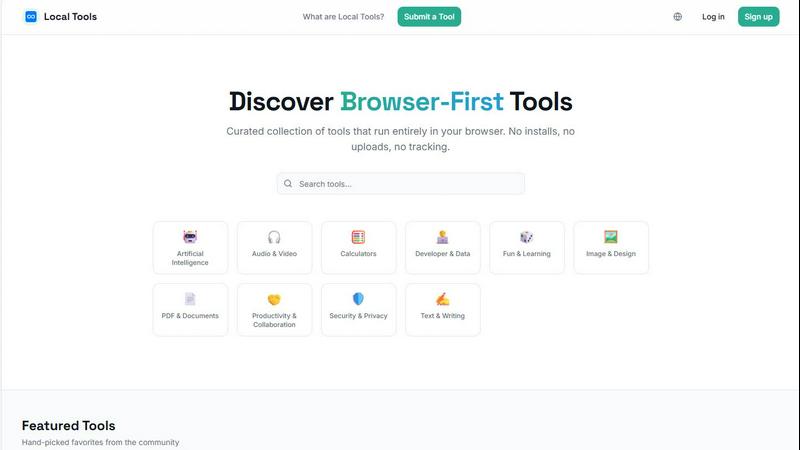
Local Tools
Feature Comparison
diffray
Multi-Agent Specialist Architecture
This is the core genius of diffray and what sets it lightyears apart. The platform employs over 30 distinct AI agents, each meticulously trained and optimized for a specific domain like security (OWASP Top 10, dependency vulnerabilities), performance (memory leaks, inefficient algorithms), concurrency (race conditions, deadlocks), and codebase consistency. This means a security expert agent scrutinizes your code for security flaws, while a separate performance expert analyzes for bottlenecks, leading to profoundly deeper and more accurate analysis than any single-model tool can achieve.
Full-Repository Context Awareness
diffray doesn't just look at the patch in isolation—a fatal flaw of simpler tools. It intelligently pulls in and understands the full context of your repository. Agents can analyze how new changes interact with existing architecture, spot deviations from established patterns, and identify breaks in consistency that would be invisible when looking at a diff alone. This context turns superficial comments into genuinely insightful guidance that understands your project's unique landscape.
Low-Noise, High-Signal Feedback
By leveraging its team of specialists, diffray virtually eliminates the plague of generic, low-value comments. The feedback it generates is concise, professional, and directly actionable. It prioritizes critical issues that matter, suppressing the trivial nitpicks that waste time. The output feels like it was written by a seasoned senior engineer who knows what's important, not a robot on a linting spree.
Integrated Workflow & Team Metrics
diffray seamlessly integrates into your existing GitHub or GitLab workflow, posting comments directly on pull requests. Beyond individual reviews, it provides teams with valuable analytics and metrics, highlighting common vulnerability patterns, tracking review time savings, and offering insights into code quality trends over time. This turns code review from a reactive gate into a strategic tool for continuous improvement.
Local Tools
Curated, Cross-Source Aggregation
Local Tools doesn't create its own utilities; it performs the vital service of discovery and comparison. It aggregates tools from multiple established "on-device" platforms, allowing you to see all your options side-by-side. This means you can find a specific PDF editor available on Site A but not Site B, or compare the output quality between two different image converters. It turns a collection of separate websites into a unified, competitive marketplace for the best browser-based tool for any given task.
Strictly Browser-First & Private Operation
This is the foundational ethos. Every tool listed is vetted to ensure it operates client-side in your browser. Your files are processed locally on your machine using JavaScript and WebAssembly—they are never uploaded to a remote server for processing. This architecture guarantees superior privacy, eliminates concerns about data retention policies, and often results in faster performance since there's no network latency for the core computation.
Functional, Intuitive Organization
Navigating thousands of tools could be chaos, but Local Tools employs a smart, category-driven structure. You won't just find a monolithic list. Tools are organized into intuitive categories like Image & Design, Developer & Data, PDF & Documents, and Security & Privacy. This functional grouping lets you drill down to exactly what you need, whether it's a text diff checker, a color palette generator, or an audio trimmer, without wading through irrelevant options.
Community-Driven Curation & Discovery
The directory is built to evolve with the web. It features a "Submit a Tool" function, allowing the community of privacy-conscious users and developers to contribute new finds. This, combined with user ratings and featured tool sections, creates a living resource. You're not just using a static list; you're tapping into a collective effort to surface the most powerful, efficient, and well-loved tools that respect user privacy.
Use Cases
diffray
Accelerating Pull Request Throughput for Fast-Moving Teams
For development teams pushing multiple merges per day, the PR review bottleneck is real. diffray acts as a first-pass expert reviewer available 24/7, instantly surfacing critical issues and leaving detailed, context-aware comments. This allows human reviewers to focus on higher-level architecture and logic, dramatically speeding up the entire cycle and getting features to production faster without sacrificing quality.
Upskilling Junior Developers and Enforcing Standards
diffray serves as an always-available mentoring tool for junior developers. By providing immediate, expert feedback on security practices, performance implications, and code style, it helps them learn best practices in real-time. Simultaneously, it acts as an unbiased enforcer of team and organizational coding standards, ensuring consistency across the entire codebase as the team grows.
Proactive Security and Compliance Auditing
Security can't be an afterthought. diffray's dedicated security agents continuously scan every pull request for vulnerabilities, misconfigurations, and compliance violations against standards like OWASP. This embeds security directly into the developer workflow (Shifting Left), preventing costly security bugs from ever reaching production and making audit trails a natural byproduct of development.
Legacy Code Modernization and Refactoring
When tackling a large, legacy codebase, understanding the impact of changes is daunting. diffray's contextual analysis is invaluable here. It can help identify how new refactoring efforts might break existing patterns, pinpoint hidden technical debt related to performance or concurrency, and ensure that modernization efforts don't inadvertently introduce new classes of bugs, making large-scale refactors safer and more predictable.
Local Tools
The Privacy-Consensitive Professional
A freelance graphic designer receives a client's logo draft on a public library computer. Using Local Tools, they find Photopea—a full-featured, Photoshop-like editor that runs in the browser. They can make crucial edits and adjustments without installing software or risking the client's intellectual property by uploading it to an unknown server. The work is done securely, locally, and with professional-grade results.
The Developer Seeking the Right Utility
A software engineer is debugging a complex API response. Instead of struggling with a dense JSON blob, they search Local Tools and find JSON Crack. They instantly visualize the data structure as an interactive graph, right in their tab, making it trivial to spot anomalies. Later, they might use a separate tool from the directory to minify their CSS, all without leaving the browser or compromising proprietary code.
The Student or Researcher Processing Data
A student working on a thesis needs to analyze survey data stored in a CSV file. They use Local Tools to find a browser-based chart generator and a statistical calculator. They can clean, visualize, and calculate metrics from their dataset entirely on their laptop, even without an internet connection after the tools are loaded. This ensures their research data remains completely confidential and accessible.
The Everyday User Solving Quick Problems
Someone needs to compress a batch of vacation photos to email to family, combine several PDFs into one document, and calculate a tip at a restaurant. Instead of searching separately and risking sketchy download links, they visit Local Tools. They quickly find Squoosh for image optimization, a PDF merger, and a calculator—solving all three tasks in minutes with tools that are fast, safe, and require no sign-ups.
Overview
About diffray
Let's be brutally honest: most AI code review tools are a massive disappointment. They promise intelligent automation but deliver a firehose of generic, low-value comments that bury the real issues in a soul-crushing avalanche of noise. You end up spending more time dismissing false positives than you save. diffray is the tool that finally breaks this cycle. It’s a revolutionary AI-powered code review platform built on a fundamentally smarter architecture. Instead of relying on a single, generalist AI model trying to be an expert at everything, diffray deploys a curated team of over 30 specialized AI agents. Think of it as having a dedicated, world-class expert for security vulnerabilities, another for performance bottlenecks, another for concurrency pitfalls, and so on. This multi-agent system conducts deep, contextual investigations into your pull requests, understanding the full scope of your repository, not just the isolated diff. The result is exactly what development teams desperately need: a dramatic reduction in false positives, a significantly higher catch rate for critical, actionable bugs, and clean, professional feedback that genuinely respects a developer's time. It transforms code review from a tedious, time-sucking chore into a genuine quality accelerator. Teams report slashing their average PR review time from 45 minutes to just 12. If you're tired of the noise and ready for signal, diffray is the only tool you should be considering.
About Local Tools
Local Tools is a game-changing answer to a modern digital headache: the scattered, overwhelming world of online utilities. Forget juggling a dozen bookmarked sites that all promise similar tools. Local Tools is a meticulously curated, searchable directory that aggregates thousands of browser-first tools from across the web, all in one intelligent hub. The core, non-negotiable principle? Every single tool runs entirely on your device. This means zero installations, no uploading your sensitive files to mysterious servers, and absolutely no tracking. Your data stays with you, making every action fast, private, and refreshingly simple.
What truly sets it apart is its curatorial approach. Instead of just dumping hundreds of near-identical tools on you, Local Tools organizes by genuine functionality. Want to compare three different in-browser image compressors or find a niche JSON visualizer that one popular site doesn't offer? This is your destination. It's designed for the pragmatist: the developer who needs a quick code formatter, the designer editing a mockup on a public computer, the student processing data for a project, or anyone who just wants to calculate something without the privacy anxiety. Local Tools cuts through the noise, transforming a fragmented ecosystem into a single, powerful, and private resource for getting things done.
Frequently Asked Questions
diffray FAQ
How is diffray different from GitHub Copilot or other AI coding assistants?
This is a crucial distinction. Tools like Copilot are primarily generative—they help you write new code. diffray is analytical—it reviews and critiques code that has already been written. Think of Copilot as a pair programmer helping you type, while diffray is the meticulous senior engineer reviewing the final pull request. They serve complementary but entirely different purposes in the development lifecycle.
Does diffray replace human code reviewers?
Absolutely not, and it doesn't try to. diffray's goal is to augment human reviewers, not replace them. It automates the tedious, repetitive parts of review (catching common bugs, enforcing style, basic security checks) so your human team can dedicate their valuable cognitive bandwidth to complex logic, architecture, design patterns, and mentorship—the things AI still cannot do well.
What programming languages and frameworks does diffray support?
Based on its described multi-agent architecture focused on universal concepts like security, performance, and concurrency, diffray is built to support a wide range of popular languages and frameworks. While the specific list isn't detailed in the provided context, its value comes from analyzing fundamental code quality and vulnerability patterns that transcend any single language. You should check their official documentation for the most current and detailed list of supported technologies.
How does diffray handle the privacy and security of our source code?
For any serious development team, this is the first question. While specific details aren't in the provided snippet, a professional tool like diffray would typically offer options for cloud-based processing with strong encryption and data residency controls, as well as potentially self-hosted or on-premise deployments for organizations with strict compliance requirements. You must review their official security whitepaper and data processing agreement for guarantees.
Local Tools FAQ
Is Local Tools really free to use?
Yes, the Local Tools directory website itself is free to access and use. The individual tools listed within the directory are also typically free, as they are primarily browser-based utilities provided by their respective developers. There is no subscription or fee for browsing, searching, and accessing the links to these external tools through the Local Tools platform.
How do you ensure the tools are truly private and run locally?
The curation team prioritizes and verifies tools that are known to operate on client-side technology. This is often evident in the tool's own description (stating "no uploads" or "runs in your browser") and can be technically observed. Tools that require file uploads to a server for processing are excluded. The focus is on tools leveraging modern web capabilities like HTML5, JavaScript, and WebAssembly to perform computations directly on the user's device.
Can I request or submit a tool to be added?
Absolutely! Local Tools has a "Submit a Tool" feature because the web is vast. If you've found an excellent browser-based, privacy-respecting utility that isn't yet in the directory, you are encouraged to submit it for review. This community-driven approach is key to keeping the resource comprehensive and up-to-date with the best available tools.
What if a linked tool stops working or changes its policy?
Local Tools is an aggregator and directory, not the host of these external tools. While efforts are made to maintain link integrity and monitor for significant changes, the operation and policies of each individual tool are managed by their original creators. Users are always advised to check the specific tool's website for its latest terms of service and privacy policy before use.
Alternatives
diffray Alternatives
diffray is a specialized AI code review tool that stands apart in the crowded developer tools market. It belongs to the category of intelligent automation for pull requests, but its unique multi-agent architecture moves it beyond simple linting or generic AI suggestions. It’s for teams that want deep, contextual bug catching, not just surface-level nitpicks. Developers often search for alternatives for a few key reasons. Budget constraints or specific pricing models can be a factor, as can the need for integration with a particular tech stack or CI/CD platform. Some teams might prioritize a different feature balance, like extensive language support over deep specialization, or require a self-hosted solution for security compliance. When evaluating other options, look beyond the marketing hype. The core question is whether a tool reduces noise while catching critical issues. Prioritize solutions that understand your full codebase context, not just the diff. True value comes from actionable feedback that saves engineering time, not from generating an overwhelming volume of low-priority comments.
Local Tools Alternatives
Local Tools is a curated directory that falls into the category of on-device, browser-first utility platforms. It aggregates thousands of tools that run entirely in your browser, eliminating the need for installs or risky file uploads. The goal is to organize a fragmented ecosystem into a single, searchable hub for privacy-focused tasks. People explore alternatives for a few key reasons. They might be looking for a platform with a different organizational structure or a more specialized focus on a particular niche, like advanced developer utilities or creative design tools. Others might prioritize a different user experience or discoverability method beyond a curated directory. When evaluating other options, your north star should be the core principle of local execution. Ensure the tools genuinely run in your browser without hidden uploads. Look for a clean, intuitive interface that matches your workflow, and consider the depth and quality of curation in your most-used categories, whether that's data conversion, image editing, or text processing.