
Kane AI vs URL to Any
Side-by-side comparison to help you choose the right tool.

Kane AI
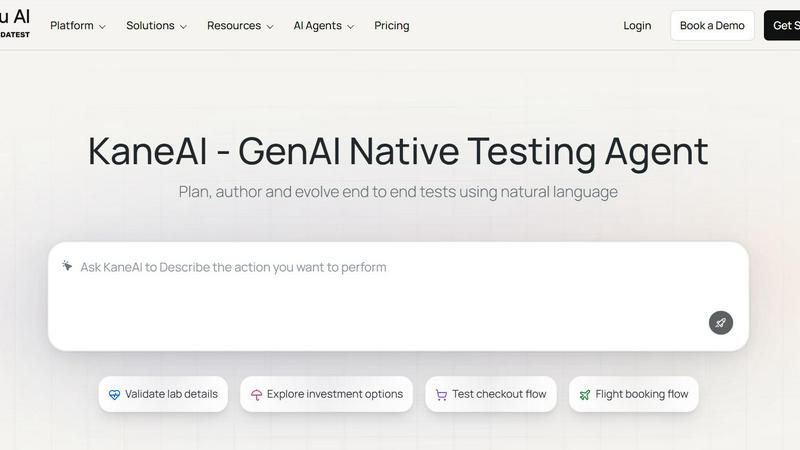
KaneAI is my top pick for creating and managing complex software tests using simple natural language commands.
Last updated: February 28, 2026

URL to Any
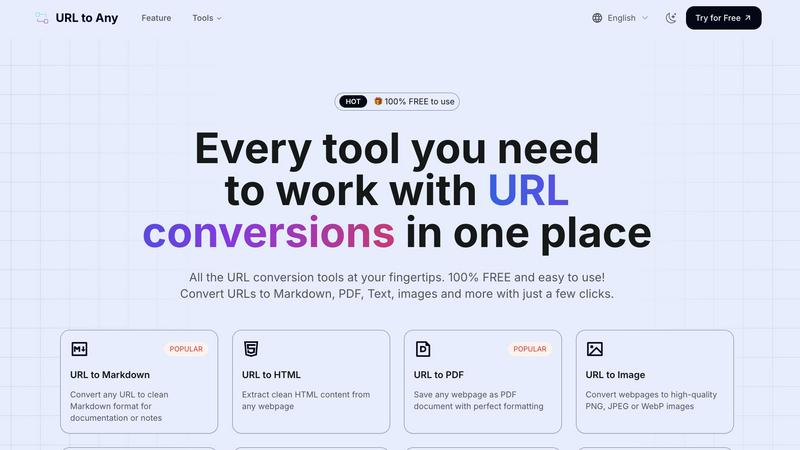
URL to Any instantly converts any webpage into Markdown, PDF, text, images, and more for free.
Last updated: March 2, 2026
Visual Comparison
Kane AI
URL to Any
Feature Comparison
Kane AI
Natural Language Test Authoring & Planning
This is the heart of Kane AI and my absolute favorite feature. You simply converse with the AI agent, describing high-level objectives like "test the checkout flow for a guest user with an expired promo code." Kane AI's Intelligent Test Planner then decomposes this into structured, automated test steps. You can even feed it JIRA tickets, PRDs, or spreadsheets to generate test cases. It’s a game-changer that completely skips the technical syntax, letting you focus on what to test instead of how to code it.
Unified Multi-Layer Testing
Forget juggling separate tools for UI, API, and database checks. Kane AI brilliantly unifies end-to-end flow testing across every critical layer of your application in one seamless strategy. You can validate UI interactions, check API responses and network payloads in real-time, run direct database queries, and even perform pixel-perfect visual comparisons and accessibility audits—all within the same test flow. This holistic approach is what true coverage looks like.
Intelligent Execution & Self-Healing
Execution is where many AI tools falter, but not Kane AI. It runs your tests across 3000+ browser, OS, and device combinations via HyperExecute. More impressively, it includes GenAI-powered healing to automatically adapt to minor UI changes and auto-dismiss popups. The step-level control is a masterstroke, allowing you to decide if a failure should stop the run, continue, or be skipped, giving you incredible resilience and precision.
Enterprise-Grade Integrations & Workflow
Kane AI is built to slot into your existing ecosystem, not force you into a new one. The native integration with Jira and Azure DevOps is seamless; you can create test cases, trigger runs, and—crucially—auto-raise well-documented bug tickets directly from a failure. Combined with enterprise essentials like SSO, RBAC, and audit logs, it ensures the platform scales with your team's security and collaboration needs.
URL to Any
URL to Markdown
This is, hands down, my most-used feature and a game-changer for anyone who works with digital notes or documentation. You simply paste a blog post, article, or tutorial link, and it returns impeccably clean Markdown. It intelligently strips away ads, navigation, and sidebars, leaving you with just the core content: headings, lists, links, and code blocks are all perfectly formatted. It saves hours of manual copying, pasting, and reformatting, making it essential for building knowledge bases or preparing content for static site generators.
URL to PDF
When you need a permanent, portable, and perfectly formatted snapshot of a webpage, this tool is a lifesaver. It's far superior to your browser's "Print to PDF" function, which often breaks layouts. URL to Any's engine captures the page as it truly appears, preserving complex designs, images, and fonts. I use it constantly to archive important receipts, save long-read articles for offline reading on my tablet, or create clean client reports from web-based dashboards. The output is professional and reliable every single time.
AI Summarizer
In an age of information overload, this feature is a secret weapon. Instead of reading a 3000-word article to extract the key points, you let the integrated AI do the heavy lifting. It analyzes the webpage content and provides a concise, coherent summary in seconds. I find it invaluable for quick research, preparing for meetings, or simply deciding if a long-form piece is worth a deep dive. It’s like having a personal research assistant who works at the speed of light.
URL Meta Tags & Heading Extractor
For SEO professionals, developers, and content strategists, this duo of tools is pure gold. The Meta Tags Extractor doesn't just show you basic tags; it gives you a complete SEO, Open Graph, and Twitter Cards audit for any URL, which you can export to CSV. The Heading Extractor visually maps out the H1 to H6 structure of a page, crucial for analyzing content hierarchy and SEO health. I use these to spy on competitor strategies, audit my own sites, and ensure every piece of content is optimally structured before publishing.
Use Cases
Kane AI
Accelerating Test Automation for Non-Coding Teams
Product managers, business analysts, and manual QA engineers can now directly contribute to automation. By describing features or uploading product requirements, they can generate comprehensive, executable test suites without writing a single line of code. This democratizes test creation and drastically reduces the dependency on a few automation specialists, unblocking the entire delivery pipeline.
Continuous Testing in CI/CD Pipelines
Development teams can embed Kane AI into their CI/CD workflows to enable true shift-left testing. Since tests are authored and maintained with natural language, they are easier to create alongside feature development. The platform's flexible scheduling and ability to run on custom environments (like a local build) make it perfect for automated regression suites that run on every commit, providing fast feedback.
Complex End-to-End Business Flow Validation
For validating intricate, multi-step user journeys—like a financial investment flow or a multi-leg flight booking—Kane AI excels. Its ability to weave together UI actions, API calls, database state checks, and visual validation into a single, coherent test ensures that critical business workflows work perfectly from front to back before any release.
Enhancing Test Coverage for Legacy Systems
Teams maintaining large, complex legacy applications often have gaps in test coverage. Kane AI's manual interaction recorder can capture existing user flows, converting them into reusable automated steps. Furthermore, its ability to generate dynamic test data and create modular, reusable test blocks makes building and expanding a regression suite for a legacy system far less daunting.
URL to Any
Content Curation & Research
As a writer, I live in this use case. When I'm researching a topic, I use URL to Any to convert key sources into Markdown or Text format. I then compile these clean text snippets into my research documents without the clutter of web page junk. The AI Summarizer helps me quickly evaluate the relevance of sources. This workflow turns a chaotic browser tab graveyard into an organized, actionable research project in minutes.
Web Development & Debugging
Developers, listen up. Need to quickly check the structured data or heading hierarchy of a live site? Use the JSON/XML and Heading Extractors. Want to grab the clean HTML of a component for reference without the surrounding site boilerplate? The "URL to HTML" tool is perfect. It's like a lightweight, instant Swiss Army knife for front-end investigation and data gathering, all without touching the browser's inspector console.
Archiving & Documentation
This is for the organizers and compliance-minded users. Need a verifiable, unalterable record of a webpage—like a terms of service update, a news article, or a transaction confirmation? Convert it to a PDF. Building internal documentation and want to include a snapshot of a web-based tool's interface? "URL to Image" creates a perfect capture. It creates trustworthy, format-stable records for your personal or business archives.
Enhanced Sharing & Accessibility
Make your shared links more powerful and accessible. Generate a QR code from a lengthy URL to share on printed materials or presentations instantly. Convert a text-heavy article to an MP3 audio file for listening on the go, which is fantastic for accessibility or consuming content during a commute. It transforms static links into multi-format resources that cater to different audience preferences and situations.
Overview
About Kane AI
Let's cut through the noise: test automation is often a bottleneck, not a catalyst. It demands specialized coding skills, creates maintenance nightmares, and leaves critical layers like APIs and accessibility as afterthoughts. Kane AI by TestMu is the paradigm shift we've been waiting for. It's not just another low-code tool with training wheels; it's a first-of-its-kind, GenAI-native testing agent built from the ground up for speed and intelligence. This platform is for modern Quality Engineering teams who are tired of the trade-off between ease-of-use and power. Its core value proposition is breathtakingly simple: you describe your testing intent in plain English, and Kane AI handles the complex orchestration—authoring, managing, debugging, and evolving sophisticated, multi-layered tests. It obliterates the traditional barrier to entry for automation, enabling teams to start fast and scale without compromising on the complexity needed for enterprise-grade applications. If you're looking to move from reactive bug-finding to proactive, AI-powered quality engineering, this is your command center.
About URL to Any
In the chaotic sprawl of the modern web, we've all hit that wall: you find a perfect article for your research, a brilliant design for inspiration, or a crucial set of instructions, but you need it in a different format. Saving it as a messy bookmark isn't enough. You need it as a clean PDF for your records, as structured Markdown for your notes, or even as a shareable image. This is the exact problem URL to Any was built to demolish. It's not just a tool; it's your personal web content alchemist, transforming any URL into practically any format you can think of with shocking ease and, believe it or not, for completely free. As someone who juggles content creation, development, and research daily, I've tried countless converters. URL to Any stands out because it consolidates a powerhouse suite of utilities into one blindingly simple, no-login-required interface. It's built for everyone—from developers needing JSON feeds and bloggers curating Markdown, to students archiving PDFs and marketers creating QR codes. The core value proposition is irresistible: instant, barrier-free access to professional-grade conversion tools without a single paywall or upsell in sight.
Frequently Asked Questions
Kane AI FAQ
How is Kane AI different from traditional low-code testing tools?
Traditional low-code tools often simplify UI recording but struggle with complex logic, conditionals, and non-UI testing. Kane AI is fundamentally different; it's a GenAI-native agent. You instruct it with natural language objectives, and it plans and generates the underlying code for sophisticated workflows across all layers (UI, API, DB). It's built for complexity and enterprise-scale performance, not just simplicity.
Does Kane AI support testing for mobile applications?
Yes, absolutely. Kane AI supports authoring and executing tests across both web and mobile applications. When combined with its execution platform, HyperExecute, you can run these tests on a vast grid of real mobile devices and emulators, ensuring your mobile experience is validated with the same rigor as your web application.
Can I use my existing test frameworks with Kane AI?
Kane AI is designed as a comprehensive platform, but it offers multi-language code export. This means you can export the test logic it generates into code for major frameworks. While it encourages using its native intelligent agent for authoring and execution, this export capability provides flexibility and a potential migration path for certain needs.
How does the "GenAI-powered healing" actually work?
When Kane AI executes a test and encounters a failure—like a button that can't be found because its CSS selector changed—its GenAI engine analyzes the context. It can intelligently suggest and apply alternative, resilient locators or interaction methods to complete the test step. This self-healing capability dramatically reduces test maintenance overhead caused by frequent, minor UI updates.
URL to Any FAQ
Is URL to Any really free to use?
Yes, and this isn't a limited "freemium" model with hidden traps. Every single tool listed—from PDF conversion and Markdown generation to AI summarization and meta tag extraction—is 100% free with no usage caps, mandatory registrations, or watermarks. They sustain the platform in a transparent way, and it's a breath of fresh air in a market full of subscription fees.
How does the tool handle privacy and my data?
Privacy is clearly a priority. Your data is processed securely in the cloud, but crucially, it is never stored on their servers after the conversion is complete. The process is transient. You paste a URL, their engine fetches and converts the public content, delivers the result to you, and then the data is purged. You aren't uploading sensitive files, and your conversion history isn't logged or tracked.
What formats can I convert a URL into?
The range is impressively comprehensive. The core formats include Markdown, PDF, PNG/JPEG/WebP Images, Plain Text, HTML, JSON, and XML. Beyond that, you have utilities for creating MP3 audio, QR Codes, and encoded/decoded text. There are also analytical tools like the URL, Meta Tag, and Heading Extractors. It truly covers the vast majority of conversion needs one would encounter.
Do I need to install any software or create an account?
Absolutely not. This is a huge part of its appeal. URL to Any is a fully web-based platform. You can access it from any modern browser on any device—desktop, tablet, or phone. There is no software to download, no extensions required (though one is offered), and no account registration. You just visit the site and start converting immediately, which minimizes friction and maximizes utility.
Alternatives
Kane AI Alternatives
Kane AI is a pioneering GenAI-native testing agent, squarely in the category of AI-powered quality engineering assistants. It allows teams to plan, create, and manage complex automated tests using simple natural language, aiming to drastically reduce the time and expertise needed for robust test automation. Users often explore alternatives for various reasons. Budget constraints or specific pricing models can be a primary driver. Others might seek tools with a narrower focus, like only API testing, or require deeper integration with a niche part of their tech stack that a generalist tool doesn't support. When evaluating an alternative, consider your team's core need. Is it raw test generation speed, support for a legacy framework, or unparalleled ease of use? The right choice balances the power of AI assistance with the practicalities of your existing workflows, integration capabilities, and long-term testing strategy.
URL to Any Alternatives
URL to Any is a fantastic, free tool in the AI Assistants category that lets you instantly convert any webpage into formats like Markdown, PDF, or even a QR code. It’s a perfect example of a simple, no-fuss utility that gets a specific job done without any barriers. However, even the best tools aren't a perfect fit for everyone. Users often seek alternatives for reasons like needing advanced editing features, wanting integrations with other apps, requiring higher conversion limits, or simply preferring a different interface. The search for the "right" tool is deeply personal and depends on your specific workflow. When evaluating other options, I always recommend looking beyond just price. Consider the output quality—does the Markdown conversion preserve links and formatting cleanly? Check for platform availability: is it a web app, a browser extension, or desktop software? And finally, think about your long-term needs; a tool that's free today might introduce limits tomorrow, so understanding the developer's model is key.