Local Tools vs Playwriter
Side-by-side comparison to help you choose the right tool.

Local Tools
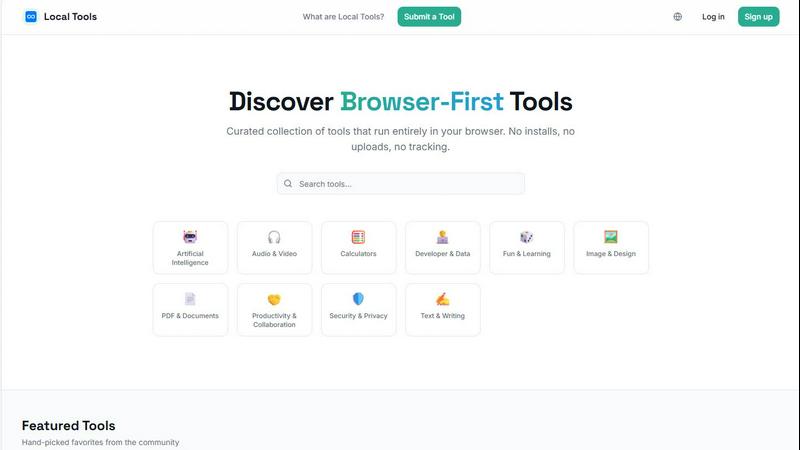
Local Tools is your curated directory for thousands of powerful, private tools that run instantly in your browser with no installs or uploads.
Last updated: April 4, 2026

Playwriter
Playwriter lets AI agents control your real Chrome browser with all your logins and extensions intact.
Last updated: March 18, 2026
Visual Comparison
Local Tools
Playwriter

Feature Comparison
Local Tools
Curated, Cross-Source Aggregation
Local Tools doesn't create its own utilities; it performs the vital service of discovery and comparison. It aggregates tools from multiple established "on-device" platforms, allowing you to see all your options side-by-side. This means you can find a specific PDF editor available on Site A but not Site B, or compare the output quality between two different image converters. It turns a collection of separate websites into a unified, competitive marketplace for the best browser-based tool for any given task.
Strictly Browser-First & Private Operation
This is the foundational ethos. Every tool listed is vetted to ensure it operates client-side in your browser. Your files are processed locally on your machine using JavaScript and WebAssembly—they are never uploaded to a remote server for processing. This architecture guarantees superior privacy, eliminates concerns about data retention policies, and often results in faster performance since there's no network latency for the core computation.
Functional, Intuitive Organization
Navigating thousands of tools could be chaos, but Local Tools employs a smart, category-driven structure. You won't just find a monolithic list. Tools are organized into intuitive categories like Image & Design, Developer & Data, PDF & Documents, and Security & Privacy. This functional grouping lets you drill down to exactly what you need, whether it's a text diff checker, a color palette generator, or an audio trimmer, without wading through irrelevant options.
Community-Driven Curation & Discovery
The directory is built to evolve with the web. It features a "Submit a Tool" function, allowing the community of privacy-conscious users and developers to contribute new finds. This, combined with user ratings and featured tool sections, creates a living resource. You're not just using a static list; you're tapping into a collective effort to surface the most powerful, efficient, and well-loved tools that respect user privacy.
Playwriter
Your Actual Browser Session
This is the killer feature. Instead of spawning a fresh, suspicious Chrome instance, Playwriter attaches directly to your existing browser via a Chrome extension. Your agent operates in an environment with all your personal logins, saved cookies, installed extensions (like ad-blockers or password managers), and even your existing tabs. This eliminates bot detection triggers from "new" browser fingerprints and avoids the memory overhead of running a second Chrome process. It’s the difference between sending a stranger to do your online shopping versus giving your trusted friend your laptop.
Full Playwright API via a Single Tool
Forget menus of dozens of limited, pre-wrapped tools like "click_button" or "extract_text." Playwriter exposes one powerful execute command that accepts any valid Playwright code. This means your AI agent can use the entire, mature Playwright API for complex interactions: waiting for specific network responses, setting JavaScript breakpoints, manipulating localStorage, or taking efficient accessibility snapshots. This approach drastically reduces context window usage and provides maximum flexibility, trusting the developer or AI to write precise instructions.
Built-in Debugger & Live Editor
Playwriter transforms your browser into a debuggable runtime for AI agents. You can set breakpoints in the agent's Playwright script, pause execution, and inspect the state of the page. The live code editing feature allows you to modify the agent's commands on-the-fly without restarting the entire session. This is invaluable for troubleshooting, refining scripts, or when the agent gets stuck on an unexpected UI element. It brings a developer-grade workflow to AI-powered automation.
Lightweight Accessibility Snapshots
Traditional full-page screenshots are context hogs, often exceeding 100KB. Playwriter's accessibility snapshots are a game-changer, typically weighing only 5-20KB. They capture the semantic structure of the page—roles, names, states, and relationships—which is exactly what an AI agent needs to understand the page layout and interact with elements. This makes agent interactions faster, more accurate, and far cheaper in terms of token usage compared to processing large image files.
Use Cases
Local Tools
The Privacy-Consensitive Professional
A freelance graphic designer receives a client's logo draft on a public library computer. Using Local Tools, they find Photopea—a full-featured, Photoshop-like editor that runs in the browser. They can make crucial edits and adjustments without installing software or risking the client's intellectual property by uploading it to an unknown server. The work is done securely, locally, and with professional-grade results.
The Developer Seeking the Right Utility
A software engineer is debugging a complex API response. Instead of struggling with a dense JSON blob, they search Local Tools and find JSON Crack. They instantly visualize the data structure as an interactive graph, right in their tab, making it trivial to spot anomalies. Later, they might use a separate tool from the directory to minify their CSS, all without leaving the browser or compromising proprietary code.
The Student or Researcher Processing Data
A student working on a thesis needs to analyze survey data stored in a CSV file. They use Local Tools to find a browser-based chart generator and a statistical calculator. They can clean, visualize, and calculate metrics from their dataset entirely on their laptop, even without an internet connection after the tools are loaded. This ensures their research data remains completely confidential and accessible.
The Everyday User Solving Quick Problems
Someone needs to compress a batch of vacation photos to email to family, combine several PDFs into one document, and calculate a tip at a restaurant. Instead of searching separately and risking sketchy download links, they visit Local Tools. They quickly find Squoosh for image optimization, a PDF merger, and a calculator—solving all three tasks in minutes with tools that are fast, safe, and require no sign-ups.
Playwriter
AI-Assisted Web Research & Data Extraction
Need to compile a report from multiple sources that require login? Instruct your AI agent to navigate your logged-in news subscriptions, academic journals, or business intelligence platforms. It can click through pagination, handle consent modals with your guidance, and extract structured data—all within your authenticated session, avoiding paywalls and login barriers that stop other automation tools cold.
Automated Testing with Real User Context
Developers can use Playwriter to create and run integration tests that mimic real user journeys. Since it uses your actual browser profile, tests can run against staging environments that require specific authentication cookies or against complex workflows that depend on browser extensions. This provides a more accurate testing environment than isolated, clean browser instances.
Routine Administrative Task Automation
Automate the tedious, repetitive web tasks that clutter your day. This could be filling out recurring forms, checking statuses on multiple dashboards, downloading daily reports from a web portal, or managing content across platforms like Shopify or WordPress. Your AI handles the routine clicks and inputs, and you simply supervise or step in for exceptions like CAPTCHAs.
Collaborative Browsing & Pair Programming
This is where Playwriter shines as a collaboration tool. You can watch the AI navigate in real-time on your screen. When it encounters a hurdle—a tricky multi-factor authentication step, an ambiguous "I'm not a robot" checkbox, or a novel UI—you can immediately intervene. Disable the extension on that tab, solve the human-required problem manually, re-enable control, and let the AI continue. It's true human-AI teamwork.
Overview
About Local Tools
Local Tools is a game-changing answer to a modern digital headache: the scattered, overwhelming world of online utilities. Forget juggling a dozen bookmarked sites that all promise similar tools. Local Tools is a meticulously curated, searchable directory that aggregates thousands of browser-first tools from across the web, all in one intelligent hub. The core, non-negotiable principle? Every single tool runs entirely on your device. This means zero installations, no uploading your sensitive files to mysterious servers, and absolutely no tracking. Your data stays with you, making every action fast, private, and refreshingly simple.
What truly sets it apart is its curatorial approach. Instead of just dumping hundreds of near-identical tools on you, Local Tools organizes by genuine functionality. Want to compare three different in-browser image compressors or find a niche JSON visualizer that one popular site doesn't offer? This is your destination. It's designed for the pragmatist: the developer who needs a quick code formatter, the designer editing a mockup on a public computer, the student processing data for a project, or anyone who just wants to calculate something without the privacy anxiety. Local Tools cuts through the noise, transforming a fragmented ecosystem into a single, powerful, and private resource for getting things done.
About Playwriter
Let's be brutally honest: most AI browser automation tools are a pain. They either lock your agent in a sterile, cookie-less sandbox that gets flagged as a bot instantly, or they give it a clunky, limited set of pre-defined "tools" that can't handle real-world web complexity. Playwriter is the antidote. It's a Chrome extension and CLI that hands the full power of the Playwright automation API directly to your AI agent, but with one critical twist: it runs inside your actual, logged-in browser session. This means your AI can navigate the web with all your extensions, cookies, and saved logins already in place, bypassing the instant detection that plagues headless instances. It's like giving your AI a driver's license for your personal browser. Built as an open-source MCP (Model Context Protocol) server, it integrates seamlessly with clients like Cursor, Claude Desktop, and VS Code. The philosophy is powerful yet simple: one single execute tool that can run any Playwright code, eliminating schema bloat and giving developers and AI agents unprecedented, granular control over the browsing experience. This isn't just automation; it's a collaborative browsing session where the AI handles the tedious work, and you step in as the human-in-the-loop when needed.
Frequently Asked Questions
Local Tools FAQ
Is Local Tools really free to use?
Yes, the Local Tools directory website itself is free to access and use. The individual tools listed within the directory are also typically free, as they are primarily browser-based utilities provided by their respective developers. There is no subscription or fee for browsing, searching, and accessing the links to these external tools through the Local Tools platform.
How do you ensure the tools are truly private and run locally?
The curation team prioritizes and verifies tools that are known to operate on client-side technology. This is often evident in the tool's own description (stating "no uploads" or "runs in your browser") and can be technically observed. Tools that require file uploads to a server for processing are excluded. The focus is on tools leveraging modern web capabilities like HTML5, JavaScript, and WebAssembly to perform computations directly on the user's device.
Can I request or submit a tool to be added?
Absolutely! Local Tools has a "Submit a Tool" feature because the web is vast. If you've found an excellent browser-based, privacy-respecting utility that isn't yet in the directory, you are encouraged to submit it for review. This community-driven approach is key to keeping the resource comprehensive and up-to-date with the best available tools.
What if a linked tool stops working or changes its policy?
Local Tools is an aggregator and directory, not the host of these external tools. While efforts are made to maintain link integrity and monitor for significant changes, the operation and policies of each individual tool are managed by their original creators. Users are always advised to check the specific tool's website for its latest terms of service and privacy policy before use.
Playwriter FAQ
Is my browsing data sent to a remote server?
Absolutely not. Playwriter is designed with privacy first. The architecture is local: the Chrome extension connects to a WebSocket relay running on localhost:19988 on your own machine. Your AI client (CLI, MCP) also connects to this local relay. All commands and data (CDP traffic) flow directly between your browser and your local client. No data is sent to any remote server, and no account is required.
How does it avoid bot detection?
It avoids the classic red flags of automation. Because it uses your existing, long-lived Chrome session with a normal history of use, cookies, and extensions, it presents a browser fingerprint that looks entirely human. Websites see it as you browsing, not a fresh, sterile automation environment. The extension uses the official chrome.debugger API, which is a supported method for development tools.
Can I use it with any AI or just specific clients?
Playwriter is built on the open Model Context Protocol (MCP), making it client-agnostic. It works seamlessly with any MCP-compliant client. This includes popular AI-powered editors like Cursor and Windsurf, desktop agents like Claude Desktop, and code editors like VS Code with an MCP plugin. The provided CLI also lets you drive it directly from your terminal or your own scripts.
What happens if the AI gets stuck or makes a mistake?
You have full control. You can see every action happening live in your browser. If the agent enters a loop or starts clicking the wrong thing, you can instantly click the extension icon to detach it (turning it gray) and regain manual control of the tab. After you fix the state of the page, re-attach the extension, and the agent can pick up from there. The built-in debugger also allows you to pause and step through the agent's commands.
Alternatives
Local Tools Alternatives
Local Tools is a curated directory that falls into the category of on-device, browser-first utility platforms. It aggregates thousands of tools that run entirely in your browser, eliminating the need for installs or risky file uploads. The goal is to organize a fragmented ecosystem into a single, searchable hub for privacy-focused tasks. People explore alternatives for a few key reasons. They might be looking for a platform with a different organizational structure or a more specialized focus on a particular niche, like advanced developer utilities or creative design tools. Others might prioritize a different user experience or discoverability method beyond a curated directory. When evaluating other options, your north star should be the core principle of local execution. Ensure the tools genuinely run in your browser without hidden uploads. Look for a clean, intuitive interface that matches your workflow, and consider the depth and quality of curation in your most-used categories, whether that's data conversion, image editing, or text processing.
Playwriter Alternatives
Playwriter is an open-source tool in the browser automation category, designed to give AI agents control over your actual, logged-in Chrome session. This solves the common problem where agents operate in a sterile, fresh browser with no extensions, logins, or context, making real-world tasks impossible. People look for alternatives for various reasons. Some need a different pricing model, like a fully hosted service versus self-hosted software. Others require specific features Playwriter may lack, or they need compatibility with a different browser or automation framework beyond the Model Context Protocol (MCP). When evaluating options, consider the core problem you need to solve. The key is whether the tool provides access to a persistent, authenticated browser session with your extensions and data. Also, assess if it offers the necessary control features, like debugging or network interception, and check its compatibility with your existing AI agent workflow and security requirements.