
Kane AI vs Prefactor
Side-by-side comparison to help you choose the right tool.

Kane AI
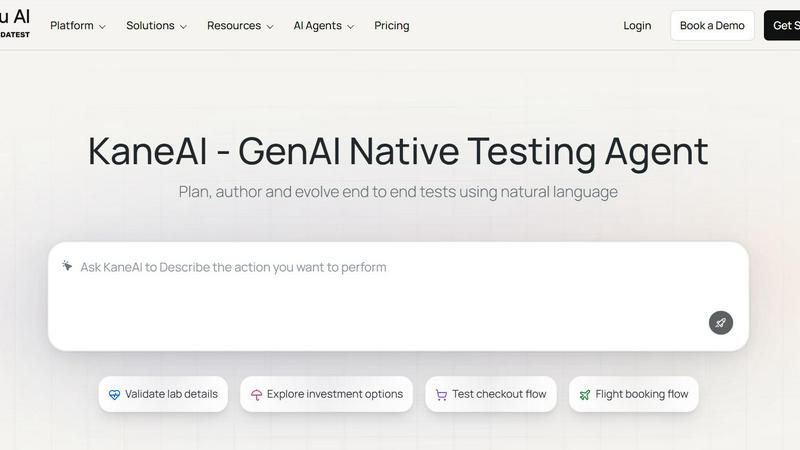
KaneAI is my top pick for creating and managing complex software tests using simple natural language commands.
Last updated: February 28, 2026

Prefactor
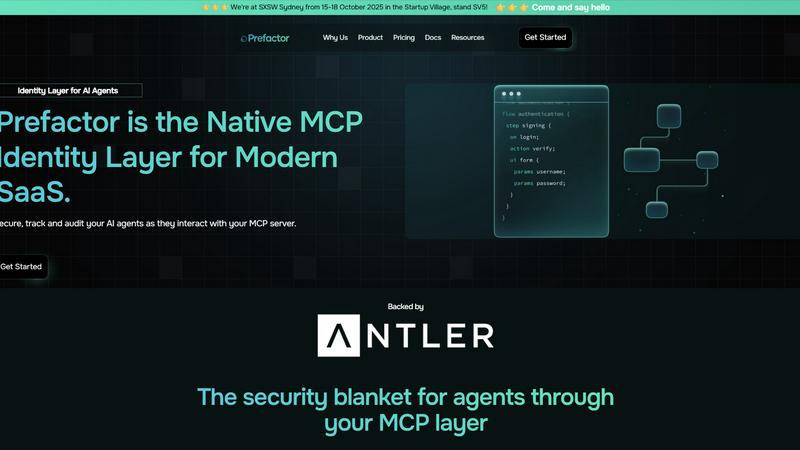
Prefactor is the essential control plane for governing AI agents securely at production scale.
Last updated: March 1, 2026
Visual Comparison
Kane AI
Prefactor
Feature Comparison
Kane AI
Natural Language Test Authoring & Planning
This is the heart of Kane AI and my absolute favorite feature. You simply converse with the AI agent, describing high-level objectives like "test the checkout flow for a guest user with an expired promo code." Kane AI's Intelligent Test Planner then decomposes this into structured, automated test steps. You can even feed it JIRA tickets, PRDs, or spreadsheets to generate test cases. It’s a game-changer that completely skips the technical syntax, letting you focus on what to test instead of how to code it.
Unified Multi-Layer Testing
Forget juggling separate tools for UI, API, and database checks. Kane AI brilliantly unifies end-to-end flow testing across every critical layer of your application in one seamless strategy. You can validate UI interactions, check API responses and network payloads in real-time, run direct database queries, and even perform pixel-perfect visual comparisons and accessibility audits—all within the same test flow. This holistic approach is what true coverage looks like.
Intelligent Execution & Self-Healing
Execution is where many AI tools falter, but not Kane AI. It runs your tests across 3000+ browser, OS, and device combinations via HyperExecute. More impressively, it includes GenAI-powered healing to automatically adapt to minor UI changes and auto-dismiss popups. The step-level control is a masterstroke, allowing you to decide if a failure should stop the run, continue, or be skipped, giving you incredible resilience and precision.
Enterprise-Grade Integrations & Workflow
Kane AI is built to slot into your existing ecosystem, not force you into a new one. The native integration with Jira and Azure DevOps is seamless; you can create test cases, trigger runs, and—crucially—auto-raise well-documented bug tickets directly from a failure. Combined with enterprise essentials like SSO, RBAC, and audit logs, it ensures the platform scales with your team's security and collaboration needs.
Prefactor
Real-Time Agent Monitoring & Dashboard
Gain complete operational visibility across your entire agent infrastructure from a single dashboard. This isn't just about uptime; it's about seeing every agent action as it happens. Track which agents are active, what tools and data they're accessing, and pinpoint exactly where failures or anomalous behavior emerge—all before they cascade into full-blown incidents. It answers the critical question everyone from engineers to executives asks: "What is this agent doing right now?"
Compliance-Ready Audit Trails
Forget sifting through cryptic API logs that mean nothing to your compliance officer. Prefactor's audit logs are its killer feature, translating raw technical events into clear, business-context narratives. When compliance or security asks "what did the agent do and why?", you can generate audit-ready reports in minutes, not weeks. Every action is recorded in language stakeholders actually understand, built to withstand rigorous regulatory scrutiny.
Identity-First Access Control
Prefactor brings the mature governance principles of human identity management to your AI workforce. Every agent gets a unique, first-class identity. Every action it takes is authenticated, and every permission to access tools or data is explicitly scoped and enforced through policy-as-code. This foundational layer ensures you know exactly who (which agent) did what and had permission to do it.
Emergency Kill Switches & Cost Tracking
Maintain ultimate control with the ability to instantly deactivate any agent across your fleet—a non-negotiable for production safety. Coupled with this is granular cost tracking across compute providers. Prefactor lets you identify expensive execution patterns and optimize spending, turning agent operations from a black-box cost center into a manageable, efficient part of your infrastructure.
Use Cases
Kane AI
Accelerating Test Automation for Non-Coding Teams
Product managers, business analysts, and manual QA engineers can now directly contribute to automation. By describing features or uploading product requirements, they can generate comprehensive, executable test suites without writing a single line of code. This democratizes test creation and drastically reduces the dependency on a few automation specialists, unblocking the entire delivery pipeline.
Continuous Testing in CI/CD Pipelines
Development teams can embed Kane AI into their CI/CD workflows to enable true shift-left testing. Since tests are authored and maintained with natural language, they are easier to create alongside feature development. The platform's flexible scheduling and ability to run on custom environments (like a local build) make it perfect for automated regression suites that run on every commit, providing fast feedback.
Complex End-to-End Business Flow Validation
For validating intricate, multi-step user journeys—like a financial investment flow or a multi-leg flight booking—Kane AI excels. Its ability to weave together UI actions, API calls, database state checks, and visual validation into a single, coherent test ensures that critical business workflows work perfectly from front to back before any release.
Enhancing Test Coverage for Legacy Systems
Teams maintaining large, complex legacy applications often have gaps in test coverage. Kane AI's manual interaction recorder can capture existing user flows, converting them into reusable automated steps. Furthermore, its ability to generate dynamic test data and create modular, reusable test blocks makes building and expanding a regression suite for a legacy system far less daunting.
Prefactor
Scaling Agent Pilots in Regulated Finance
A Fortune 500 bank's AI team has multiple agent pilots for loan processing and fraud detection. While the tech works, security and compliance block production deployment due to a lack of audit trails and access controls. Prefactor provides the governed control plane, giving each agent an identity, logging all actions in business terms, and enabling policy-based access, finally allowing them to move from pilot to approved production.
Managing AI Agents in Healthcare Operations
A healthcare technology company uses agents to automate patient intake and records matching. The strict requirements of HIPAA and need for detailed access logs make deployment daunting. Prefactor implements identity-first control and generates compliance-ready audit trails that clearly document every agent interaction with protected health information, satisfying legal and regulatory teams.
Governing Autonomous Agents in Critical Infrastructure
A mining or energy company employs agents for autonomous monitoring and reporting of equipment. The "fail-safe" requirement is extreme. Prefactor's real-time dashboard provides the necessary visibility to monitor agent health, while the emergency kill switch offers an instant shutdown capability, ensuring agents can be governed safely in high-stakes physical environments.
Centralizing Control for Multi-Framework AI Teams
A product team uses LangChain for some workflows, CrewAI for others, and custom frameworks for specific tasks. Managing security and visibility across this heterogeneous stack is a nightmare. Prefactor integrates across these frameworks, providing a single pane of glass for monitoring, audit, and policy enforcement, unifying governance regardless of the underlying agent technology.
Overview
About Kane AI
Let's cut through the noise: test automation is often a bottleneck, not a catalyst. It demands specialized coding skills, creates maintenance nightmares, and leaves critical layers like APIs and accessibility as afterthoughts. Kane AI by TestMu is the paradigm shift we've been waiting for. It's not just another low-code tool with training wheels; it's a first-of-its-kind, GenAI-native testing agent built from the ground up for speed and intelligence. This platform is for modern Quality Engineering teams who are tired of the trade-off between ease-of-use and power. Its core value proposition is breathtakingly simple: you describe your testing intent in plain English, and Kane AI handles the complex orchestration—authoring, managing, debugging, and evolving sophisticated, multi-layered tests. It obliterates the traditional barrier to entry for automation, enabling teams to start fast and scale without compromising on the complexity needed for enterprise-grade applications. If you're looking to move from reactive bug-finding to proactive, AI-powered quality engineering, this is your command center.
About Prefactor
Let's be brutally honest: the AI agent space is flooded with frameworks that make building a slick demo laughably easy. The real, gut-wrenching challenge begins when you try to push those agents into a real, regulated enterprise environment. That's where the dream meets the compliance, security, and operational reality wall. Prefactor isn't just another tool in your AI stack; it's the essential, non-negotiable control plane built specifically for this nightmare scenario. If your product or engineering team is running multiple agent pilots but hitting a brick wall with security reviews and compliance sign-offs, Prefactor is your definitive solution. It transforms chaotic, opaque automations into governed, transparent assets by giving every single AI agent a first-class, auditable identity. Its core genius is providing elegant trust: it finally aligns security, product, engineering, and compliance teams around one source of truth. By managing access through policy-as-code, automating permissions in CI/CD pipelines, and delivering full visibility over every action, Prefactor turns risky agent experiments into compliant, scalable operations. This is the critical infrastructure that bridges the infamous gap from a compelling POC to governed, trustworthy production, especially for industries like banking, healthcare, and mining where "move fast and break things" is a recipe for disaster.
Frequently Asked Questions
Kane AI FAQ
How is Kane AI different from traditional low-code testing tools?
Traditional low-code tools often simplify UI recording but struggle with complex logic, conditionals, and non-UI testing. Kane AI is fundamentally different; it's a GenAI-native agent. You instruct it with natural language objectives, and it plans and generates the underlying code for sophisticated workflows across all layers (UI, API, DB). It's built for complexity and enterprise-scale performance, not just simplicity.
Does Kane AI support testing for mobile applications?
Yes, absolutely. Kane AI supports authoring and executing tests across both web and mobile applications. When combined with its execution platform, HyperExecute, you can run these tests on a vast grid of real mobile devices and emulators, ensuring your mobile experience is validated with the same rigor as your web application.
Can I use my existing test frameworks with Kane AI?
Kane AI is designed as a comprehensive platform, but it offers multi-language code export. This means you can export the test logic it generates into code for major frameworks. While it encourages using its native intelligent agent for authoring and execution, this export capability provides flexibility and a potential migration path for certain needs.
How does the "GenAI-powered healing" actually work?
When Kane AI executes a test and encounters a failure—like a button that can't be found because its CSS selector changed—its GenAI engine analyzes the context. It can intelligently suggest and apply alternative, resilient locators or interaction methods to complete the test step. This self-healing capability dramatically reduces test maintenance overhead caused by frequent, minor UI updates.
Prefactor FAQ
What exactly is an "AI Agent Control Plane"?
Think of it like the control tower at a major airport. Individual AI agent frameworks (LangChain, CrewAI, etc.) are the planes—they do the actual work. The control plane is the essential layer of infrastructure that manages the traffic: it gives each "plane" (agent) a unique identity, dictates its permissions (flight path), monitors its every move in real-time, and maintains a perfect log of all activity. It's the system that brings order, safety, and governance to autonomous operations.
How does Prefactor work with existing AI agent frameworks?
Prefactor is designed to be framework-agnostic. It provides SDKs and integrations that work seamlessly with popular frameworks like LangChain, CrewAI, and AutoGen, as well as custom-built agents. You can deploy it alongside your existing agents, often in just hours. It doesn't replace your framework; it adds the critical production-grade governance layer that these frameworks typically lack.
Is Prefactor only for large, regulated enterprises?
While its features are absolutely essential for regulated industries (finance, healthcare, etc.), any team moving multiple AI agents from demo to real-world production will benefit. If you care about knowing what your agents are doing, controlling their access, having audit trails, and managing costs, Prefactor provides the enterprise-ready infrastructure so you don't have to build it from scratch.
What is MCP and how does Prefactor relate to it?
Model Context Protocol (MCP) is becoming a standard way for AI agents to connect to tools and data sources. Prefactor's whitepaper "MCP in Production" addresses the critical gap: while MCP enables connectivity, teams are "flying blind" in production without governance. Prefactor acts as the control plane for MCP-enabled agents, providing the essential visibility, audit, and security controls needed to use MCP safely at scale.
Alternatives
Kane AI Alternatives
Kane AI is a pioneering GenAI-native testing agent, squarely in the category of AI-powered quality engineering assistants. It allows teams to plan, create, and manage complex automated tests using simple natural language, aiming to drastically reduce the time and expertise needed for robust test automation. Users often explore alternatives for various reasons. Budget constraints or specific pricing models can be a primary driver. Others might seek tools with a narrower focus, like only API testing, or require deeper integration with a niche part of their tech stack that a generalist tool doesn't support. When evaluating an alternative, consider your team's core need. Is it raw test generation speed, support for a legacy framework, or unparalleled ease of use? The right choice balances the power of AI assistance with the practicalities of your existing workflows, integration capabilities, and long-term testing strategy.
Prefactor Alternatives
Prefactor is the essential control plane for governing AI agents in production at scale. It belongs to the emerging category of AI governance and security platforms, specifically designed to bring order and compliance to the chaotic world of autonomous AI agents. Users often look for alternatives for a few key reasons. Some find their needs are simpler and don't require such a comprehensive governance layer, while others may have specific platform requirements or budget constraints that lead them to explore other options in the market. When evaluating any solution in this space, you should look for core capabilities that enable trust at scale. This includes robust identity management for non-human entities, real-time visibility into agent actions, and policy-driven controls that integrate seamlessly into your existing engineering and security workflows. The goal is to move from risky experiments to governed operations.