SERPView vs Surnex
Side-by-side comparison to help you choose the right tool.

SERPView
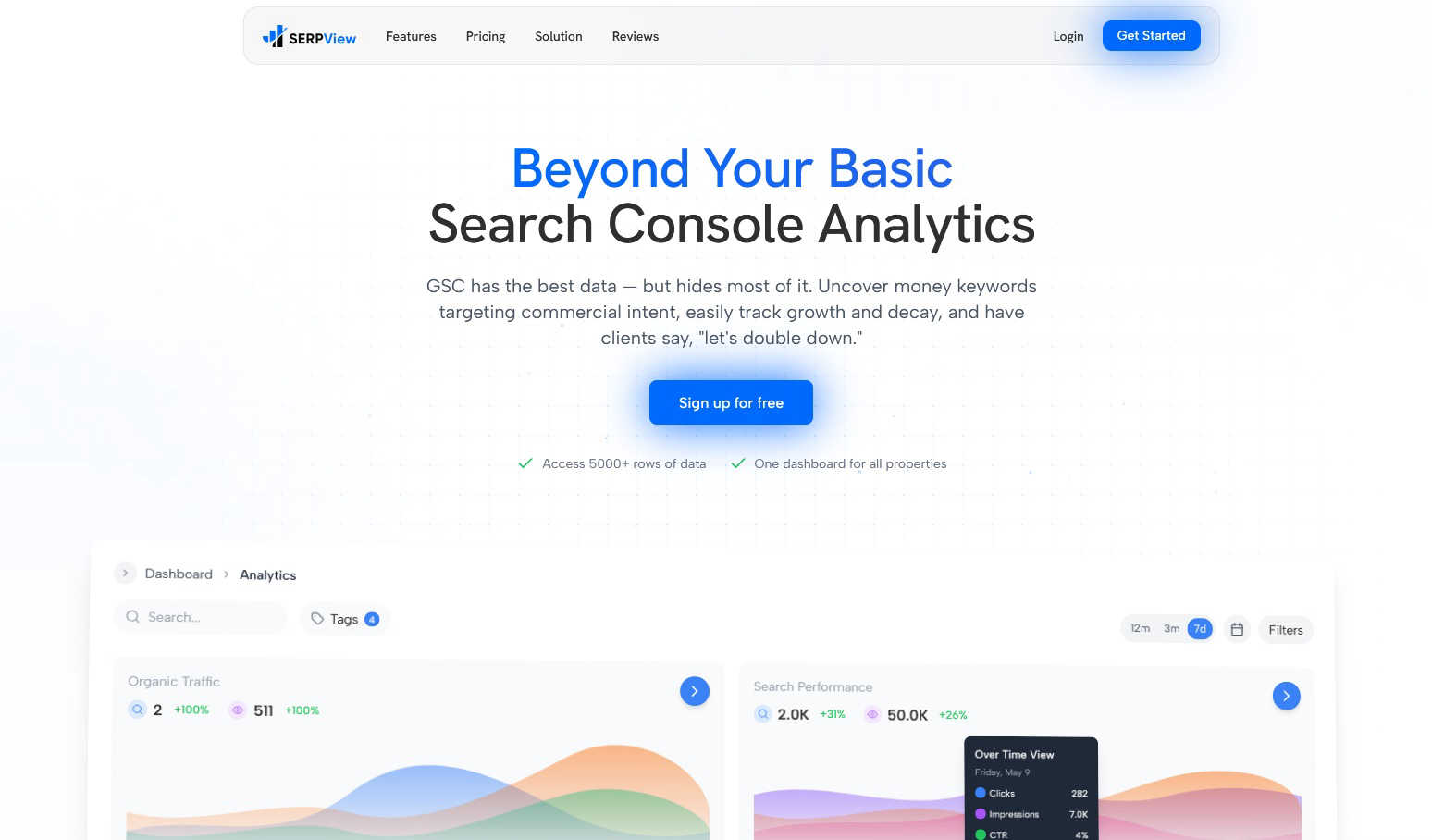
SERPView unlocks Google Search Console's hidden data to reveal your best keywords and traffic opportunities.
Last updated: March 1, 2026

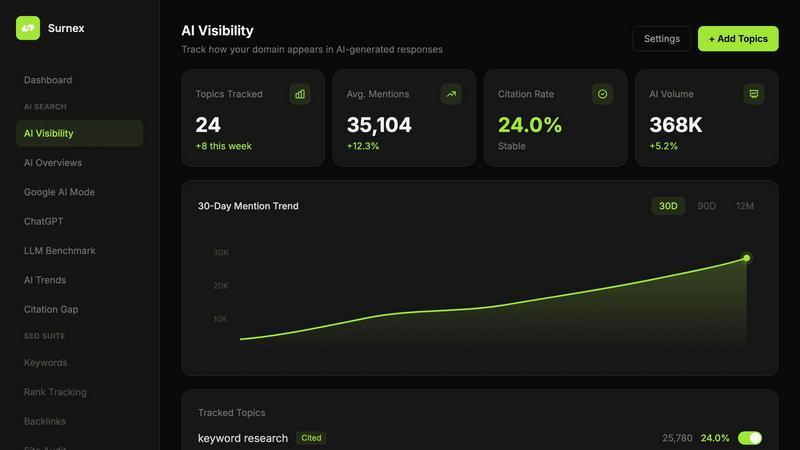
Surnex brilliantly unifies AI search visibility and traditional SEO tools into one essential platform for modern agencies.
Last updated: March 26, 2026
Visual Comparison
SERPView
Surnex
Feature Comparison
SERPView
Performance Tracking Without Limits
This is the game-changer. SERPView shatters Google's 1,000-row data ceiling, granting you access to a staggering 50,000 rows of historical performance data. This means you can track clicks, impressions, CTR, and average position across your entire keyword and page universe, not just a tiny, unrepresentative sample. No more guessing what's happening beyond the first page of GSC data. You get the complete picture, enabling deep-dive analysis and accurate trend spotting over any meaningful period.
Advanced Keyword & Page Analysis
Move beyond basic lists. SERPView's keyword analysis helps you pinpoint "money keywords" with commercial intent and track their precise ranking movements over time. Similarly, the page analysis feature clearly highlights your top-performing and underperforming content, showing you exactly which pages are driving traffic and which need immediate optimization. It turns vague hunches into specific, prioritized action items for your content and technical SEO strategies.
Mobile vs. Desktop & International Insights
Understanding how your audience interacts with your site is crucial. SERPView brilliantly segments performance data by device type (mobile vs. desktop), allowing you to identify significant opportunities for device-specific optimization. Furthermore, its international SEO insights let you track performance across different countries and languages, which is invaluable for businesses with a global audience or those looking to expand. You can tailor your strategy based on what actually works in each region.
Query Counting & Update Annotations
Two of my favorite "hidden gem" features. Query Counting shows you how many unique search queries are driving impressions, broken down by ranking position. This is phenomenal for understanding your search visibility footprint. The Google Updates & Annotations feature is a strategic powerhouse, allowing you to mark algorithm update dates and add custom notes directly onto your performance charts. This lets you correlate ranking volatility with specific events, turning reactive panic into proactive understanding.
Surnex
AI Visibility Tracking
This is the game-changer. Surnex actively monitors and reports on your brand's presence across every major AI search surface, including ChatGPT, Google's AI Overviews, Perplexity's AI Mode, and Claude. You can see real citation rates, track how often you're mentioned versus competitors, and observe visibility trends over time. It finally gives you a quantifiable metric for "AI presence," moving beyond guesswork into actionable data.
Citation Gap Analysis
My favorite feature for proactive strategy. Surnex doesn't just show you where you are; it intelligently highlights where you're missing. The platform identifies specific queries and topics where your competitors are earning citations in AI-generated answers and you are not. It prioritizes these gaps with scores and source-level intelligence, turning a vague worry into a clear, prioritized content and link-building roadmap.
Full SEO Toolkit
To replace your existing stack, Surnex packs a powerful, integrated suite of traditional SEO tools. This includes keyword rank tracking, backlink analysis and monitoring, comprehensive site audits, domain authority metrics, and Core Web Vitals tracking. You're not sacrificing depth for breadth; it's everything you need to manage foundational SEO health without ever leaving the platform.
Structured Workflows & API-First Design
This is where Surnex proves it's built for serious teams. It offers pre-built, repeatable workflows for common tasks like AI Visibility Audits and Client Reporting, bringing consistency to operations. More impressively, every single feature is accessible via a robust REST API. This means developers can bake Surnex's search intelligence directly into custom dashboards, client portals, or even autonomous AI agents.
Use Cases
SERPView
For the SEO Agency Managing Multiple Clients
Juggling a dozen different GSC accounts is a productivity killer. SERPView allows agencies to connect all client properties into one unified dashboard. This centralization makes performance reporting, identifying cross-client trends, and delivering actionable insights incredibly efficient. You can provide far more value without the administrative headache, all from a single, professional interface.
For the In-House Marketer Proving SEO ROI
In-house teams need to demonstrate impact and justify budgets. SERPView's deep data access and clear visualizations make it easy to create compelling reports that show progress, highlight wins (like keyword movements into the top 3), and identify new opportunities. The ability to track topic clusters and page performance directly ties SEO efforts to business outcomes like traffic and engagement.
For the Content Team Optimizing Existing Assets
Content teams can move from publishing and hoping to a true data-informed model. By using the Page Analysis and Keyword Analysis features, writers and editors can quickly identify high-potential pages that are languishing on page 2 of Google, or discover new keyword variations their existing content can be optimized for. It turns the content refresh process from a guesswork exercise into a targeted surgical strike.
For the E-commerce Store Tracking Product Visibility
E-commerce sites live and die by their search visibility for commercial product keywords. SERPView enables store owners to track thousands of product-related keywords beyond the basic GSC limit, monitor category page performance, and understand how device usage (mobile vs. desktop) affects different product segments. This data is critical for optimizing product titles, descriptions, and site structure to capture more commercial traffic.
Surnex
Marketing Agency Client Delivery
For agencies, Surnex is a client-service powerhouse. It allows you to monitor a client's AI search footprint alongside their traditional SEO campaign in one unified workflow. You can create white-label reports that showcase value across both domains, proving you're ahead of the curve, all without managing multiple logins and subscriptions for each client.
In-House SEO & Content Strategy
Internal teams can break down silos with Surnex. It provides cross-team visibility, allowing content, product, and leadership teams to see the direct impact of their work on both AI and traditional search visibility from a single dashboard. This aligns efforts and prioritizes projects based on a complete view of search performance.
AI-Powered Product Development
Developers and builders can leverage the API-first design to integrate Surnex's data directly into their own applications. Imagine building a research agent that checks brand visibility in real-time, or a customer-facing tool that showcases a company's authority. Surnex provides the foundational data layer for innovative search intelligence products.
Competitive Intelligence & Benchmarking
Beyond tracking yourself, Surnex is invaluable for competitive analysis. You can benchmark your AI citation performance against key competitors and use the LLM comparison tool to see how different AI models answer the same prompt. This reveals strategic opportunities and weaknesses in your competitors' digital strategies.
Overview
About SERPView
Let's be honest: Google Search Console is a treasure trove of data, but using it feels like trying to drink from a firehose with a thimble. The interface is clunky, the data limits are frustrating, and connecting the dots across multiple properties is a nightmare. That's precisely why SERPView exists, and in my opinion, it's not just an add-on; it's the essential, modern dashboard GSC always should have been. SERPView is a powerful analytics platform built specifically to unlock the full potential of your Google Search Console data. It's crafted for SEO professionals, digital marketers, and website owners who are tired of the limitations and ready to make truly data-driven decisions. The core value proposition is breathtakingly simple: it gives you unfettered access to over 50,000 rows of GSC data (versus the standard 1,000), presents it all in a single, intuitive dashboard, and layers on advanced analytics that Google simply doesn't provide. This tool is for anyone who has ever felt there were hidden insights just out of reach in their search performance data. It transforms raw, cumbersome numbers into clear, actionable intelligence, empowering you to track keyword movements, analyze page performance, compare device data, and manage multiple websites from one centralized command center. If you're serious about SEO, this is the upgrade you've been waiting for.
About Surnex
Let's be honest: the SEO landscape is a mess right now. You're juggling a keyword rank tracker, a backlink analyzer, a site audit tool, and now you're supposed to somehow track your brand across a dozen different AI chatbots? It's unsustainable. That's why Surnex is such a breath of fresh air. This platform is built for the new reality of search, where your visibility hinges as much on citations in a ChatGPT answer as it does on position #3 in Google. Surnex unifies AI search visibility tracking with a full, core SEO toolkit into a single, coherent dashboard. It's specifically designed for agencies, in-house marketing teams, and developers who are tired of the tool sprawl and need to future-proof their strategy. Instead of piecing together insights from four different subscriptions, you get one platform that shows you exactly where your brand appears (or, crucially, doesn't appear) across ChatGPT, Google AI Overviews, Perplexity, and Claude, while simultaneously managing your traditional keyword rankings, backlinks, and site health. Its core value proposition is ruthless efficiency: move faster, uncover concrete opportunities in the AI space, and deliver reports that actually reflect the modern search ecosystem, all from one place.
Frequently Asked Questions
SERPView FAQ
How is SERPView different from Google Search Console?
Think of Google Search Console as the raw data warehouse and SERPView as the sophisticated business intelligence platform built on top of it. GSC provides the foundational data but with severe limits (1,000 rows) and a basic interface. SERPView removes those limits, gives you 50x more data, adds advanced analytics (like query counting, device breakdowns, annotations), and presents everything in a unified, customizable, and shareable dashboard for multiple properties.
What data does SERPView access, and is it secure?
SERPView connects directly to your Google Search Console account via Google's secure OAuth API. It only reads your search performance data; it cannot make any changes to your website or Google account. The connection is read-only and highly secure, using the same official protocol that countless other trusted marketing apps use. Your data is processed and presented but never altered or owned by SERPView.
Can I use SERPView for multiple websites?
Absolutely, and this is one of its strongest suits. You can connect and manage multiple Google Search Console properties (websites) from within your single SERPView account. All the data aggregates into one master dashboard, but you can also filter and view reports for each property individually. This makes it perfect for agencies, freelancers with multiple clients, or businesses with several domains.
How much historical data can I see in SERPView?
SERPView pulls in 16 months of historical search performance data from the moment you connect your Google Search Console account. As you continue to use the platform, it will automatically accumulate and store this data over time, building a rich, long-term performance history that you can analyze and compare against. This far exceeds the limited, rolling timeframe often visible in the native GSC interface.
Surnex FAQ
How is Surnex different from Semrush or Ahrefs?
While Semrush and Ahrefs are excellent traditional SEO suites, they were built for a links-and-keywords world. Surnex is built from the ground up for the age of AI search. Its fundamental differentiator is its deep, integrated tracking of brand visibility across major AI platforms like ChatGPT and Claude—a capability that is an afterthought or non-existent in legacy tools. It combines this with core SEO features to create a unified platform for modern search visibility.
What AI search engines does Surnex track?
Surnex currently tracks visibility across the most critical AI search surfaces: OpenAI's ChatGPT (including browsing), Google's AI Overviews (SGE), Perplexity.ai's AI Mode, and Anthropic's Claude. The platform is designed to add new surfaces as they become significant players in the information discovery landscape.
Is there an API?
Absolutely, and it's a core strength. Surnex is built API-first, meaning every feature and data point available in the dashboard is also accessible via a comprehensive REST API. This allows teams to automate workflows, build custom integrations, and embed Surnex's search intelligence directly into their own software products and internal tools.
Can I use Surnex for client reporting?
Yes, and it's a primary use case. Surnex includes white-label, client-ready reporting features that seamlessly blend AI visibility metrics with traditional SEO data (rankings, backlinks, audits). This allows you to provide a holistic view of a client's search performance in one professional report, demonstrating expertise in the full spectrum of modern search.
Alternatives
SERPView Alternatives
SERPView is a powerful analytics platform designed to supercharge the data you get from Google Search Console. It falls squarely into the SEO analytics and data visualization category, helping marketers move beyond GSC's basic reports to uncover deeper performance insights and hidden keyword opportunities. Users often seek alternatives for a variety of practical reasons. Budget is a common driver, as premium tools may not fit every team's finances. Others might need specific integrations with different marketing stacks, or they may prioritize certain features like competitor tracking or rank monitoring over deep-dive GSC analysis. The search for the right fit is all about matching a tool's strengths to your unique workflow. When evaluating other options, focus on your core needs. Consider the depth of historical data access, the flexibility of filtering and segmentation, and how well the platform visualizes complex information. The goal is to find a solution that turns raw search console data into clear, actionable intelligence without unnecessary complexity.
Surnex Alternatives
Surnex is an AI search and SEO tracking platform designed specifically for agencies. It consolidates the critical tasks of tracking brand visibility in both traditional search results and, crucially, within AI-generated answers from tools like ChatGPT and Gemini. This positions it at the intersection of modern SEO and AI operations, a category focused on future-proofing digital visibility. Users often explore alternatives for several practical reasons. Budget constraints or specific pricing models can be a primary driver, as agency needs vary widely. Others might seek a platform that integrates more deeply with their existing tech stack, or they may require a toolset that leans more heavily into either classic SEO auditing or pure AI agent management, rather than Surnex's combined approach. When evaluating other options, focus on how well they bridge the gap between AI and SEO. A robust alternative should not only track rankings and backlinks but also provide clear insights into citations and brand mentions within AI answers. Consider the workflow: does it save time by automating tasks for your team, or does it add complexity? The goal is to reduce tool sprawl while gaining actionable intelligence to move faster and uncover new opportunities.