SERPView vs TrafficClaw
Side-by-side comparison to help you choose the right tool.

SERPView
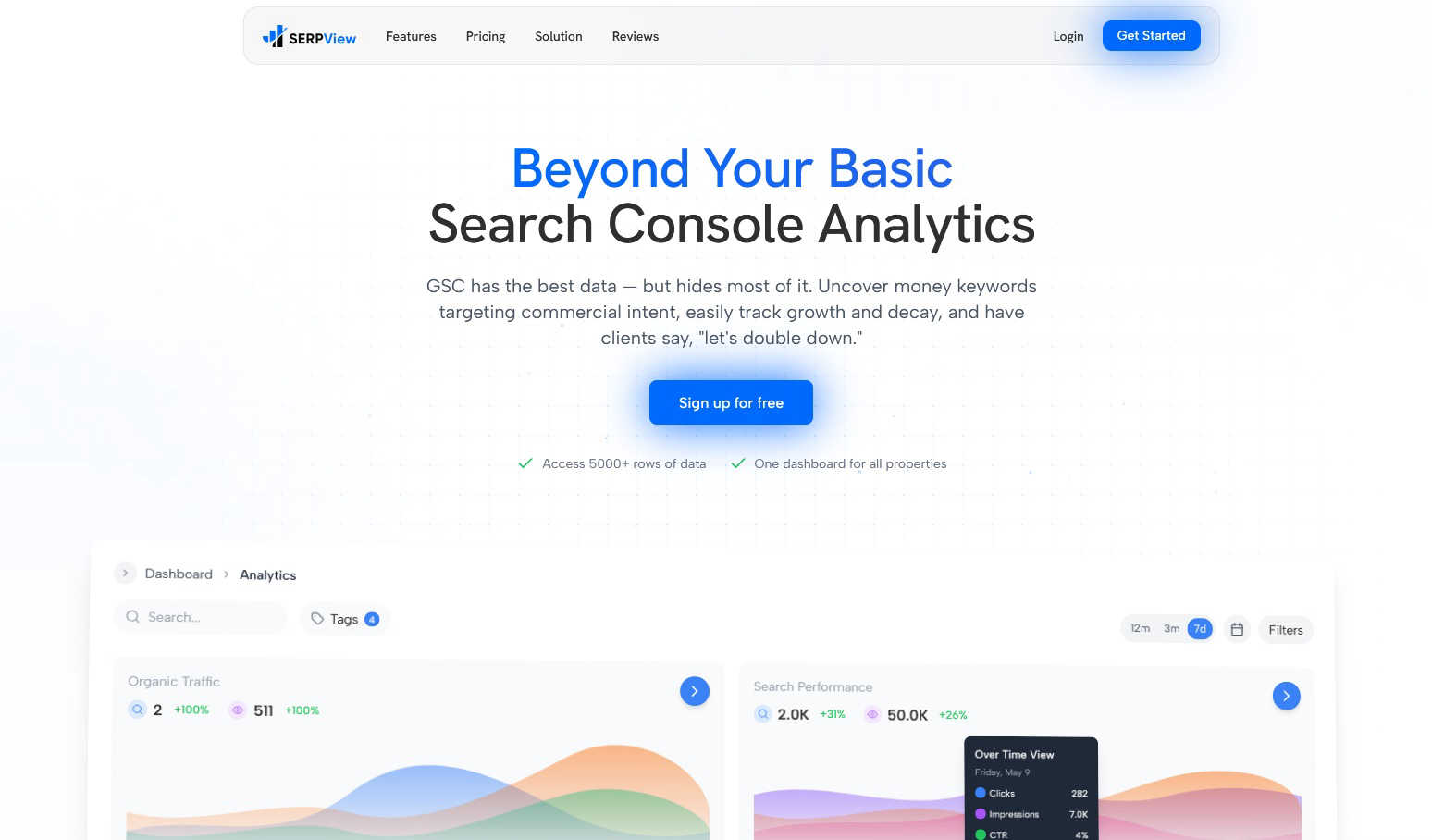
SERPView unlocks Google Search Console's hidden data to reveal your best keywords and traffic opportunities.
Last updated: March 1, 2026

TrafficClaw
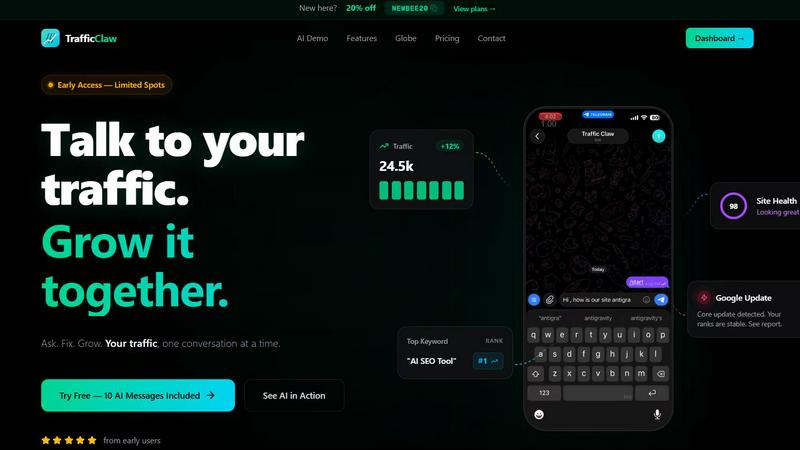
TrafficClaw is an AI analyst that talks to your SEO data to deliver actionable growth insights, not generic advice.
Last updated: April 13, 2026
Visual Comparison
SERPView
TrafficClaw
Feature Comparison
SERPView
Performance Tracking Without Limits
This is the game-changer. SERPView shatters Google's 1,000-row data ceiling, granting you access to a staggering 50,000 rows of historical performance data. This means you can track clicks, impressions, CTR, and average position across your entire keyword and page universe, not just a tiny, unrepresentative sample. No more guessing what's happening beyond the first page of GSC data. You get the complete picture, enabling deep-dive analysis and accurate trend spotting over any meaningful period.
Advanced Keyword & Page Analysis
Move beyond basic lists. SERPView's keyword analysis helps you pinpoint "money keywords" with commercial intent and track their precise ranking movements over time. Similarly, the page analysis feature clearly highlights your top-performing and underperforming content, showing you exactly which pages are driving traffic and which need immediate optimization. It turns vague hunches into specific, prioritized action items for your content and technical SEO strategies.
Mobile vs. Desktop & International Insights
Understanding how your audience interacts with your site is crucial. SERPView brilliantly segments performance data by device type (mobile vs. desktop), allowing you to identify significant opportunities for device-specific optimization. Furthermore, its international SEO insights let you track performance across different countries and languages, which is invaluable for businesses with a global audience or those looking to expand. You can tailor your strategy based on what actually works in each region.
Query Counting & Update Annotations
Two of my favorite "hidden gem" features. Query Counting shows you how many unique search queries are driving impressions, broken down by ranking position. This is phenomenal for understanding your search visibility footprint. The Google Updates & Annotations feature is a strategic powerhouse, allowing you to mark algorithm update dates and add custom notes directly onto your performance charts. This lets you correlate ranking volatility with specific events, turning reactive panic into proactive understanding.
TrafficClaw
AI Chat Analyst
This is the heart of TrafficClaw and, in my opinion, its killer feature. You interact with a conversational AI that has direct, read-only access to your connected Google Analytics 4 and Search Console data. You ask natural language questions like "Why are my conversions down?" or "Show me my top underperforming pages," and it doesn't just spit out a chart. It analyzes the correlation between your traffic, keyword rankings, and user behavior to deliver a written "verdict" with evidence and concrete next steps. It feels less like using software and more like consulting a sharp, data-obsessed colleague who works at light speed.
SEO Intelligence Suite
Moving beyond basic rank tracking, TrafficClaw's SEO tools are built for proactive growth. It automatically hunts for keyword gaps your competitors rank for but you don't, alerts you to content decay (pages that are losing traffic over time), and detects keyword cannibalization—where your own pages compete against each other, confusing Google. Crucially, it includes optimization for AI search (like Gemini), helping you structure content for the next frontier of search. It turns SEO from a maintenance task into a growth engine.
Real-Time Analytics & Live Globe
Forget refreshing GA4. TrafficClaw provides a consolidated, real-time dashboard showing current visitors, traffic trends, bounce rates, and referrers. The standout is the embeddable 3D globe, which visually plots your live visitors on a world map with a cute animal alias and activity feed. It's not just eye candy; it's a powerful, immediate way to see geographic engagement and visitor flow, and you can embed it on your own site with a single line of code—no extra tracking scripts needed.
Integrated Site Audit & Content Tools
This feature closes the loop between insight and action. The built-in site auditor goes deep on page-level performance, grading Core Web Vitals and offering auto-fix suggestions for technical SEO. Then, the content tools help you execute. Need to target a discovered keyword gap? Use the AI blog writer and schema generator. Found a page that needs bolstering? The internal linking optimizer provides smart suggestions. It’s a seamless workflow from diagnosis to remedy.
Use Cases
SERPView
For the SEO Agency Managing Multiple Clients
Juggling a dozen different GSC accounts is a productivity killer. SERPView allows agencies to connect all client properties into one unified dashboard. This centralization makes performance reporting, identifying cross-client trends, and delivering actionable insights incredibly efficient. You can provide far more value without the administrative headache, all from a single, professional interface.
For the In-House Marketer Proving SEO ROI
In-house teams need to demonstrate impact and justify budgets. SERPView's deep data access and clear visualizations make it easy to create compelling reports that show progress, highlight wins (like keyword movements into the top 3), and identify new opportunities. The ability to track topic clusters and page performance directly ties SEO efforts to business outcomes like traffic and engagement.
For the Content Team Optimizing Existing Assets
Content teams can move from publishing and hoping to a true data-informed model. By using the Page Analysis and Keyword Analysis features, writers and editors can quickly identify high-potential pages that are languishing on page 2 of Google, or discover new keyword variations their existing content can be optimized for. It turns the content refresh process from a guesswork exercise into a targeted surgical strike.
For the E-commerce Store Tracking Product Visibility
E-commerce sites live and die by their search visibility for commercial product keywords. SERPView enables store owners to track thousands of product-related keywords beyond the basic GSC limit, monitor category page performance, and understand how device usage (mobile vs. desktop) affects different product segments. This data is critical for optimizing product titles, descriptions, and site structure to capture more commercial traffic.
TrafficClaw
Diagnosing Sudden Traffic Drops
This is the classic, hair-pulling scenario TrafficClaw was made for. Instead of manually cross-referencing GA4 events, Search Console impressions, and Google update logs, you simply ask the AI, "Why did my traffic drop 40% on March 15th?" Within seconds, it can analyze your data and deliver a verdict like, "A core update rolled out that day. While your overall ranks are stable, you lost position 3 for your top keyword 'cloud hosting reviews' to a competitor's newer guide, causing a 12k impression drop. Recommended fix: Update your post with a more comprehensive comparison table."
Uncovering Hidden Keyword Opportunities
You're stuck thinking you've targeted all relevant keywords. TrafficClaw's SEO intelligence continuously scours your niche to find "keyword gaps"—high-potential terms your site could rank for but currently doesn't. You can ask the AI, "What are my top 5 keyword gap opportunities?" and get a list of specific, data-backed terms with search volume and difficulty, allowing you to strategically plan your next content piece or page update.
Preventing Content Cannibalization
You've written multiple blog posts on similar topics, and now they're mysteriously underperforming. TrafficClaw automatically detects when your pages are competing for the same keywords and alerts you. The AI can then advise on how to consolidate or differentiate the content, ensuring you have one strong page to rank instead of several weak ones that split authority. It solves a complex, often invisible SEO problem effortlessly.
Real-Time Campaign & Launch Monitoring
When you launch a new product, feature, or marketing campaign, you want immediate feedback. With the real-time dashboard and globe, you can watch live visitor spikes, see which countries are engaging first, and monitor referral sources the moment they happen. You can ask the AI, "How is traffic from my LinkedIn campaign today performing vs. direct traffic?" for instant, comparative analysis without waiting for data to process.
Overview
About SERPView
Let's be honest: Google Search Console is a treasure trove of data, but using it feels like trying to drink from a firehose with a thimble. The interface is clunky, the data limits are frustrating, and connecting the dots across multiple properties is a nightmare. That's precisely why SERPView exists, and in my opinion, it's not just an add-on; it's the essential, modern dashboard GSC always should have been. SERPView is a powerful analytics platform built specifically to unlock the full potential of your Google Search Console data. It's crafted for SEO professionals, digital marketers, and website owners who are tired of the limitations and ready to make truly data-driven decisions. The core value proposition is breathtakingly simple: it gives you unfettered access to over 50,000 rows of GSC data (versus the standard 1,000), presents it all in a single, intuitive dashboard, and layers on advanced analytics that Google simply doesn't provide. This tool is for anyone who has ever felt there were hidden insights just out of reach in their search performance data. It transforms raw, cumbersome numbers into clear, actionable intelligence, empowering you to track keyword movements, analyze page performance, compare device data, and manage multiple websites from one centralized command center. If you're serious about SEO, this is the upgrade you've been waiting for.
About TrafficClaw
Let's be brutally honest: modern analytics are a mess. You've got Google Analytics 4 with its labyrinthine interface, Search Console with its pretty-but-passive graphs, and a dozen other tools that show you the "what" but never the "why." When your traffic plummets, you're left piecing together clues like a digital detective with no leads. TrafficClaw is the antidote to this frustration. It's not another dashboard to stare at; it's an AI analyst you can actually talk to. You connect your GA4 and Search Console accounts (a 30-second, read-only process), and then you just ask questions in plain English. "Why did my traffic drop last Tuesday?" "What's my top opportunity for more organic traffic?" "Is a Google update affecting me?" Instead of generic blog post advice, you get a specific, actionable verdict backed by your own live data. It's built for founders, marketers, and developers who are tired of data guesswork and want to have a direct conversation with their analytics to drive real, intelligent growth. The core promise is simple yet revolutionary: stop analyzing and start asking.
Frequently Asked Questions
SERPView FAQ
How is SERPView different from Google Search Console?
Think of Google Search Console as the raw data warehouse and SERPView as the sophisticated business intelligence platform built on top of it. GSC provides the foundational data but with severe limits (1,000 rows) and a basic interface. SERPView removes those limits, gives you 50x more data, adds advanced analytics (like query counting, device breakdowns, annotations), and presents everything in a unified, customizable, and shareable dashboard for multiple properties.
What data does SERPView access, and is it secure?
SERPView connects directly to your Google Search Console account via Google's secure OAuth API. It only reads your search performance data; it cannot make any changes to your website or Google account. The connection is read-only and highly secure, using the same official protocol that countless other trusted marketing apps use. Your data is processed and presented but never altered or owned by SERPView.
Can I use SERPView for multiple websites?
Absolutely, and this is one of its strongest suits. You can connect and manage multiple Google Search Console properties (websites) from within your single SERPView account. All the data aggregates into one master dashboard, but you can also filter and view reports for each property individually. This makes it perfect for agencies, freelancers with multiple clients, or businesses with several domains.
How much historical data can I see in SERPView?
SERPView pulls in 16 months of historical search performance data from the moment you connect your Google Search Console account. As you continue to use the platform, it will automatically accumulate and store this data over time, building a rich, long-term performance history that you can analyze and compare against. This far exceeds the limited, rolling timeframe often visible in the native GSC interface.
TrafficClaw FAQ
Is my Google data safe with TrafficClaw?
Absolutely. TrafficClaw uses secure, read-only Google OAuth to connect to your GA4 and Search Console. This means the tool can only view your data; it cannot edit, delete, or modify anything in your Google accounts. Your data is not sold or used to train public AI models. It remains yours, and you can revoke access at any time directly from your Google account security settings.
How is this different from ChatGPT or other AI chatbots?
Generic AI chatbots give generic advice based on public internet knowledge. TrafficClaw's AI Analyst is specialized and connected. It bases every single response on the private, live data from your specific website. When you ask "why did my traffic drop?", it's analyzing your traffic graphs, your keyword rankings, and your user behavior to give you a unique, actionable verdict, not a list of possible reasons from a blog.
What's included in the free trial?
The free trial includes 10 AI messages. This allows you to fully connect your GA4 and Search Console accounts and ask a series of substantive questions to experience the core "ask and get a verdict" functionality. You also get access to the dashboard and can explore the features to see how it would work with your real data before committing to a paid plan.
Can I use TrafficClaw on multiple websites?
Yes. During the connection process, TrafficClaw auto-detects all the GA4 properties and Search Console sites associated with your Google account. You can manage and analyze data from multiple websites within a single TrafficClaw dashboard, asking specific questions about each site. This makes it an efficient tool for agencies or developers managing several client or project sites.
Alternatives
SERPView Alternatives
SERPView is a powerful analytics platform designed to supercharge the data you get from Google Search Console. It falls squarely into the SEO analytics and data visualization category, helping marketers move beyond GSC's basic reports to uncover deeper performance insights and hidden keyword opportunities. Users often seek alternatives for a variety of practical reasons. Budget is a common driver, as premium tools may not fit every team's finances. Others might need specific integrations with different marketing stacks, or they may prioritize certain features like competitor tracking or rank monitoring over deep-dive GSC analysis. The search for the right fit is all about matching a tool's strengths to your unique workflow. When evaluating other options, focus on your core needs. Consider the depth of historical data access, the flexibility of filtering and segmentation, and how well the platform visualizes complex information. The goal is to find a solution that turns raw search console data into clear, actionable intelligence without unnecessary complexity.
TrafficClaw Alternatives
TrafficClaw is an AI assistant for SEO and analytics, a tool that lets you ask plain-English questions about your traffic data and get actionable answers. It connects to sources like GA4 and Search Console to move beyond static graphs and provide context. This places it in the growing category of conversational analytics and AI-driven SEO platforms. People look for alternatives for various reasons. Perhaps the pricing doesn't fit a startup budget, or a specific required data source isn't supported. Some users might need deeper, more traditional reporting dashboards, while others prioritize different workflow integrations. It's a natural part of finding the right tool-to-task fit. When evaluating alternatives, focus on the core promise: actionable insight from your data. Consider the depth of data source connections, the intelligence and specificity of the AI's answers, and how well it integrates into your existing workflow. The goal is to stop guessing and start understanding.