CCAPI vs WebPageSnap - Professional Web Scraper API
Side-by-side comparison to help you choose the right tool.

CCAPI
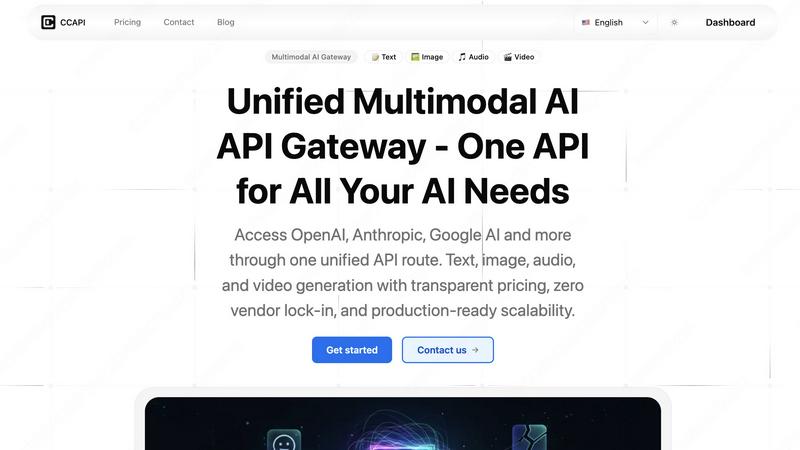
CCAPI instantly connects you to all major AI models through one reliable, always-on gateway.
Last updated: February 28, 2026

WebPageSnap is my top choice for instantly scraping any webpage with smart caching and global speed.
Last updated: February 28, 2026
Visual Comparison
CCAPI
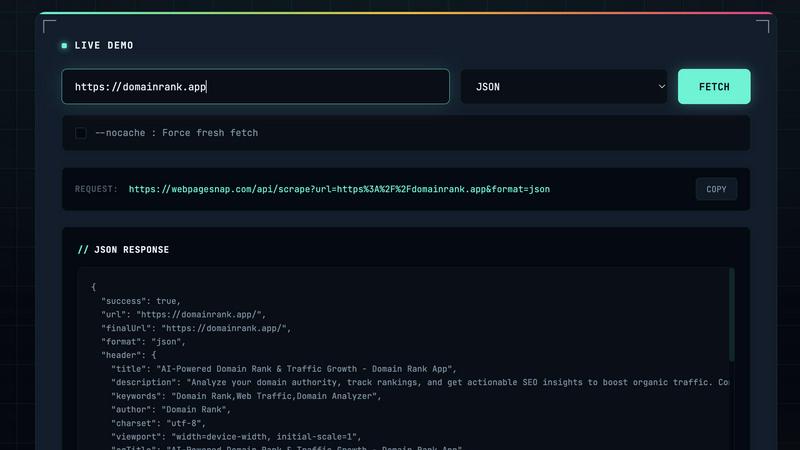
WebPageSnap - Professional Web Scraper API
Feature Comparison
CCAPI
Unified Multimodal Gateway
CCAPI consolidates access to the entire spectrum of generative AI—text, image, audio, and video—through one consistent API structure. Instead of integrating separately with OpenAI for chat, Stability AI for images, and Suno for audio, you make all your calls to api.ccapi.ai. This dramatically reduces integration complexity, standardizes error handling, and future-proofs your app. You can switch from generating a story with Claude to creating a soundtrack for it with ElevenLabs using the same SDK and authentication flow.
Intelligent Auto-Failover & Smart Routing
This is the engine that makes CCAPI indispensable for production applications. The system continuously monitors the health and latency of all connected providers. When a request to, say, OpenAI times out or returns an error, CCAPI's router instantly (in ~120ms) retries the request using an alternative provider like Anthropic or Google AI. This happens seamlessly behind the scenes, ensuring your end-users never experience downtime. It effectively turns multiple single points of failure into a robust, always-on AI pipeline.
OpenAI-Compatible Endpoint
Adoption is frictionless. CCAPI speaks the same language as the OpenAI API. For most developers, integration is as simple as changing the baseURL in their existing OpenAI SDK client from https://api.openai.com/v1 to https://api.ccapi.ai/v1. Your existing code for chat completions, function calling, and streaming works immediately. This design philosophy respects developer time and eliminates costly migration projects, letting you leverage a superior infrastructure layer in minutes.
Transparent Pay-As-You-Go Billing
CCAPI cuts through the nonsense of platform credits and mandatory subscriptions. You deposit real USD (e.g., $100) which becomes your usable balance, and you only pay for what you consume across any model. The platform provides a detailed usage dashboard with real-time metrics on costs, latency, and success rates per provider. This transparency ensures you know exactly where every dollar is going and can optimize for cost or performance without any financial gimmicks.
WebPageSnap - Professional Web Scraper API
Smart Cache with KV Storage
This isn't your basic cache. WebPageSnap employs a sophisticated Key-Value storage system with a 7-day Time-To-Live (TTL), achieving an exceptional 95%+ cache hit rate. What this means for you is that repeated requests for the same URL are served from the nearest edge location in under 50ms, drastically reducing latency and costs. It's smart caching that actually works, eliminating redundant fetches and supercharging your application's performance without any extra code on your part.
Global Edge Network Deployment
Forget scraping from a single, distant data center. WebPageSnap is deployed on a massive network of over 200 Cloudflare edge nodes worldwide. When you make a request, it's processed from the geographical location nearest to you and the target server. This global distribution is the secret sauce behind its consistently low latency, making it feel like you're fetching data locally, even when scraping websites on the other side of the planet.
Multi-Format Output (JSON & HTML)
Flexibility is key, and WebPageSnap delivers. You can choose your output format with a simple parameter. Need clean, structured data for your app? Get perfectly parsed JSON containing all the page metadata. Require the raw HTML for custom parsing or archiving? Just set format=html. This dual-output capability means one API seamlessly fits both high-level data extraction and low-level content fetching use cases.
Anti-Bot Bypass & Smart Redirects
Modern websites are minefields of JavaScript redirects and anti-bot measures. WebPageSnap handles this gracefully by simulating a real browser environment. It automatically detects and follows JavaScript redirects to ensure you always get the content from the final destination page. This intelligent behavior means you spend less time debugging "missing" content and more time using the data you actually need.
Use Cases
CCAPI
Building Resilient Production AI Applications
For any startup or enterprise running customer-facing AI features, downtime is unacceptable. CCAPI is the reliability layer that ensures your chatbot, content generator, or moderation tool stays operational even if a major provider like OpenAI has an outage. By automatically failing over to backup models, it guarantees service continuity, protecting your user experience and your business's reputation without requiring you to build complex fallback logic.
Rapid AI Model Prototyping and Evaluation
Developers and researchers can test and compare the latest models from different labs (like GLM-5 vs. DeepSeek V4) through a single interface without managing numerous API keys and SDKs. This is perfect for running benchmarks, A/B testing model outputs for a specific task, or simply experimenting with the newest model release like Kling 3.0 for video, all with instant access and no waitlists.
Cost and Performance Optimization
With access to pricing and latency data across many providers, you can programmatically route requests based on your priorities. You might send simple queries to a cost-effective model like DeepSeek V4 and reserve premium models like Claude 4.6 for complex reasoning tasks. CCAPI's dashboard gives you the insights needed to design these routing rules, optimizing your application's performance and monthly AI spend simultaneously.
Consolidating Multi-Modal AI Workflows
If your application needs to generate a product description (text), a marketing image, a voiceover (audio), and a short promotional clip (video), doing this natively would require four different integrations. CCAPI enables all these modalities from one platform. You can orchestrate complex, multi-step generative workflows using a unified toolchain, simplifying backend code and data pipeline management significantly.
WebPageSnap - Professional Web Scraper API
Building Content Aggregation Platforms
If you're building a news aggregator, a price comparison engine, or a market research tool, you need to pull data from dozens of sources reliably. WebPageSnap's robust API and smart cache ensure your platform has a steady, fast stream of structured content (titles, descriptions, images) without being blocked or slowed down by source websites, letting you focus on building a great user experience.
Powering AI and Data Science Workflows
Data scientists and AI developers need clean, reliable data feeds for training models or analysis. Manually collecting web data is a time sink. With WebPageSnap, you can automate the ingestion of web content directly into your data pipelines. Fetch article text, product listings, or forum discussions as structured JSON, ready for immediate processing and analysis, turning the chaotic web into a tidy dataset.
Enhancing SEO and Marketing Analysis Tools
SEO professionals and marketers need to audit websites, track competitors, and analyze metadata at scale. WebPageSnap is perfect for this. Use it to programmatically fetch and parse Open Graph tags, meta descriptions, page titles, and keyword data from hundreds of URLs in minutes, providing the raw data needed for comprehensive SEO audits and competitive intelligence reports.
Automating Internal Business Intelligence
Companies often need to monitor external sources for brand mentions, regulatory updates, or market shifts. WebPageSnap allows product and operations teams to build simple internal dashboards or alerts that scrape relevant government sites, news portals, or competitor blogs. The reliable, fast API acts as a tireless data collector, feeding critical external intelligence directly into business systems.
Overview
About CCAPI
CCAPI is the developer's definitive gateway to the fragmented world of artificial intelligence. In an ecosystem where new models from OpenAI, Anthropic, Google, and a dozen other labs drop weekly, managing API keys, endpoints, and fallback logic is a full-time job. CCAPI eliminates that chaos. It's a unified, multimodal API that aggregates over seven major AI providers—including the latest from ByteDance, Kuaishou, and MiniMax—under a single, OpenAI-compatible endpoint. Built for engineers who value resilience and simplicity, it allows you to access cutting-edge text, image, audio, and video generation models through one call. Its killer feature is smart routing: if your primary provider fails or is rate-limited, CCAPI automatically fails over to a backup in about 120ms, guaranteeing a 99.9% success rate for your requests. You get instant access to models like GPT-5.2, Claude 4.6, and the newest video generators like Kling 3.0 without a waitlist, all while your application gains enterprise-grade uptime. It’s the infrastructure layer that lets you focus on building your product, not babysitting API connections.
About WebPageSnap - Professional Web Scraper API
Let's be brutally honest: most web scraping tools are a fragile mess. They're slow, they break with every minor website update, and managing your own infrastructure is a developer's nightmare. WebPageSnap is the refreshingly robust antidote we've all been waiting for. In my opinion, it stands out as one of the most elegantly simple yet powerful scraper APIs available today. At its core, it's a professional-grade service that fetches, intelligently caches, and delivers web page content in pristine JSON or raw HTML format. But the real magic is its architecture. Built on Cloudflare Workers, it's not just another server; it's a globally distributed force across over 200 edge nodes. This is a game-changer, translating to jaw-dropping 20-50ms response times and a 95%+ cache hit rate that isn't just marketing fluff—it's a tangible performance revolution.
Who is this for? It's for the pragmatic developer who's sick of maintaining brittle scraping scripts, the data scientist who needs reliable data feeds without the operational headache, and any product team building features that depend on fresh, external web content. Its value proposition is stunningly clear: enterprise-grade reliability and blistering speed, delivered through a dead-simple API. You get the raw power and control of a custom-built scraper with the sheer convenience of a "set it and forget it" API call. For anyone serious about integrating web data into their applications, WebPageSnap isn't just an option; it's the tool you should have in your top drawer.
Frequently Asked Questions
CCAPI FAQ
How does the automatic failover work?
When you send a request to CCAPI, its intelligent router first sends it to your configured or default model provider. If that request fails (e.g., network error, 5xx status code, rate limit) or exceeds a latency threshold, the system immediately and automatically retries the same request with a different, available provider. This switch happens in approximately 120 milliseconds, making the failure largely imperceptible to your end-users and ensuring a 99.9% success rate for your API calls.
Is there a lock-in period or subscription fee?
Absolutely not. CCAPI operates on a pure pay-as-you-go model. You add funds to your account in real USD, and your balance is deducted only for the API calls you make. There are no monthly subscriptions, minimum spends, or hidden fees. You can stop using the service at any time, and any remaining balance is yours to use or can be addressed according to their terms.
Can I use my own API keys with CCAPI?
Yes, through the Custom Providers feature. This allows you to bring your own API keys from services like OpenAI or Anthropic and configure them within your CCAPI dashboard. You can then route requests through CCAPI's smart routing and monitoring infrastructure using your own keys, giving you the benefits of failover and unified logging while managing your own direct billing with the provider.
What SDKs and languages are supported?
Because CCAPI provides an OpenAI-compatible endpoint, it works with any SDK or HTTP client that can call a REST API. This includes the official OpenAI Python and Node.js libraries, LangChain, LlamaIndex, and even simple cURL commands. You simply replace the OpenAI base URL with CCAPI's. If your tool can talk to OpenAI, it can talk to CCAPI.
WebPageSnap - Professional Web Scraper API FAQ
What is a web scraper API?
A web scraper API is a service that programmatically extracts content from websites, handling the complexities of HTTP requests, parsing, and bot mitigation for you. Our web scraper API goes further by providing this extraction as a simple, scalable service. It delivers content in clean, structured JSON or raw HTML formats, making it incredibly easy to integrate live web data directly into your applications, databases, or analytics tools without managing your own scraping infrastructure.
How does this web scraper API handle JavaScript-heavy pages?
Our web scraper API is built to handle the modern web. It automatically simulates real browser behavior to execute JavaScript and, crucially, detects and follows JavaScript redirects. This ensures you receive the complete, final page content even for complex, single-page applications (SPAs) and dynamic websites that would normally break simpler, HTTP-only scrapers. You get the data a real user would see.
Is the web scraper API free to use?
Yes, WebPageSnap offers a generous free tier to get you started. You can make up to 100,000 requests per day at no cost, which is more than enough for prototyping, small projects, or moderate usage. This allows you to fully test the API's speed, reliability, and features in your own environment before considering any potential upgrade for higher-volume needs.
What is the Claude Code Skill for WebPageSnap?
The Claude Code Skill is a powerful integration that allows Claude Code, an AI assistant, to automatically use the WebPageSnap API. Once installed, you can simply ask Claude to "fetch the content from [URL]" or "scrape this page," and it will handle the API call and present the structured results (like page title, description, and body content) directly within the conversation. It turns web scraping into a simple, natural language command.
Alternatives
CCAPI Alternatives
CCAPI is a unified multimodal AI API gateway, a developer tool that acts as a single access point to multiple AI models from providers like OpenAI, Anthropic, and Google. It simplifies building AI-powered features by handling the complexity of different APIs, authentication, and formats under one route. Developers often seek alternatives for various reasons. Cost is a major factor, as pricing structures can differ significantly. Others might need a specific feature CCAPI lacks, prefer a different user experience, or require a platform that aligns with a particular cloud provider or development stack. When evaluating other options, consider your primary needs. Look at the breadth of model providers supported, the simplicity of the unified interface, and the robustness of features like fallback routing and consistent error handling. The best choice depends on your project's scale, required AI modalities, and budget.
WebPageSnap - Professional Web Scraper API Alternatives
WebPageSnap - Professional Web Scraper API is a top-tier tool in the web data extraction category, designed for developers and businesses that need reliable, fast access to webpage content. It stands out for its global edge network and intelligent caching, delivering raw HTML or JSON with minimal latency. Even the best tools aren't a perfect fit for everyone. Users often explore alternatives due to budget constraints, specific feature requirements like headless browser rendering or built-in parsing, or a need for a different pricing model such as pay-as-you-go versus monthly subscriptions. Platform preferences, like needing a Python library instead of a REST API, also drive the search. When evaluating other options, prioritize core reliability and speed. Look for robust anti-bot bypass mechanisms, transparent pricing that scales with your needs, and a feature set that matches your technical stack. The ideal alternative should remove the infrastructure burden without compromising on data delivery consistency.