Agenta vs diffray
Side-by-side comparison to help you choose the right tool.

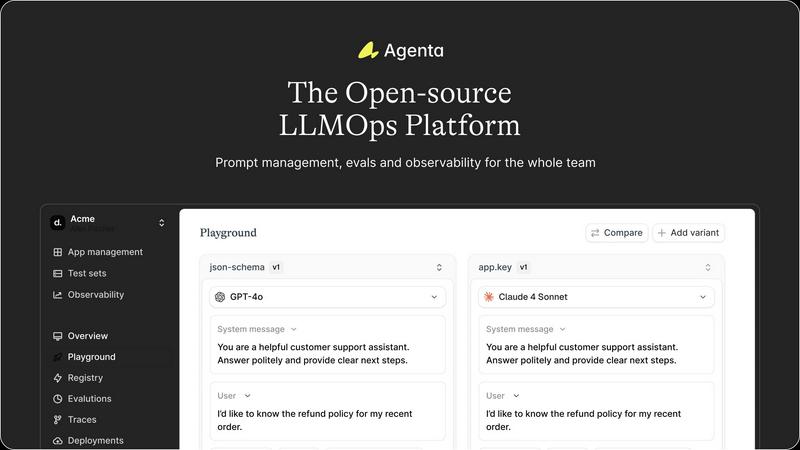
Agenta is an open-source platform that streamlines LLM development, enabling teams to collaborate and build reliable.
Last updated: March 1, 2026

diffray
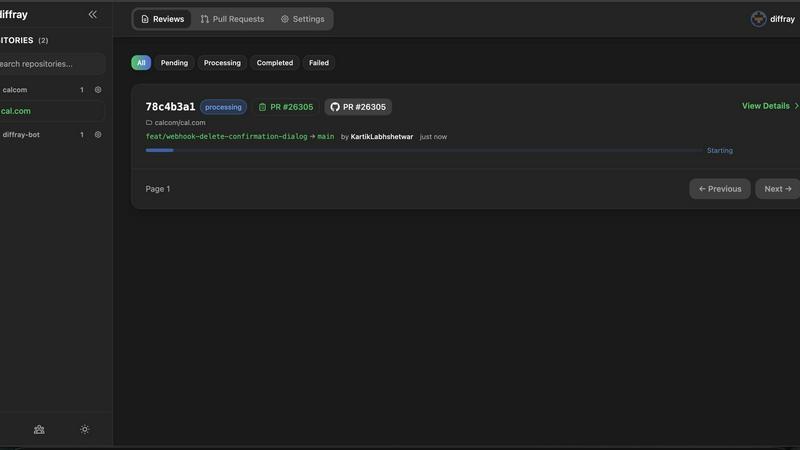
Diffray uses 30 specialized AI agents to catch real bugs in your code, not just nitpicks.
Last updated: February 28, 2026
Visual Comparison
Agenta
diffray
Feature Comparison
Agenta
Centralized Prompt Management
Agenta allows you to centralize all your prompts, evaluations, and traces in one platform. This eliminates the confusion of scattered files and improves accessibility for all team members, ensuring everyone is on the same page.
Automated Evaluations
With Agenta, you can create a systematic process to run experiments, track results, and validate every change made to your LLMs. This feature replaces guesswork with evidence by providing automated evaluations that help you understand what changes impact performance.
Unified Playground
The platform includes a unified playground where you can compare prompts and models side-by-side. This feature is invaluable for identifying the best-performing prompts and models, allowing for quick iterations and improvements.
Real-time Observability
Agenta provides tools for monitoring production systems and tracing every request. This feature allows you to gather user feedback efficiently, debug your AI systems, and detect regressions, ensuring a smoother user experience.
diffray
Multi-Agent Specialist Architecture
This is the core genius of diffray and what sets it lightyears apart. The platform employs over 30 distinct AI agents, each meticulously trained and optimized for a specific domain like security (OWASP Top 10, dependency vulnerabilities), performance (memory leaks, inefficient algorithms), concurrency (race conditions, deadlocks), and codebase consistency. This means a security expert agent scrutinizes your code for security flaws, while a separate performance expert analyzes for bottlenecks, leading to profoundly deeper and more accurate analysis than any single-model tool can achieve.
Full-Repository Context Awareness
diffray doesn't just look at the patch in isolation—a fatal flaw of simpler tools. It intelligently pulls in and understands the full context of your repository. Agents can analyze how new changes interact with existing architecture, spot deviations from established patterns, and identify breaks in consistency that would be invisible when looking at a diff alone. This context turns superficial comments into genuinely insightful guidance that understands your project's unique landscape.
Low-Noise, High-Signal Feedback
By leveraging its team of specialists, diffray virtually eliminates the plague of generic, low-value comments. The feedback it generates is concise, professional, and directly actionable. It prioritizes critical issues that matter, suppressing the trivial nitpicks that waste time. The output feels like it was written by a seasoned senior engineer who knows what's important, not a robot on a linting spree.
Integrated Workflow & Team Metrics
diffray seamlessly integrates into your existing GitHub or GitLab workflow, posting comments directly on pull requests. Beyond individual reviews, it provides teams with valuable analytics and metrics, highlighting common vulnerability patterns, tracking review time savings, and offering insights into code quality trends over time. This turns code review from a reactive gate into a strategic tool for continuous improvement.
Use Cases
Agenta
Collaborative Prompt Development
In teams where multiple stakeholders are involved, Agenta facilitates collaborative prompt development by providing a shared workspace. This enables product managers, developers, and domain experts to work together effectively, improving the quality of prompts.
Rigorous Evaluation Processes
Agenta is ideal for organizations that require rigorous evaluation processes. By automating evaluations and integrating domain expert feedback, teams can ensure that their LLMs meet high standards before deployment, reducing the risk of errors in production.
Debugging and Troubleshooting
When issues arise in production, Agenta’s observability tools help teams trace failures to their source. This capability allows for more efficient debugging, as you can pinpoint problems quickly and take corrective action.
Rapid Iteration of LLMs
For teams focused on rapid iteration, Agenta provides the tools necessary to test and compare various prompts and models in real-time. This accelerates the development cycle, allowing businesses to bring reliable AI features to market faster.
diffray
Accelerating Pull Request Throughput for Fast-Moving Teams
For development teams pushing multiple merges per day, the PR review bottleneck is real. diffray acts as a first-pass expert reviewer available 24/7, instantly surfacing critical issues and leaving detailed, context-aware comments. This allows human reviewers to focus on higher-level architecture and logic, dramatically speeding up the entire cycle and getting features to production faster without sacrificing quality.
Upskilling Junior Developers and Enforcing Standards
diffray serves as an always-available mentoring tool for junior developers. By providing immediate, expert feedback on security practices, performance implications, and code style, it helps them learn best practices in real-time. Simultaneously, it acts as an unbiased enforcer of team and organizational coding standards, ensuring consistency across the entire codebase as the team grows.
Proactive Security and Compliance Auditing
Security can't be an afterthought. diffray's dedicated security agents continuously scan every pull request for vulnerabilities, misconfigurations, and compliance violations against standards like OWASP. This embeds security directly into the developer workflow (Shifting Left), preventing costly security bugs from ever reaching production and making audit trails a natural byproduct of development.
Legacy Code Modernization and Refactoring
When tackling a large, legacy codebase, understanding the impact of changes is daunting. diffray's contextual analysis is invaluable here. It can help identify how new refactoring efforts might break existing patterns, pinpoint hidden technical debt related to performance or concurrency, and ensure that modernization efforts don't inadvertently introduce new classes of bugs, making large-scale refactors safer and more predictable.
Overview
About Agenta
Agenta is an open-source LLMOps platform designed as a comprehensive solution for teams developing large language model (LLM) applications. It addresses the chaos often associated with LLM development by centralizing disparate workflows into a structured and collaborative environment. With Agenta, developers, product managers, and domain experts can come together, enhancing communication and efficiency. The platform provides integrated tools for prompt management, evaluation, and observability, transforming the LLM development process into a systematic engineering discipline. By eliminating guesswork and silos, Agenta helps teams ship reliable AI features with confidence. If your organization has been struggling with the unpredictability of LLMs and disjointed workflows, Agenta offers the infrastructure needed to streamline development and foster collaboration.
About diffray
Let's be brutally honest: most AI code review tools are a massive disappointment. They promise intelligent automation but deliver a firehose of generic, low-value comments that bury the real issues in a soul-crushing avalanche of noise. You end up spending more time dismissing false positives than you save. diffray is the tool that finally breaks this cycle. It’s a revolutionary AI-powered code review platform built on a fundamentally smarter architecture. Instead of relying on a single, generalist AI model trying to be an expert at everything, diffray deploys a curated team of over 30 specialized AI agents. Think of it as having a dedicated, world-class expert for security vulnerabilities, another for performance bottlenecks, another for concurrency pitfalls, and so on. This multi-agent system conducts deep, contextual investigations into your pull requests, understanding the full scope of your repository, not just the isolated diff. The result is exactly what development teams desperately need: a dramatic reduction in false positives, a significantly higher catch rate for critical, actionable bugs, and clean, professional feedback that genuinely respects a developer's time. It transforms code review from a tedious, time-sucking chore into a genuine quality accelerator. Teams report slashing their average PR review time from 45 minutes to just 12. If you're tired of the noise and ready for signal, diffray is the only tool you should be considering.
Frequently Asked Questions
Agenta FAQ
What makes Agenta different from other LLM tools?
Agenta stands out by providing a comprehensive, open-source platform that centralizes workflows, enhances collaboration, and applies LLMOps best practices. This structured approach minimizes guesswork and maximizes reliability.
Is Agenta suitable for small teams?
Absolutely. Agenta is designed to cater to teams of all sizes, from small startups to large enterprises. Its collaborative features and centralized management make it particularly useful for teams looking to streamline their LLM development processes.
Can Agenta integrate with existing tools?
Yes, Agenta seamlessly integrates with various frameworks and models, including LangChain and OpenAI. This flexibility allows teams to leverage their existing tech stack while benefiting from Agenta's powerful features.
Is there a community for Agenta users?
Yes, Agenta boasts an active community where users can ask questions, share ideas, and collaborate on projects. Joining the community can help you get the most out of Agenta and connect with other AI builders.
diffray FAQ
How is diffray different from GitHub Copilot or other AI coding assistants?
This is a crucial distinction. Tools like Copilot are primarily generative—they help you write new code. diffray is analytical—it reviews and critiques code that has already been written. Think of Copilot as a pair programmer helping you type, while diffray is the meticulous senior engineer reviewing the final pull request. They serve complementary but entirely different purposes in the development lifecycle.
Does diffray replace human code reviewers?
Absolutely not, and it doesn't try to. diffray's goal is to augment human reviewers, not replace them. It automates the tedious, repetitive parts of review (catching common bugs, enforcing style, basic security checks) so your human team can dedicate their valuable cognitive bandwidth to complex logic, architecture, design patterns, and mentorship—the things AI still cannot do well.
What programming languages and frameworks does diffray support?
Based on its described multi-agent architecture focused on universal concepts like security, performance, and concurrency, diffray is built to support a wide range of popular languages and frameworks. While the specific list isn't detailed in the provided context, its value comes from analyzing fundamental code quality and vulnerability patterns that transcend any single language. You should check their official documentation for the most current and detailed list of supported technologies.
How does diffray handle the privacy and security of our source code?
For any serious development team, this is the first question. While specific details aren't in the provided snippet, a professional tool like diffray would typically offer options for cloud-based processing with strong encryption and data residency controls, as well as potentially self-hosted or on-premise deployments for organizations with strict compliance requirements. You must review their official security whitepaper and data processing agreement for guarantees.
Alternatives
Agenta Alternatives
Agenta is an open-source platform designed to help teams build and manage reliable LLM applications, serving as a mission control for LLMOps. It centralizes the chaotic process of developing AI features, enabling collaboration among developers, product managers, and domain experts. Users often seek alternatives to Agenta due to various factors such as pricing, specific feature sets, or compatibility with existing workflows and platforms. When choosing an alternative, it's important to consider the platform's ability to facilitate experimentation, provide robust evaluation tools, and support seamless collaboration across team members. Ensuring that the alternative aligns with your team's specific needs and workflows can make a significant difference in the development process.
diffray Alternatives
diffray is a specialized AI code review tool that stands apart in the crowded developer tools market. It belongs to the category of intelligent automation for pull requests, but its unique multi-agent architecture moves it beyond simple linting or generic AI suggestions. It’s for teams that want deep, contextual bug catching, not just surface-level nitpicks. Developers often search for alternatives for a few key reasons. Budget constraints or specific pricing models can be a factor, as can the need for integration with a particular tech stack or CI/CD platform. Some teams might prioritize a different feature balance, like extensive language support over deep specialization, or require a self-hosted solution for security compliance. When evaluating other options, look beyond the marketing hype. The core question is whether a tool reduces noise while catching critical issues. Prioritize solutions that understand your full codebase context, not just the diff. True value comes from actionable feedback that saves engineering time, not from generating an overwhelming volume of low-priority comments.