Dreamflow vs Miget
Side-by-side comparison to help you choose the right tool.

Dreamflow
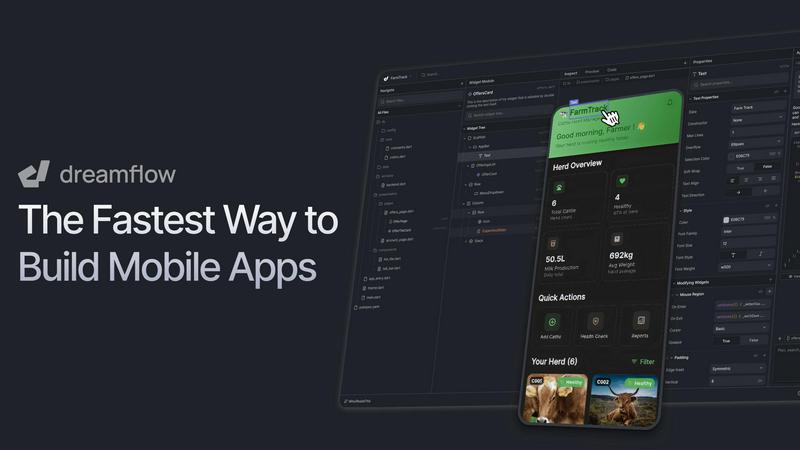
Dreamflow is an AI-powered visual builder that transforms your app ideas into responsive, production-ready applications.
Last updated: March 1, 2026

Miget
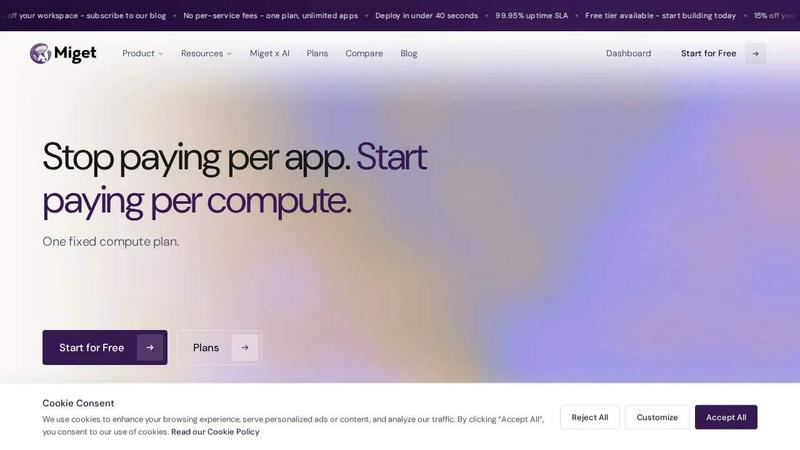
Miget is the only platform where one flat compute plan lets you deploy unlimited apps and services without per-component fees.
Last updated: April 13, 2026
Visual Comparison
Dreamflow
Miget
Feature Comparison
Dreamflow
Tri-Surface Editing
Dreamflow's tri-surface editing allows users to switch effortlessly between AI prompts, a visual design canvas, and full Flutter code. This seamless integration ensures that any changes made in one area are instantly reflected across all surfaces, promoting an efficient and fluid development workflow.
AI-Powered Generation
With context-aware generation, Dreamflow employs intelligent AI that understands user needs and best practices. This feature helps scaffold app features accurately and efficiently, allowing users to focus on creativity and innovation without getting bogged down in technicalities.
Cross-Platform Development
Dreamflow empowers users to build robust and responsive applications that adapt seamlessly to various device sizes. Utilizing the power of Flutter, users can deploy their apps to the App Store, Play Store, and the web with just a few clicks, simplifying the launch process.
Backend Integrations
The platform comes with built-in integrations for popular backend services like Firebase and Supabase. This capability allows users to create full-stack applications from the ground up, ensuring scalability and efficiency from day one.
Miget
Unlimited Services Per Plan
This is the cornerstone of Miget's value proposition. Once you choose a compute plan, the number of apps, databases, and background workers you deploy inside it is unlimited. There are no line-item charges for adding a Redis instance or spinning up a new microservice. This eliminates billing surprises and empowers developers to build and experiment freely, transforming infrastructure from a cost center into a predictable, fixed resource you can fully utilize.
GitHub-Native Deployments & Preview Apps
Miget deeply integrates with your GitHub workflow. Simply connect your repository, and every push to a branch triggers an automatic build and deployment. More impressively, every pull request automatically generates a full-stack preview environment with its own unique URL, complete with cloned data and services. This allows for real-world testing and stakeholder reviews without touching production, all handled with zero manual CI/CD configuration.
Managed Databases Within Compute
Unlike other platforms that charge separately for data services, Miget includes managed databases like PostgreSQL, MySQL, and Valkey (Redis-compatible) as part of your compute allocation. You can provision and scale them without incurring additional fees, making it a true all-in-one platform. This simplifies architecture and budgeting, as your database costs are capped and predictable from the start.
Full-Stack Cloning & Instant Redeploys
Miget understands the need for speed and accurate testing. With one click, you can clone an entire application environment—including its code, database schema, and data. This is perfect for creating staging areas or debugging in isolation. Coupled with intelligent build caches (Migetpacks) that auto-detect your stack, this feature enables redeploys in under 40 seconds, dramatically improving developer velocity.
Use Cases
Dreamflow
Rapid Prototyping
Entrepreneurs can leverage Dreamflow to quickly turn their app ideas into functional prototypes. With the platform's AI-driven features and intuitive design tools, users can iterate on their concepts in real-time, significantly reducing the time to market.
MVP Development
Startups looking to validate their business ideas can utilize Dreamflow to build Minimum Viable Products (MVPs) efficiently. By using the tri-surface editing, they can refine their applications based on user feedback, making adjustments swiftly before a full-scale launch.
App Enhancements
Existing applications can benefit from Dreamflow's features, allowing developers to enhance functionality or redesign aspects of their apps without starting from scratch. The platform's integration capabilities make it easier to incorporate new backend services and features.
Collaborative Projects
Teams can use Dreamflow for collaborative app development, where multiple users can work together in real-time, making it ideal for remote teams. The synchronization across AI, design, and code ensures that all team members are on the same page, fostering better communication and project management.
Miget
The Indie Hacker & Side Project Builder
For solo developers bootstrapping a product, predictable cost is everything. Miget's fixed pricing allows an indie hacker to deploy their web app, a PostgreSQL database, a Redis cache, and several background workers for processing jobs—all on a single, affordable plan. They can launch fast, iterate constantly, and never worry about a surprise $50 charge for adding a new service.
The Growing Startup & Microservices Architecture
As a startup scales, its application often evolves into a suite of microservices and APIs. On a traditional PaaS, this quickly becomes prohibitively expensive. Miget allows a growing team to containerize and deploy numerous services, each with their own databases, all within a single compute budget. Features like team roles, audit logs, and per-PR previews support collaborative development at scale.
AI App Developers & Prototypers
Developers building with AI often need to rapidly spin up endpoints, model backends, and vector databases to test new ideas. Miget's model encourages this experimentation. With tools like skills.md for one-click infrastructure setup and the ability to deploy from prompts, builders can go from concept to a shareable preview URL in minutes, without cost anxiety holding them back.
Enterprise Teams Seeking Cost Control & Flexibility
Larger organizations can use Miget to gain predictable billing for internal tools, developer platforms, and specific product lines. The ability to bring your own cloud (BYOC) or bare metal, combined with Helm charts and Terraform support, provides the governance and control enterprises require, while still benefiting from the simplified, cost-predictable PaaS experience.
Overview
About Dreamflow
Dreamflow is a revolutionary platform designed to simplify mobile app development for developers and creators alike, enabling them to create applications with minimal hassle. It caters to a diverse audience, from solo entrepreneurs to large enterprises, providing powerful tools that facilitate the creation of production-ready mobile applications ready for deployment across various platforms. The standout feature of Dreamflow is its innovative tri-surface editing capability, which synchronizes AI prompts, a visual design canvas, and full Flutter code. This unique approach allows users to brainstorm ideas using AI, refine them through an intuitive drag-and-drop interface, and ultimately fine-tune the code for complete control over the final product. Dreamflow streamlines the app development process, ensuring flexibility, scalability, and full ownership, whether for launching a new startup or enhancing existing applications.
About Miget
Miget is a revolutionary Platform-as-a-Service (PaaS) that fundamentally changes how developers pay for and manage their cloud infrastructure. If you're tired of watching your monthly bill balloon with every new app, database, or background worker you add, Miget is your answer. The core philosophy is brilliantly simple: stop paying per service and start paying per compute. You select a fixed compute plan with a predictable cost, and then you can deploy an unlimited number of applications, managed databases (like PostgreSQL and Redis), and workers within that reserved capacity. This model is a direct challenge to traditional PaaS providers whose per-component pricing can stifle experimentation and turn infrastructure into a constant budgeting headache. Built on robust, isolated Kubernetes, Miget offers a full-stack, production-ready experience with zero-config builds from Git, automatic TLS for custom domains, and features like preview apps for every pull request. It's designed for everyone from indie hackers launching their first side project to growing engineering teams scaling a microservices architecture, all united by the desire for simplicity, predictability, and control over their cloud spend.
Frequently Asked Questions
Dreamflow FAQ
What types of applications can I build with Dreamflow?
Dreamflow is versatile and allows you to create a wide range of mobile applications, from simple personal projects to complex enterprise solutions. The platform's flexibility supports various use cases, making it suitable for almost any app idea.
Is Dreamflow suitable for beginners?
Absolutely! Dreamflow is designed with user-friendliness in mind. Its AI-powered features and visual design tools make it accessible even for those with little to no coding experience, empowering beginners to create quality applications.
Can I export my projects from Dreamflow?
Yes, Dreamflow allows users to export their full Flutter projects. This feature ensures that developers have full control over their code and can make further customizations as needed outside the platform.
What support options are available for Dreamflow users?
Dreamflow provides various support resources, including documentation, video tutorials, and a community forum. Additionally, enterprise users can access dedicated support and onboarding engagement to ensure a smooth development experience.
Miget FAQ
How does the pricing work if services are unlimited?
You pay only for the compute plan you select (e.g., a plan with 2 vCPUs and 4GB RAM). This reserves a pool of resources. You can then deploy as many containerized applications, databases, and workers as you want into that pool, sharing the total CPU and memory. Your bill is fixed; it only increases if you upgrade to a larger compute plan for more resources.
What happens if I exceed my plan's compute resources?
Miget is designed for intelligent resource sharing. If your total usage approaches the limits of your plan, you will need to optimize your services or upgrade to a larger plan. The platform provides monitoring to help you track usage. Crucially, you are billed for your reservation, not for bursting, which keeps costs predictable.
Is there a free tier?
Yes, Miget offers a free tier to start building. This allows you to experience the platform, deploy applications, and use managed services within the resource constraints of the free plan. It's an excellent way to test the deployment workflow, preview app feature, and see if the model fits your development style before committing financially.
How is isolation and security handled between customers?
Miget is built on Kubernetes with full isolation between tenants. Each customer's workloads run in isolated environments. The platform also offers features like automatic TLS/SSL, private networking options, and for enterprise plans, the ability to deploy into your own cloud account (BYOC), ensuring your infrastructure meets your security and compliance requirements.
Alternatives
Dreamflow Alternatives
Dreamflow is a cutting-edge visual AI builder that seamlessly integrates design and code, enabling users to develop mobile applications effortlessly across a multitude of devices. As a versatile platform, it caters to a diverse audience, from independent entrepreneurs to large enterprises, by providing the necessary tools to create production-ready apps without the complexities of traditional development methods. However, users often seek alternatives to Dreamflow for various reasons, including pricing concerns, specific feature requirements, or compatibility with different platforms. When exploring alternatives, it's crucial to consider factors such as ease of use, flexibility in design and coding, deployment capabilities, and the level of support offered. Finding a platform that aligns with your unique development needs can significantly enhance your app-building experience.
Miget Alternatives
Miget is a modern, flat-rate PaaS platform that rethinks how developers pay for hosting. Instead of billing per app or database, it offers a single compute plan where you can run unlimited services. This places it in a growing category of developer-centric platforms focused on simplicity and predictable costs. People often look beyond Miget for a few key reasons. Some need a free tier for initial experiments, while others require very specific runtimes or deeper cloud integrations. The search usually boils down to balancing cost predictability against the flexibility of a traditional, pay-as-you-go model. When evaluating alternatives, focus on your core needs. Consider your budget's tolerance for variable costs versus the appeal of a fixed monthly fee. Also, weigh the importance of built-in managed services versus the ability to bring your own tools. The right choice aligns with both your project's technical demands and your financial comfort zone.