Dividend Data vs echoloc
Side-by-side comparison to help you choose the right tool.

Dividend Data
Stop copying stock data manually and instantly pull dividends, prices, and financials directly into your spreadsheets.
Last updated: March 11, 2026

Echoloc transforms job posts into actionable buying signals, helping sales teams pinpoint high-intent accounts.
Last updated: February 28, 2026
Visual Comparison
Dividend Data
echoloc
Feature Comparison
Dividend Data
Extensive Spreadsheet Functions
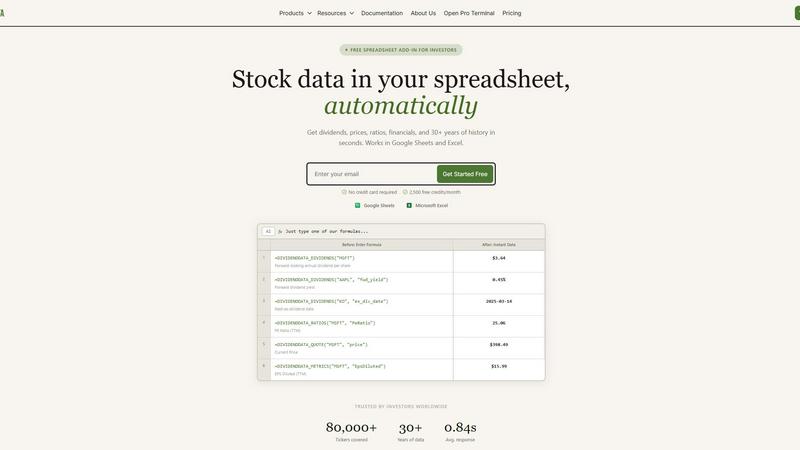
Dividend Data provides 16 custom, intuitive functions that cover virtually every data point a serious investor needs. From DIVIDENDDATA_DIVIDENDS to pull yield and payment dates, to DIVIDENDDATA_RATIOS for PE and debt ratios, and DIVIDENDDATA_METRICS for deep financials like EPS. These formulas act as direct conduits, turning your spreadsheet cells into live data feeds without any coding or complex setup required.
Deep Historical & Fundamental Data
The platform isn't just about today's price. It offers a profound depth of data, including over 30 years of historical price and dividend information. This allows for robust back-testing, long-term trend analysis, and calculating compound growth rates. You get access to complete financial statements, enabling full fundamental analysis on everything from revenue to free cash flow, all within your existing workflow.
Seamless Dual-Platform Integration
A major practical advantage is its native integration with both Google Sheets and Microsoft Excel. Whether your team uses the cloud-based collaboration of Sheets or the advanced power of desktop Excel, Dividend Data works flawlessly. The add-ins are officially listed on the Google Workspace and Microsoft AppSource marketplaces, ensuring security, easy installation, and automatic updates.
AI-Powered Research Assistant
Beyond spreadsheets, the Dividend Data Terminal web app includes a standout feature: the AI Analyst. This is like having a tireless research assistant. You can chat with it to get summaries of company performance, ask for comparisons between stocks, or request explanations of specific financial metrics, significantly speeding up the initial research and due diligence process.
echoloc
Real-Time Job Analysis
Echoloc analyzes over 10 million job postings to uncover actionable insights about companies' hiring trends and intentions. This feature keeps sales professionals updated with real-time information, allowing them to act swiftly on emerging opportunities.
Evidence-Based Matching
Every result generated by Echoloc includes snippets from job postings, providing transparency and eliminating guesswork. This feature ensures users have concrete evidence of hiring signals, making it easier to craft informed outreach strategies.
Searchable Hiring Signals
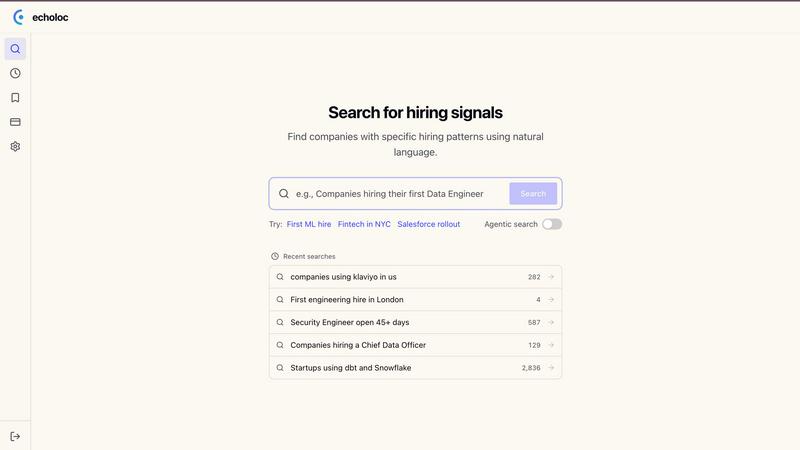
With a user-friendly search functionality, Echoloc allows users to find specific hiring signals by simply typing in their queries in plain English. This intuitive design makes it accessible for sales professionals without the need for complex filters.
Comprehensive Industry Tracking
Echoloc tracks over 30 million companies across various industries, giving users a broad perspective on market trends. This extensive coverage ensures that sales teams can identify potential leads across different verticals, enhancing their overall targeting strategy.
Use Cases
Dividend Data
Building a Dynamic Dividend Dashboard
Create a master portfolio tracker that automatically updates. List your holdings in one column, and use Dividend Data formulas in adjacent columns to pull live data on current price, dividend yield, annual income, and ex-dividend dates. This creates a real-time view of your income stream and portfolio health that refreshes with a simple sheet recalculation.
Screening for Dividend Growth Stocks
Quickly build a custom stock screener directly in Excel or Sheets. Combine Dividend Data functions with native spreadsheet filters to scan for companies meeting specific criteria, such as a dividend yield above 3%, a payout ratio below 60%, and 10+ years of consecutive dividend growth. This turns your spreadsheet into a powerful discovery engine.
Conducting Deep Fundamental Analysis
When researching a single company, use the various functions to pull a complete set of financials into a structured model. Analyze trends in revenue, net income, debt-to-equity, and free cash flow over multiple years. This centralized approach is far more efficient than juggling multiple PDF reports or browser tabs.
Automated Financial Modeling
For investors who build discounted cash flow (DCF) or dividend discount models (DDM), Dividend Data automates the data input stage. Formulas can pull historical EPS growth, current dividend rates, and other vital inputs directly into your model's assumptions, ensuring your valuations are always based on the latest available data.
echoloc
Identifying Growth Opportunities
Sales teams can use Echoloc to pinpoint companies that are hiring key positions, such as data engineers or sales executives, indicating they are likely to invest in new technology. This insight allows for timely outreach to businesses in growth phases.
Targeting New Market Entrants
Echoloc can help identify startups or companies launching new products by analyzing job postings for critical roles. This allows sales professionals to engage with these companies early, positioning their offerings as solutions to upcoming challenges.
Enhancing Competitive Intelligence
By monitoring job postings of competitors, sales teams can gain insights into market movements and strategies. This feature enables them to adjust their outreach and positioning based on competitor hiring trends.
Improving Sales Forecasting
Echoloc's real-time data can aid in predicting sales cycles by providing insights into when companies are likely to make purchasing decisions. This predictive capability allows sales teams to better manage their pipelines and forecast revenue more accurately.
Overview
About Dividend Data
Dividend Data is a game-changer for any investor who lives in spreadsheets. Forget about clunky APIs, expensive data terminals, or the soul-crushing tedium of manual copy-pasting from financial websites. This tool brings institutional-grade stock market data directly into your native environment: Google Sheets and Microsoft Excel. With over 30 years of historical data for more than 80,000 tickers, it transforms your spreadsheet into a powerful, live-updating research terminal. The magic lies in its simplicity—you just type a plain-English custom formula like =DIVIDENDDATA_DIVIDENDS("MSFT"), and instantly, the forward annual dividend, yield, or the next ex-date appears. Built by a dividend investor for dividend investors, its core focus is on the metrics that matter most for fundamental and income-focused analysis: dividends, payout ratios, growth rates, full financial statements, and key valuation ratios. What truly sets it apart is its generous, no-strings-attached free tier offering 2,500 monthly credits that never expire, making professional-grade data accessible to everyone. This is the tool for the self-directed investor who demands depth, reliability, and efficiency without the institutional price tag.
About echoloc
Echoloc is an innovative platform that redefines how sales professionals discover and connect with potential buyers. By leveraging job postings as valuable data points, Echoloc reveals hidden buying signals that indicate a company's readiness to invest in new technologies and services. This capability is especially beneficial for sales development representatives (SDRs), account executives (AEs), and revenue teams, allowing them to identify opportunities before they become apparent in traditional intent data. For example, if a company is hiring its first data engineer, it signals growth and a likelihood of increased spending. Echoloc empowers sales teams with actionable insights derived from real-time job descriptions, ensuring outreach is timely and targeted. This strategic advantage not only enhances lead generation but also keeps teams ahead of competitors by catching buyer intent early on.
Frequently Asked Questions
Dividend Data FAQ
Is there really a free plan that doesn't expire?
Yes, absolutely. This is one of Dividend Data's most user-friendly policies. The free plan offers 2,500 credits per month, and it does not expire or require a credit card to start. You can use it indefinitely for light to moderate analysis, which is perfect for tracking a personal portfolio or researching a handful of stocks each month.
How do the credits work?
Each cell you populate with a Dividend Data formula consumes one credit, regardless of the amount of historical data that function returns. For example, =DIVIDENDDATA_DIVIDENDS("AAPL", "fwd_yield") uses one credit to fetch that single data point. The 2,500 free credits reset monthly, providing a substantial amount of data for individual investors.
What's the difference between the Spreadsheet Add-in and the PRO Terminal?
The Spreadsheet Add-in is for getting data directly into Excel or Google Sheets. The PRO Terminal is a separate, powerful web application with advanced data visualizations, the AI Analyst chat feature, and automated portfolio tracking with linked broker accounts. They are complementary products; many users start with the spreadsheet tool and graduate to the Terminal for enhanced research.
How current is the data provided?
The data is highly current, with key metrics like stock prices updating near real-time. Fundamental data like earnings and financial statements are updated shortly after companies report, typically aligning with standard financial data providers. The average response time for a data pull is a swift 0.84 seconds.
echoloc FAQ
How does echoloc identify buyer intent?
Echoloc analyzes job postings to extract hiring signals that suggest a company's readiness to invest in new technologies or services. By focusing on specific roles and hiring trends, it reveals when companies are likely to spend.
Can I customize my searches in echoloc?
Yes, Echoloc allows users to perform searches in plain English, making it easy to find specific hiring signals without needing complex filters. This user-friendly design is aimed at enhancing accessibility for sales professionals.
What types of companies does echoloc track?
Echoloc tracks a wide range of companies across various industries, with over 30 million entities in its database. This extensive coverage ensures that users can identify potential leads in multiple sectors and markets.
Is there a demo available for echoloc?
Yes, Echoloc offers a demo for potential users to explore its features and functionalities. This allows sales teams to understand how the platform can enhance their lead generation and sales strategies before committing.
Alternatives
Dividend Data Alternatives
Dividend Data is a specialized tool for investors, bringing decades of stock market data directly into spreadsheets. It falls into the category of financial data add-ons, designed specifically for those analyzing dividends and company fundamentals without needing to code. Users often look for alternatives for a few key reasons. Pricing is a major factor, as some services can be prohibitively expensive. Others might need different features, like real-time data or broader market coverage, or they may require a solution that works exclusively on one platform like Excel or through a dedicated API. When evaluating other options, focus on your core needs. Consider the depth and history of the dividend data, the total cost relative to your usage, and how seamlessly it integrates with your existing workflow in Sheets or Excel. The best tool is the one that delivers the specific metrics you need without complexity or hidden fees.
echoloc Alternatives
Echoloc is a groundbreaking platform within the business and finance category, specifically tailored for sales professionals. It uniquely identifies buying signals in job postings, enabling teams to target accounts that are on the verge of making purchases. Users often seek alternatives to Echoloc for various reasons, including pricing concerns, a desire for different features, or compatibility with their existing platforms. When selecting an alternative, it's crucial to consider functionality, ease of use, and the quality of insights provided, ensuring the choice aligns with your team's specific sales strategies.