Gaffa vs Playwriter
Side-by-side comparison to help you choose the right tool.

Gaffa is my top pick for effortlessly scraping and automating data with real browsers.
Last updated: March 1, 2026

Playwriter
Playwriter lets AI agents control your real Chrome browser with all your logins and extensions intact.
Last updated: March 18, 2026
Visual Comparison
Gaffa
Playwriter

Feature Comparison
Gaffa
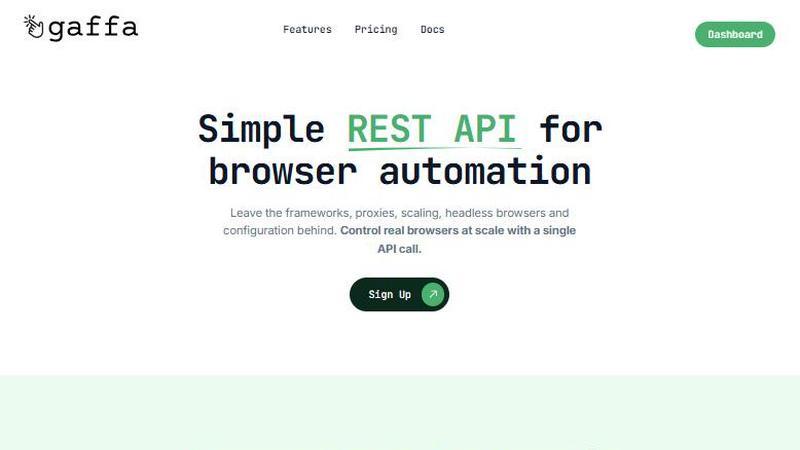
Simple REST API
This is the heart of Gaffa's genius. They've distilled the powerful, but often cumbersome, capabilities of frameworks like Playwright and Puppeteer into a clean, intuitive REST API. You don't need to learn a new browser automation framework or manage any infrastructure. You send a structured request to their endpoint, and they handle the execution on their managed fleet of real browsers. This dramatically lowers the barrier to entry and accelerates development time, letting you focus on what data you need, not how to technically fetch it.
Real Browser Automation & JavaScript Rendering
Gaffa doesn't cut corners with simple HTTP requests that fail on modern, dynamic websites. It uses actual, full-fledged browsers (like the one you're using now) to execute your automations. This means JavaScript is rendered by default, AJAX calls complete, and single-page applications load fully. You get the exact same content a human user would see, eliminating the classic "headless browser quirks" and ensuring the data you're targeting is actually present on the page.
Managed Proxies & Global Scaling
They've seamlessly integrated a network of residential proxies into their service. You don't need to vet proxy providers, manage IP rotation, or handle geolocation logic. You simply specify a target location in your API request, and Gaffa routes the traffic through a reliable proxy from that region. Furthermore, their infrastructure is built to scale elastically. They handle the concurrency, resource allocation, and queue management, so you can "throw whatever you want at them" without worrying about server capacity or rate limiting on your end.
Built-in Data Processing & Full Observability
Gaffa goes beyond just fetching raw HTML. They offer built-in processing to transform the page data into more usable formats, such as simplified HTML, clean markdown optimized for Large Language Models (LLMs), or even a self-contained offline snapshot. Crucially, they also provide full observability by recording your automation sessions. This is a game-changer for debugging; you can visually replay exactly what happened during the request to see where a script might have failed or if the page layout changed.
Playwriter
Your Actual Browser Session
This is the killer feature. Instead of spawning a fresh, suspicious Chrome instance, Playwriter attaches directly to your existing browser via a Chrome extension. Your agent operates in an environment with all your personal logins, saved cookies, installed extensions (like ad-blockers or password managers), and even your existing tabs. This eliminates bot detection triggers from "new" browser fingerprints and avoids the memory overhead of running a second Chrome process. It’s the difference between sending a stranger to do your online shopping versus giving your trusted friend your laptop.
Full Playwright API via a Single Tool
Forget menus of dozens of limited, pre-wrapped tools like "click_button" or "extract_text." Playwriter exposes one powerful execute command that accepts any valid Playwright code. This means your AI agent can use the entire, mature Playwright API for complex interactions: waiting for specific network responses, setting JavaScript breakpoints, manipulating localStorage, or taking efficient accessibility snapshots. This approach drastically reduces context window usage and provides maximum flexibility, trusting the developer or AI to write precise instructions.
Built-in Debugger & Live Editor
Playwriter transforms your browser into a debuggable runtime for AI agents. You can set breakpoints in the agent's Playwright script, pause execution, and inspect the state of the page. The live code editing feature allows you to modify the agent's commands on-the-fly without restarting the entire session. This is invaluable for troubleshooting, refining scripts, or when the agent gets stuck on an unexpected UI element. It brings a developer-grade workflow to AI-powered automation.
Lightweight Accessibility Snapshots
Traditional full-page screenshots are context hogs, often exceeding 100KB. Playwriter's accessibility snapshots are a game-changer, typically weighing only 5-20KB. They capture the semantic structure of the page—roles, names, states, and relationships—which is exactly what an AI agent needs to understand the page layout and interact with elements. This makes agent interactions faster, more accurate, and far cheaper in terms of token usage compared to processing large image files.
Use Cases
Gaffa
Large-Scale Competitive Intelligence & Price Monitoring
For e-commerce businesses or market analysts, manually tracking competitor prices and product catalogs is impossible. Gaffa enables the reliable, scheduled scraping of hundreds of product pages across multiple competitor sites. Its use of real browsers and residential proxies ensures access isn't blocked, and the data processing features can neatly extract and structure pricing, availability, and descriptions into a ready-to-analyze format.
Automated Lead Generation & Data Enrichment
Sales and marketing teams can use Gaffa to automate the collection of public contact information, company details, and news from websites, LinkedIn, and business directories. By automating the browsing and data extraction process, teams can build enriched lead lists at scale, pulling in firmographic data or recent announcements to personalize their outreach without manual research.
Archiving Web Content & Compliance Screenshots
Organizations often need to reliably archive web content for legal compliance, record-keeping, or historical reference. Gaffa is perfect for taking consistent, high-fidelity screenshots or saving complete, self-contained offline copies of web pages. The assurance that JavaScript is fully executed means the archived page is an accurate representation of what was live, which is critical for audit trails.
Feeding LLMs & AI Models with Fresh Web Data
AI and machine learning projects frequently need large, current datasets from the web. Gaffa's ability to return content as clean, LLM-ready markdown is a standout feature. Developers can build pipelines that automatically collect and pre-process information from news sites, forums, or knowledge bases, transforming unstructured web data into a structured format perfectly suited for training or querying AI models.
Playwriter
AI-Assisted Web Research & Data Extraction
Need to compile a report from multiple sources that require login? Instruct your AI agent to navigate your logged-in news subscriptions, academic journals, or business intelligence platforms. It can click through pagination, handle consent modals with your guidance, and extract structured data—all within your authenticated session, avoiding paywalls and login barriers that stop other automation tools cold.
Automated Testing with Real User Context
Developers can use Playwriter to create and run integration tests that mimic real user journeys. Since it uses your actual browser profile, tests can run against staging environments that require specific authentication cookies or against complex workflows that depend on browser extensions. This provides a more accurate testing environment than isolated, clean browser instances.
Routine Administrative Task Automation
Automate the tedious, repetitive web tasks that clutter your day. This could be filling out recurring forms, checking statuses on multiple dashboards, downloading daily reports from a web portal, or managing content across platforms like Shopify or WordPress. Your AI handles the routine clicks and inputs, and you simply supervise or step in for exceptions like CAPTCHAs.
Collaborative Browsing & Pair Programming
This is where Playwriter shines as a collaboration tool. You can watch the AI navigate in real-time on your screen. When it encounters a hurdle—a tricky multi-factor authentication step, an ambiguous "I'm not a robot" checkbox, or a novel UI—you can immediately intervene. Disable the extension on that tab, solve the human-required problem manually, re-enable control, and let the AI continue. It's true human-AI teamwork.
Overview
About Gaffa
If you've ever tried to build a serious web scraping or automation pipeline, you know the soul-crushing reality: it's a full-time job of fighting bot detection, managing headless browsers, and rotating proxies. Gaffa is the elegant antidote to this infrastructure madness. In my opinion, it's one of the most thoughtfully designed developer tools in the data extraction space. Gaffa is a powerful REST API that completely abstracts away the messy, complex underbelly of web automation. Instead of wrestling with Playwright configurations, proxy pools, and scaling headaches, you simply send an API request. Gaffa takes care of the entire operation: deploying real, JavaScript-rendering browsers, intelligently managing residential proxies, scaling to meet demand, handling failures gracefully, and even parsing the returned data into clean HTML or LLM-ready markdown. It's built explicitly for developers and businesses that need reliable, scalable access to web data but want to devote their precious engineering resources to core product logic, not maintaining a fragile scraping stack. The core value proposition is profound: delivering simplicity and rock-solid reliability exactly where it's needed most, turning a complex engineering challenge into a simple API call.
About Playwriter
Let's be brutally honest: most AI browser automation tools are a pain. They either lock your agent in a sterile, cookie-less sandbox that gets flagged as a bot instantly, or they give it a clunky, limited set of pre-defined "tools" that can't handle real-world web complexity. Playwriter is the antidote. It's a Chrome extension and CLI that hands the full power of the Playwright automation API directly to your AI agent, but with one critical twist: it runs inside your actual, logged-in browser session. This means your AI can navigate the web with all your extensions, cookies, and saved logins already in place, bypassing the instant detection that plagues headless instances. It's like giving your AI a driver's license for your personal browser. Built as an open-source MCP (Model Context Protocol) server, it integrates seamlessly with clients like Cursor, Claude Desktop, and VS Code. The philosophy is powerful yet simple: one single execute tool that can run any Playwright code, eliminating schema bloat and giving developers and AI agents unprecedented, granular control over the browsing experience. This isn't just automation; it's a collaborative browsing session where the AI handles the tedious work, and you step in as the human-in-the-loop when needed.
Frequently Asked Questions
Gaffa FAQ
What is a credit and how is it calculated?
Credits are Gaffa's unit of consumption for its API. You are billed credits based on two primary factors: request time and proxy bandwidth. Browser runtime is charged at 1 credit per 30 seconds (or 2 credits per 30 seconds if screen recording is enabled). Additionally, any request that uses a residential proxy (by specifying a proxy_location) consumes 1500 credits per 1GB of bandwidth used. Each successful request deducts the corresponding credits from your monthly plan allowance.
Does Gaffa offer a free trial?
Yes, absolutely. You can sign up for a free account and immediately begin using the full Gaffa API to build and test automations. The key point is that the free tier allows you to run your automations exclusively on Gaffa's dedicated demo site (demo.gaffa.dev). This lets you experiment with all features, understand the API response format, and build your scripts without any cost before upgrading to a paid plan to run on the open web.
What is your refund policy?
Gaffa offers a straightforward refund policy. If you request a refund before using any credits within your current billing cycle (month), they will be happy to issue one. This policy is designed to be fair and low-risk for new users who may find the service isn't a fit shortly after subscribing, provided they haven't consumed resources.
Do unused credits roll over to the next month?
No, credits do not roll over. The credit allowances included in your monthly subscription plan (Starter, Startup, Growth) are reset at the start of each new billing cycle. Any credits you do not use by the end of the month are forfeited. This is a common model in utility-based APIs and encourages efficient planning of your automation workloads.
Playwriter FAQ
Is my browsing data sent to a remote server?
Absolutely not. Playwriter is designed with privacy first. The architecture is local: the Chrome extension connects to a WebSocket relay running on localhost:19988 on your own machine. Your AI client (CLI, MCP) also connects to this local relay. All commands and data (CDP traffic) flow directly between your browser and your local client. No data is sent to any remote server, and no account is required.
How does it avoid bot detection?
It avoids the classic red flags of automation. Because it uses your existing, long-lived Chrome session with a normal history of use, cookies, and extensions, it presents a browser fingerprint that looks entirely human. Websites see it as you browsing, not a fresh, sterile automation environment. The extension uses the official chrome.debugger API, which is a supported method for development tools.
Can I use it with any AI or just specific clients?
Playwriter is built on the open Model Context Protocol (MCP), making it client-agnostic. It works seamlessly with any MCP-compliant client. This includes popular AI-powered editors like Cursor and Windsurf, desktop agents like Claude Desktop, and code editors like VS Code with an MCP plugin. The provided CLI also lets you drive it directly from your terminal or your own scripts.
What happens if the AI gets stuck or makes a mistake?
You have full control. You can see every action happening live in your browser. If the agent enters a loop or starts clicking the wrong thing, you can instantly click the extension icon to detach it (turning it gray) and regain manual control of the tab. After you fix the state of the page, re-attach the extension, and the agent can pick up from there. The built-in debugger also allows you to pause and step through the agent's commands.
Alternatives
Gaffa Alternatives
Gaffa is a powerful web automation and data extraction API designed for developers. It falls squarely into the productivity and management category, as it saves teams from the immense engineering overhead of building and maintaining their own scraping infrastructure. By handling real browsers, proxies, and CAPTCHAs through a simple REST API, it lets you focus on using data, not fighting to collect it. Users often look for alternatives for a few key reasons. Pricing is a major factor, as needs can range from small personal projects to massive enterprise-scale operations. Some may require specific features Gaffa lacks, like a local SDK or integration with a particular tech stack, while others might be on a different platform like Python instead of Node.js. When evaluating alternatives, prioritize reliability against modern bot detection above all. Look for solutions that use real browsers and quality residential proxies. Consider the developer experience: is the API or SDK intuitive? Finally, assess the total cost of ownership, factoring in not just subscription fees but also the engineering time you'll save or spend on maintenance.
Playwriter Alternatives
Playwriter is an open-source tool in the browser automation category, designed to give AI agents control over your actual, logged-in Chrome session. This solves the common problem where agents operate in a sterile, fresh browser with no extensions, logins, or context, making real-world tasks impossible. People look for alternatives for various reasons. Some need a different pricing model, like a fully hosted service versus self-hosted software. Others require specific features Playwriter may lack, or they need compatibility with a different browser or automation framework beyond the Model Context Protocol (MCP). When evaluating options, consider the core problem you need to solve. The key is whether the tool provides access to a persistent, authenticated browser session with your extensions and data. Also, assess if it offers the necessary control features, like debugging or network interception, and check its compatibility with your existing AI agent workflow and security requirements.