Gaffa vs TrafficClaw
Side-by-side comparison to help you choose the right tool.

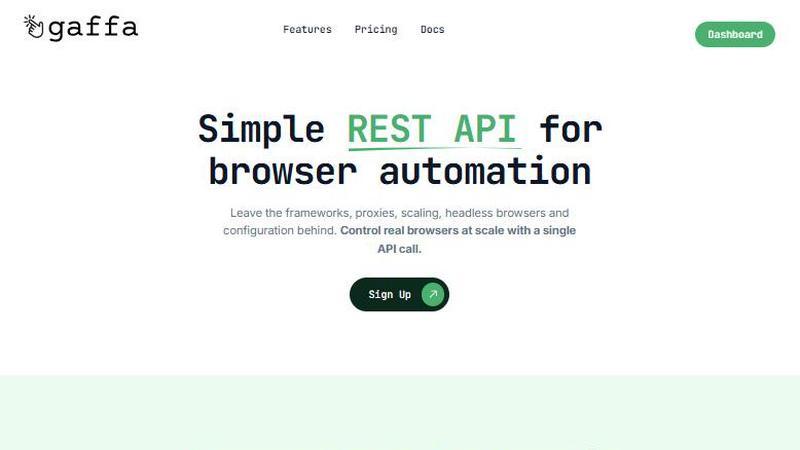
Gaffa is my top pick for effortlessly scraping and automating data with real browsers.
Last updated: March 1, 2026

TrafficClaw
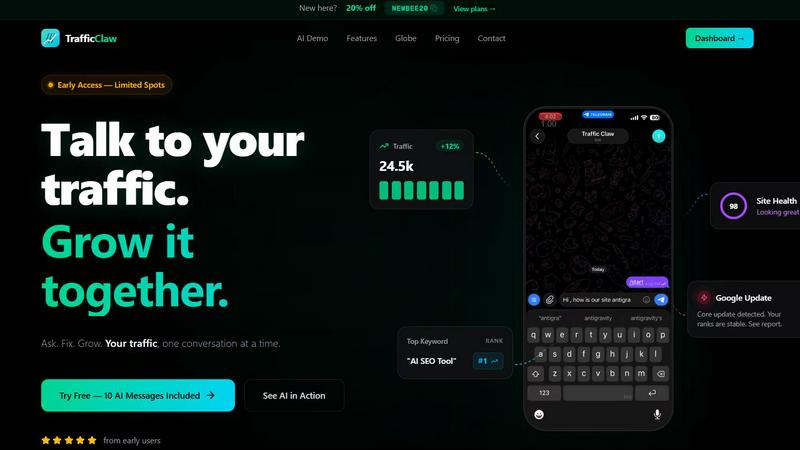
TrafficClaw is an AI analyst that talks to your SEO data to deliver actionable growth insights, not generic advice.
Last updated: April 13, 2026
Visual Comparison
Gaffa
TrafficClaw
Feature Comparison
Gaffa
Simple REST API
This is the heart of Gaffa's genius. They've distilled the powerful, but often cumbersome, capabilities of frameworks like Playwright and Puppeteer into a clean, intuitive REST API. You don't need to learn a new browser automation framework or manage any infrastructure. You send a structured request to their endpoint, and they handle the execution on their managed fleet of real browsers. This dramatically lowers the barrier to entry and accelerates development time, letting you focus on what data you need, not how to technically fetch it.
Real Browser Automation & JavaScript Rendering
Gaffa doesn't cut corners with simple HTTP requests that fail on modern, dynamic websites. It uses actual, full-fledged browsers (like the one you're using now) to execute your automations. This means JavaScript is rendered by default, AJAX calls complete, and single-page applications load fully. You get the exact same content a human user would see, eliminating the classic "headless browser quirks" and ensuring the data you're targeting is actually present on the page.
Managed Proxies & Global Scaling
They've seamlessly integrated a network of residential proxies into their service. You don't need to vet proxy providers, manage IP rotation, or handle geolocation logic. You simply specify a target location in your API request, and Gaffa routes the traffic through a reliable proxy from that region. Furthermore, their infrastructure is built to scale elastically. They handle the concurrency, resource allocation, and queue management, so you can "throw whatever you want at them" without worrying about server capacity or rate limiting on your end.
Built-in Data Processing & Full Observability
Gaffa goes beyond just fetching raw HTML. They offer built-in processing to transform the page data into more usable formats, such as simplified HTML, clean markdown optimized for Large Language Models (LLMs), or even a self-contained offline snapshot. Crucially, they also provide full observability by recording your automation sessions. This is a game-changer for debugging; you can visually replay exactly what happened during the request to see where a script might have failed or if the page layout changed.
TrafficClaw
AI Chat Analyst
This is the heart of TrafficClaw and, in my opinion, its killer feature. You interact with a conversational AI that has direct, read-only access to your connected Google Analytics 4 and Search Console data. You ask natural language questions like "Why are my conversions down?" or "Show me my top underperforming pages," and it doesn't just spit out a chart. It analyzes the correlation between your traffic, keyword rankings, and user behavior to deliver a written "verdict" with evidence and concrete next steps. It feels less like using software and more like consulting a sharp, data-obsessed colleague who works at light speed.
SEO Intelligence Suite
Moving beyond basic rank tracking, TrafficClaw's SEO tools are built for proactive growth. It automatically hunts for keyword gaps your competitors rank for but you don't, alerts you to content decay (pages that are losing traffic over time), and detects keyword cannibalization—where your own pages compete against each other, confusing Google. Crucially, it includes optimization for AI search (like Gemini), helping you structure content for the next frontier of search. It turns SEO from a maintenance task into a growth engine.
Real-Time Analytics & Live Globe
Forget refreshing GA4. TrafficClaw provides a consolidated, real-time dashboard showing current visitors, traffic trends, bounce rates, and referrers. The standout is the embeddable 3D globe, which visually plots your live visitors on a world map with a cute animal alias and activity feed. It's not just eye candy; it's a powerful, immediate way to see geographic engagement and visitor flow, and you can embed it on your own site with a single line of code—no extra tracking scripts needed.
Integrated Site Audit & Content Tools
This feature closes the loop between insight and action. The built-in site auditor goes deep on page-level performance, grading Core Web Vitals and offering auto-fix suggestions for technical SEO. Then, the content tools help you execute. Need to target a discovered keyword gap? Use the AI blog writer and schema generator. Found a page that needs bolstering? The internal linking optimizer provides smart suggestions. It’s a seamless workflow from diagnosis to remedy.
Use Cases
Gaffa
Large-Scale Competitive Intelligence & Price Monitoring
For e-commerce businesses or market analysts, manually tracking competitor prices and product catalogs is impossible. Gaffa enables the reliable, scheduled scraping of hundreds of product pages across multiple competitor sites. Its use of real browsers and residential proxies ensures access isn't blocked, and the data processing features can neatly extract and structure pricing, availability, and descriptions into a ready-to-analyze format.
Automated Lead Generation & Data Enrichment
Sales and marketing teams can use Gaffa to automate the collection of public contact information, company details, and news from websites, LinkedIn, and business directories. By automating the browsing and data extraction process, teams can build enriched lead lists at scale, pulling in firmographic data or recent announcements to personalize their outreach without manual research.
Archiving Web Content & Compliance Screenshots
Organizations often need to reliably archive web content for legal compliance, record-keeping, or historical reference. Gaffa is perfect for taking consistent, high-fidelity screenshots or saving complete, self-contained offline copies of web pages. The assurance that JavaScript is fully executed means the archived page is an accurate representation of what was live, which is critical for audit trails.
Feeding LLMs & AI Models with Fresh Web Data
AI and machine learning projects frequently need large, current datasets from the web. Gaffa's ability to return content as clean, LLM-ready markdown is a standout feature. Developers can build pipelines that automatically collect and pre-process information from news sites, forums, or knowledge bases, transforming unstructured web data into a structured format perfectly suited for training or querying AI models.
TrafficClaw
Diagnosing Sudden Traffic Drops
This is the classic, hair-pulling scenario TrafficClaw was made for. Instead of manually cross-referencing GA4 events, Search Console impressions, and Google update logs, you simply ask the AI, "Why did my traffic drop 40% on March 15th?" Within seconds, it can analyze your data and deliver a verdict like, "A core update rolled out that day. While your overall ranks are stable, you lost position 3 for your top keyword 'cloud hosting reviews' to a competitor's newer guide, causing a 12k impression drop. Recommended fix: Update your post with a more comprehensive comparison table."
Uncovering Hidden Keyword Opportunities
You're stuck thinking you've targeted all relevant keywords. TrafficClaw's SEO intelligence continuously scours your niche to find "keyword gaps"—high-potential terms your site could rank for but currently doesn't. You can ask the AI, "What are my top 5 keyword gap opportunities?" and get a list of specific, data-backed terms with search volume and difficulty, allowing you to strategically plan your next content piece or page update.
Preventing Content Cannibalization
You've written multiple blog posts on similar topics, and now they're mysteriously underperforming. TrafficClaw automatically detects when your pages are competing for the same keywords and alerts you. The AI can then advise on how to consolidate or differentiate the content, ensuring you have one strong page to rank instead of several weak ones that split authority. It solves a complex, often invisible SEO problem effortlessly.
Real-Time Campaign & Launch Monitoring
When you launch a new product, feature, or marketing campaign, you want immediate feedback. With the real-time dashboard and globe, you can watch live visitor spikes, see which countries are engaging first, and monitor referral sources the moment they happen. You can ask the AI, "How is traffic from my LinkedIn campaign today performing vs. direct traffic?" for instant, comparative analysis without waiting for data to process.
Overview
About Gaffa
If you've ever tried to build a serious web scraping or automation pipeline, you know the soul-crushing reality: it's a full-time job of fighting bot detection, managing headless browsers, and rotating proxies. Gaffa is the elegant antidote to this infrastructure madness. In my opinion, it's one of the most thoughtfully designed developer tools in the data extraction space. Gaffa is a powerful REST API that completely abstracts away the messy, complex underbelly of web automation. Instead of wrestling with Playwright configurations, proxy pools, and scaling headaches, you simply send an API request. Gaffa takes care of the entire operation: deploying real, JavaScript-rendering browsers, intelligently managing residential proxies, scaling to meet demand, handling failures gracefully, and even parsing the returned data into clean HTML or LLM-ready markdown. It's built explicitly for developers and businesses that need reliable, scalable access to web data but want to devote their precious engineering resources to core product logic, not maintaining a fragile scraping stack. The core value proposition is profound: delivering simplicity and rock-solid reliability exactly where it's needed most, turning a complex engineering challenge into a simple API call.
About TrafficClaw
Let's be brutally honest: modern analytics are a mess. You've got Google Analytics 4 with its labyrinthine interface, Search Console with its pretty-but-passive graphs, and a dozen other tools that show you the "what" but never the "why." When your traffic plummets, you're left piecing together clues like a digital detective with no leads. TrafficClaw is the antidote to this frustration. It's not another dashboard to stare at; it's an AI analyst you can actually talk to. You connect your GA4 and Search Console accounts (a 30-second, read-only process), and then you just ask questions in plain English. "Why did my traffic drop last Tuesday?" "What's my top opportunity for more organic traffic?" "Is a Google update affecting me?" Instead of generic blog post advice, you get a specific, actionable verdict backed by your own live data. It's built for founders, marketers, and developers who are tired of data guesswork and want to have a direct conversation with their analytics to drive real, intelligent growth. The core promise is simple yet revolutionary: stop analyzing and start asking.
Frequently Asked Questions
Gaffa FAQ
What is a credit and how is it calculated?
Credits are Gaffa's unit of consumption for its API. You are billed credits based on two primary factors: request time and proxy bandwidth. Browser runtime is charged at 1 credit per 30 seconds (or 2 credits per 30 seconds if screen recording is enabled). Additionally, any request that uses a residential proxy (by specifying a proxy_location) consumes 1500 credits per 1GB of bandwidth used. Each successful request deducts the corresponding credits from your monthly plan allowance.
Does Gaffa offer a free trial?
Yes, absolutely. You can sign up for a free account and immediately begin using the full Gaffa API to build and test automations. The key point is that the free tier allows you to run your automations exclusively on Gaffa's dedicated demo site (demo.gaffa.dev). This lets you experiment with all features, understand the API response format, and build your scripts without any cost before upgrading to a paid plan to run on the open web.
What is your refund policy?
Gaffa offers a straightforward refund policy. If you request a refund before using any credits within your current billing cycle (month), they will be happy to issue one. This policy is designed to be fair and low-risk for new users who may find the service isn't a fit shortly after subscribing, provided they haven't consumed resources.
Do unused credits roll over to the next month?
No, credits do not roll over. The credit allowances included in your monthly subscription plan (Starter, Startup, Growth) are reset at the start of each new billing cycle. Any credits you do not use by the end of the month are forfeited. This is a common model in utility-based APIs and encourages efficient planning of your automation workloads.
TrafficClaw FAQ
Is my Google data safe with TrafficClaw?
Absolutely. TrafficClaw uses secure, read-only Google OAuth to connect to your GA4 and Search Console. This means the tool can only view your data; it cannot edit, delete, or modify anything in your Google accounts. Your data is not sold or used to train public AI models. It remains yours, and you can revoke access at any time directly from your Google account security settings.
How is this different from ChatGPT or other AI chatbots?
Generic AI chatbots give generic advice based on public internet knowledge. TrafficClaw's AI Analyst is specialized and connected. It bases every single response on the private, live data from your specific website. When you ask "why did my traffic drop?", it's analyzing your traffic graphs, your keyword rankings, and your user behavior to give you a unique, actionable verdict, not a list of possible reasons from a blog.
What's included in the free trial?
The free trial includes 10 AI messages. This allows you to fully connect your GA4 and Search Console accounts and ask a series of substantive questions to experience the core "ask and get a verdict" functionality. You also get access to the dashboard and can explore the features to see how it would work with your real data before committing to a paid plan.
Can I use TrafficClaw on multiple websites?
Yes. During the connection process, TrafficClaw auto-detects all the GA4 properties and Search Console sites associated with your Google account. You can manage and analyze data from multiple websites within a single TrafficClaw dashboard, asking specific questions about each site. This makes it an efficient tool for agencies or developers managing several client or project sites.
Alternatives
Gaffa Alternatives
Gaffa is a powerful web automation and data extraction API designed for developers. It falls squarely into the productivity and management category, as it saves teams from the immense engineering overhead of building and maintaining their own scraping infrastructure. By handling real browsers, proxies, and CAPTCHAs through a simple REST API, it lets you focus on using data, not fighting to collect it. Users often look for alternatives for a few key reasons. Pricing is a major factor, as needs can range from small personal projects to massive enterprise-scale operations. Some may require specific features Gaffa lacks, like a local SDK or integration with a particular tech stack, while others might be on a different platform like Python instead of Node.js. When evaluating alternatives, prioritize reliability against modern bot detection above all. Look for solutions that use real browsers and quality residential proxies. Consider the developer experience: is the API or SDK intuitive? Finally, assess the total cost of ownership, factoring in not just subscription fees but also the engineering time you'll save or spend on maintenance.
TrafficClaw Alternatives
TrafficClaw is an AI assistant for SEO and analytics, a tool that lets you ask plain-English questions about your traffic data and get actionable answers. It connects to sources like GA4 and Search Console to move beyond static graphs and provide context. This places it in the growing category of conversational analytics and AI-driven SEO platforms. People look for alternatives for various reasons. Perhaps the pricing doesn't fit a startup budget, or a specific required data source isn't supported. Some users might need deeper, more traditional reporting dashboards, while others prioritize different workflow integrations. It's a natural part of finding the right tool-to-task fit. When evaluating alternatives, focus on the core promise: actionable insight from your data. Consider the depth of data source connections, the intelligence and specificity of the AI's answers, and how well it integrates into your existing workflow. The goal is to stop guessing and start understanding.