Fusedash vs iGPT
Side-by-side comparison to help you choose the right tool.

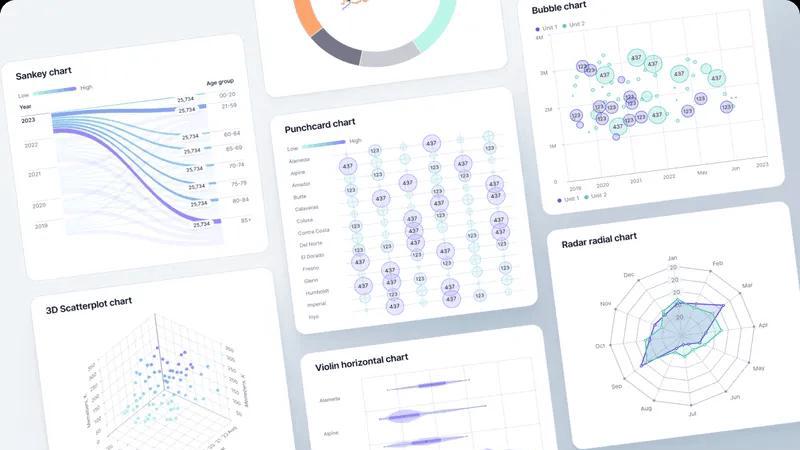
Fusedash transforms raw data into intuitive dashboards and charts, empowering teams to act on insights instantly.
Last updated: March 4, 2026

iGPT instantly gives AI agents trusted context from messy email data.
Last updated: March 1, 2026
Visual Comparison
Fusedash
iGPT
Feature Comparison
Fusedash
Flexible Views
Fusedash allows you to create tailored dashboard views for different audiences. Whether you need dashboards, charts, maps, or report-style presentations, you can customize layouts, filters, and time ranges, ensuring stakeholders see exactly what they need without unnecessary back and forth.
AI Chart Generator
With the AI Chart Generator, you can quickly create clear visuals from your CSV files or APIs in mere minutes. This feature enables you to select the right chart type, apply comparisons, and refine labels, streamlining the reporting process while ensuring that your charts effectively convey the intended narrative.
Dashboard Software
Fusedash provides a comprehensive workspace for dashboards and reporting, allowing teams to combine KPIs with narrative elements. This integration helps stakeholders understand not just the numbers, but also the context behind them, reducing the risk of conflicting information and keeping teams aligned.
AI Chat
The Smart Chat feature leverages AI to facilitate data exploration. Users can ask questions in plain language, receive suggestions for relevant metrics and charts, and easily transform insights into shareable dashboard views, making data analysis more intuitive and collaborative.
iGPT
Unified Intelligence Endpoint
This is iGPT's killer feature. Instead of managing a complex pipeline of vector databases, chunking logic, and multi-step prompt chains, you send one natural language request. The API handles retrieval, context shaping, and reasoning in a single, elegant pipeline, returning responses ready for automation in ~200ms. It’s a developer experience masterpiece that replaces weeks of integration work with a single curl command.
Deep Email & Attachment Processing
iGPT doesn't just skim subject lines. It deeply indexes entire email conversations, automatically reconstructing threads across time and participants. More impressively, it processes attachments—PDFs, spreadsheets, documents—extracting text, data, and structure to understand the full context of a conversation. This holistic view is what separates real intelligence from simple keyword matching.
Enterprise-Grade Security & Compliance
In a world rightfully paranoid about data leaks, iGPT's security model is a standout. It operates on a zero data retention policy, processing each inference in memory without storing inputs, prompts, or outputs. Combined with OAuth-only processing, granular Role-Based Access Control (RBAC), and a full audit trail, it allows enterprises to leverage powerful AI without the compliance nightmare.
Context Engineering Framework (CEF)
This is the secret sauce behind the quality of responses. iGPT's CEF automatically optimizes context windows for your LLM, applying hybrid retrieval (semantic + keyword + filters) that is scored and reranked in one call. It delivers cited answers linked directly back to source emails and files, providing not just an answer but the verifiable evidence behind it, eliminating the need for manual prompt tuning.
Use Cases
Fusedash
Marketing Performance Tracking
Marketing teams can utilize Fusedash to monitor campaign performance in real-time. By visualizing key metrics and KPIs in customizable dashboards, marketers can quickly assess what strategies are working and adjust their tactics accordingly.
Sales Insights and Forecasting
Sales departments can leverage Fusedash to create detailed reports and dashboards that highlight sales trends and forecasts. With the ability to drill down into segments and time periods, sales teams can better understand their performance and make data-driven decisions.
Operational Efficiency Monitoring
Operations teams can use Fusedash to track efficiency metrics, such as production rates or supply chain performance. The platform's ability to visualize data from various sources allows for comprehensive analysis, leading to improved operational strategies.
Financial Reporting and Analysis
Finance teams can benefit from Fusedash by streamlining their reporting processes. By consolidating financial data into a single view and utilizing narrative reporting alongside traditional dashboards, finance professionals can provide stakeholders with clear insights and actionable recommendations.
iGPT
Autonomous Email Assistants
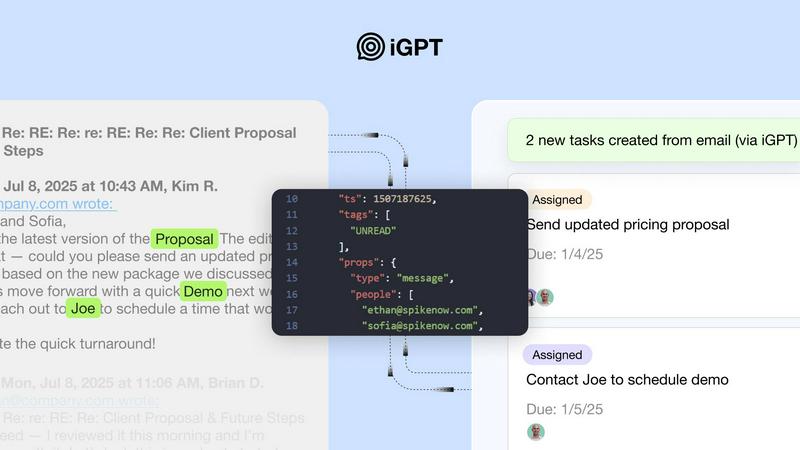
Build agents that do more than just draft replies. With full conversational and attachment context, these assistants can prioritize inboxes, summarize critical threads, suggest actions, and even auto-generate tasks or calendar invites—all while understanding the nuanced history and relationships between participants.
Customer Support Copilots
Revolutionize support by instantly rebuilding a customer's entire story. iGPT can analyze long, messy email chains, track tone shifts, and cross-reference attached documents (like invoices or error logs) to give support agents a complete, chronological history in seconds, drastically reducing resolution time and improving customer satisfaction.
Workflow & CRM Automation
Automatically extract decisive momentum from communication chaos. Transform email threads into structured tasks, approvals, deadlines, and CRM updates. Flag stalled deals or pending decisions by analyzing communication patterns and extracting key details like owners, dates, and commitments directly from the conversation.
Compliance & Audit Trail Generation
For regulated industries, iGPT is a game-changer. It creates a verifiable, citable audit trail by tracing feedback, approvals, contractual terms, and operational rationale directly back to the original email and attachment source. This turns unstructured inboxes into a searchable, compliant record of decision-making.
Overview
About Fusedash
Fusedash is an innovative AI-powered data visualization platform that revolutionizes how teams interpret and act on their data. Designed for organizations that struggle with disparate data sources and inefficient reporting processes, Fusedash offers a unified workspace for creating insightful dashboards, interactive charts, detailed maps, and narrative reports. The platform stands out by allowing users to define key performance indicators (KPIs) and metrics once, ensuring that everyone across departments is aligned on the same trusted data. This eliminates the frustration of conflicting reports and manual data compilations. Whether you are in leadership, marketing, or operations, Fusedash empowers you to monitor real-time data and understand the underlying trends driving your business decisions. By integrating AI features such as natural language data chat and smart visualization assistance, Fusedash not only accelerates data exploration but also enhances accessibility, transforming raw data into actionable insights that foster alignment and drive strategic initiatives.
About iGPT
In the chaotic world of enterprise software, email remains the final frontier—a messy, unstructured battleground where most AI tools spectacularly fail. iGPT is the definitive, purpose-built solution to this problem. It's not just another API wrapper; it's an intelligence layer that transforms the raw, nuanced data of email threads and attachments into structured, actionable, and trustworthy context for AI agents and automated workflows. Think of it as the critical middleware that finally allows your systems to understand the human conversations where real business decisions are made. Its core proposition is breathtakingly simple: a single, unified API call that obliterates the entire fragile, labor-intensive stack of parsing, chunking, indexing, and endless prompt engineering typically required to work with email. Built with uncompromising enterprise-grade security—featuring zero data retention, full audit trails, and granular RBAC—iGPT empowers developers to deploy confident, context-aware agents for sales, support, and operations without ever sacrificing compliance or control. If you're serious about building the next generation of autonomous workflows, this is the non-negotiable tool you've been waiting for.
Frequently Asked Questions
Fusedash FAQ
What types of data can I use with Fusedash?
Fusedash supports various data sources, including CSV uploads and API connections. This flexibility allows you to integrate diverse datasets into a unified workspace for comprehensive analysis.
How does Fusedash ensure data consistency across reports?
Fusedash allows users to define KPIs and metrics once and reuse them across dashboards, charts, and reports. This eliminates discrepancies and ensures that all teams are aligned on the same data.
Can I customize the visualizations in Fusedash?
Yes, Fusedash provides extensive customization options for visualizations. You can tailor layouts, filters, and chart types to meet the specific needs of different stakeholders, enhancing the clarity and relevance of your data presentations.
Is there a learning curve for using Fusedash?
Fusedash is designed with user-friendliness in mind, featuring intuitive interfaces and AI-powered tools. While new users may require some time to familiarize themselves, the platform's comprehensive resources and support help facilitate a smooth onboarding process.
iGPT FAQ
How does iGPT handle data privacy and security?
iGPT is architected for the enterprise with a foundational commitment to privacy. It employs a strict zero data retention policy, meaning your emails, prompts, and outputs are never stored post-processing. All inferences run in memory. It uses OAuth for authentication and enforces granular Role-Based Access Control (RBAC) on every request. Furthermore, your data is never used to train or improve any models.
What makes iGPT different from using a generic LLM API on email text?
A generic LLM API sees raw, messy text. iGPT provides deep, structured context. It automatically reconstructs email threads, processes attachments, and uses its Context Engineering Framework (CEF) to perform hybrid retrieval and optimal context shaping before the LLM even sees the query. This results in faster, more accurate, and fully cited answers without you building and maintaining a complex retrieval pipeline.
What types of email sources and attachments can it connect to?
iGPT is designed to connect to standard enterprise email sources. It deeply indexes emails from connected accounts. For attachments, it has robust processing capabilities for common business documents including PDFs, Word documents, Excel spreadsheets, and PowerPoint presentations, extracting both text and structural data to inform its understanding.
Is there a way to test iGPT before committing?
Absolutely. iGPT offers a comprehensive live playground where you can connect test data sources, experiment with different CEF quality tiers, and make real API calls to see the results. They even provide $10 in free credits to get started, with no credit card required, which is a fantastic and low-risk way to evaluate its power firsthand.
Alternatives
Fusedash Alternatives
Fusedash is an AI-powered data visualization platform that enables teams to transform raw data into actionable insights through clear dashboards and charts. As part of the Analytics & Data and Business Intelligence categories, it aims to streamline data reporting and foster alignment across organizations by ensuring that everyone is working from the same set of trusted metrics. Users often seek alternatives to Fusedash for a variety of reasons, including pricing considerations, specific feature sets, or compatibility with their existing platforms. When searching for an alternative, it's essential to assess the platform's ability to deliver real-time data insights, the flexibility in visualizations, and the overall ease of use to ensure it meets your team's unique needs and enhances decision-making processes.
iGPT Alternatives
iGPT is a specialized business intelligence tool designed to solve a very specific enterprise problem: giving AI agents structured, secure context from messy email data. It acts as an intelligence layer, transforming chaotic email threads and attachments into actionable insights for automated workflows. Users often look for alternatives for a few key reasons. Budget is a primary driver, as specialized enterprise tools command a premium. Others might seek a broader platform that bundles email parsing with other functions, or they may have simpler needs that don't require iGPT's deep, security-first architecture for complex agentic systems. When evaluating any alternative, focus on its core competency with unstructured email data. Can it truly understand threaded conversations and attachment contents in real-time? Crucially, scrutinize its security posture and data handling policies. The best tool is one that delivers reliable context without becoming a compliance liability.