Local Tools vs Quickfix AI
Side-by-side comparison to help you choose the right tool.

Local Tools
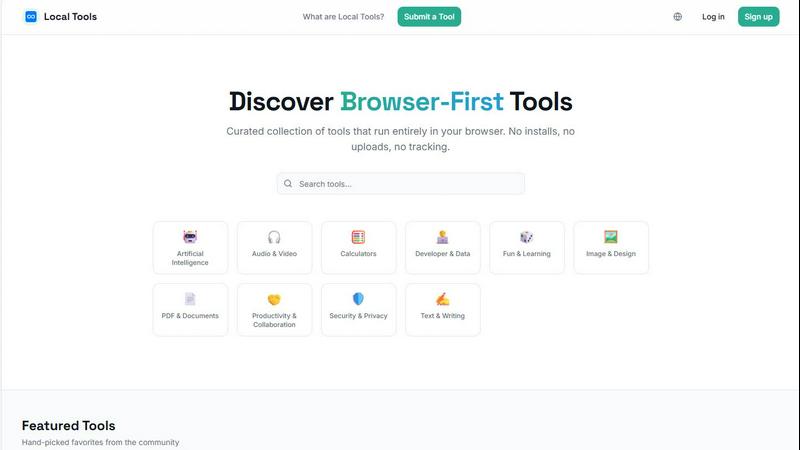
Local Tools is your curated directory for thousands of powerful, private tools that run instantly in your browser with no installs or uploads.
Last updated: April 4, 2026

Quickfix AI
Quickfix AI instantly diagnoses your computer's health and explains it in plain English.
Last updated: March 1, 2026
Visual Comparison
Local Tools
Quickfix AI
Feature Comparison
Local Tools
Curated, Cross-Source Aggregation
Local Tools doesn't create its own utilities; it performs the vital service of discovery and comparison. It aggregates tools from multiple established "on-device" platforms, allowing you to see all your options side-by-side. This means you can find a specific PDF editor available on Site A but not Site B, or compare the output quality between two different image converters. It turns a collection of separate websites into a unified, competitive marketplace for the best browser-based tool for any given task.
Strictly Browser-First & Private Operation
This is the foundational ethos. Every tool listed is vetted to ensure it operates client-side in your browser. Your files are processed locally on your machine using JavaScript and WebAssembly—they are never uploaded to a remote server for processing. This architecture guarantees superior privacy, eliminates concerns about data retention policies, and often results in faster performance since there's no network latency for the core computation.
Functional, Intuitive Organization
Navigating thousands of tools could be chaos, but Local Tools employs a smart, category-driven structure. You won't just find a monolithic list. Tools are organized into intuitive categories like Image & Design, Developer & Data, PDF & Documents, and Security & Privacy. This functional grouping lets you drill down to exactly what you need, whether it's a text diff checker, a color palette generator, or an audio trimmer, without wading through irrelevant options.
Community-Driven Curation & Discovery
The directory is built to evolve with the web. It features a "Submit a Tool" function, allowing the community of privacy-conscious users and developers to contribute new finds. This, combined with user ratings and featured tool sections, creates a living resource. You're not just using a static list; you're tapping into a collective effort to surface the most powerful, efficient, and well-loved tools that respect user privacy.
Quickfix AI
Comprehensive One-Click System Scan
This is the heart of the experience. With a single click on "Start Scan," Quickfix AI dives deep into every critical subsystem of your computer. It doesn't just skim the surface; it analyzes CPU load patterns, memory pressure, GPU utilization, storage health and capacity, battery degradation, network connection status, and core security settings like firewall status. All this data is gathered, processed, and presented in a unified, visually intuitive dashboard in under 60 seconds. It's the ultimate shortcut to knowing exactly what's happening under the hood.
Plain-English AI Explanations & Recommendations
This is the killer feature that sets Quickfix AI apart. Once your diagnostic report is ready, you can literally chat with the AI about your findings. Ask "Why is my Mac running slow?" and it will parse the entire report to give you a specific, understandable answer, like pinpointing that Chrome is using 45% of your CPU. It reads the technical diagnostics so you don't have to, offering clear explanations and practical, step-by-step recommendations to fix issues or optimize performance, with zero technical knowledge required.
Remote Diagnostics via Sharing Code
A game-changer for IT support teams or anyone helping friends and family. Instead of trying to guide someone through screenshots or confusing instructions, you can simply send them a secure link. They run the Quickfix AI agent on their machine, which generates a unique sharing code. You enter that code on your end, and voila—you can instantly view their full diagnostic report remotely. This eliminates the guesswork and allows for accurate, efficient troubleshooting from anywhere in the world.
Holistic Health & Performance Dashboard
Quickfix AI consolidates all vital statistics into one beautifully designed, easy-to-read interface. You don't need to jump between five different system tools. See your CPU, Memory, and GPU usage percentages at a glance. Monitor your disk space and health. Check your battery's remaining capacity and cycle count. Verify your upload/download speeds and security protection status. This dashboard provides immediate, actionable insight into your system's overall wellness, making proactive maintenance simple.
Use Cases
Local Tools
The Privacy-Consensitive Professional
A freelance graphic designer receives a client's logo draft on a public library computer. Using Local Tools, they find Photopea—a full-featured, Photoshop-like editor that runs in the browser. They can make crucial edits and adjustments without installing software or risking the client's intellectual property by uploading it to an unknown server. The work is done securely, locally, and with professional-grade results.
The Developer Seeking the Right Utility
A software engineer is debugging a complex API response. Instead of struggling with a dense JSON blob, they search Local Tools and find JSON Crack. They instantly visualize the data structure as an interactive graph, right in their tab, making it trivial to spot anomalies. Later, they might use a separate tool from the directory to minify their CSS, all without leaving the browser or compromising proprietary code.
The Student or Researcher Processing Data
A student working on a thesis needs to analyze survey data stored in a CSV file. They use Local Tools to find a browser-based chart generator and a statistical calculator. They can clean, visualize, and calculate metrics from their dataset entirely on their laptop, even without an internet connection after the tools are loaded. This ensures their research data remains completely confidential and accessible.
The Everyday User Solving Quick Problems
Someone needs to compress a batch of vacation photos to email to family, combine several PDFs into one document, and calculate a tip at a restaurant. Instead of searching separately and risking sketchy download links, they visit Local Tools. They quickly find Squoosh for image optimization, a PDF merger, and a calculator—solving all three tasks in minutes with tools that are fast, safe, and require no sign-ups.
Quickfix AI
The Anxious Troubleshooter
Your computer is making weird noises, running painfully slow, or just "doesn't feel right." Instead of spiraling into worry or searching forums for hours, you run Quickfix AI. In a minute, it tells you if your drive is failing, your memory is maxed out, or a background process is hogging resources. It transforms vague dread into a clear, understandable problem with suggested solutions, giving you peace of mind and a path forward.
The Power User & Tech Enthusiast
Gamers, developers, and content creators who push their hardware need to monitor performance bottlenecks. Quickfix AI provides the deep insights needed to optimize setups. Is a thermal throttle causing frame drops? Is the RAM speed the limiting factor? The tool offers the granular data and AI analysis to fine-tune systems for peak efficiency, ensuring your hardware is working as hard as you are.
The IT Support Professional
For IT teams, time is money. Quickfix AI revolutionizes the first line of support. Instead of lengthy back-and-forth emails trying to diagnose a user's issue, support staff can send a secure link, get a sharing code, and instantly access a full diagnostic report. This allows for accurate, remote diagnosis before a ticket is even escalated, dramatically reducing resolution times and improving user satisfaction.
The Family Tech Helper
We've all been the "tech person" for a parent or friend. Now, instead of trying to decipher their descriptions over the phone, you guide them to download and run Quickfix AI. They share the code with you, and you can immediately see if their hard drive is full, their Wi-Fi is weak, or their antivirus is disabled. You can provide precise, confident help without needing to be physically present, saving everyone time and frustration.
Overview
About Local Tools
Local Tools is a game-changing answer to a modern digital headache: the scattered, overwhelming world of online utilities. Forget juggling a dozen bookmarked sites that all promise similar tools. Local Tools is a meticulously curated, searchable directory that aggregates thousands of browser-first tools from across the web, all in one intelligent hub. The core, non-negotiable principle? Every single tool runs entirely on your device. This means zero installations, no uploading your sensitive files to mysterious servers, and absolutely no tracking. Your data stays with you, making every action fast, private, and refreshingly simple.
What truly sets it apart is its curatorial approach. Instead of just dumping hundreds of near-identical tools on you, Local Tools organizes by genuine functionality. Want to compare three different in-browser image compressors or find a niche JSON visualizer that one popular site doesn't offer? This is your destination. It's designed for the pragmatist: the developer who needs a quick code formatter, the designer editing a mockup on a public computer, the student processing data for a project, or anyone who just wants to calculate something without the privacy anxiety. Local Tools cuts through the noise, transforming a fragmented ecosystem into a single, powerful, and private resource for getting things done.
About Quickfix AI
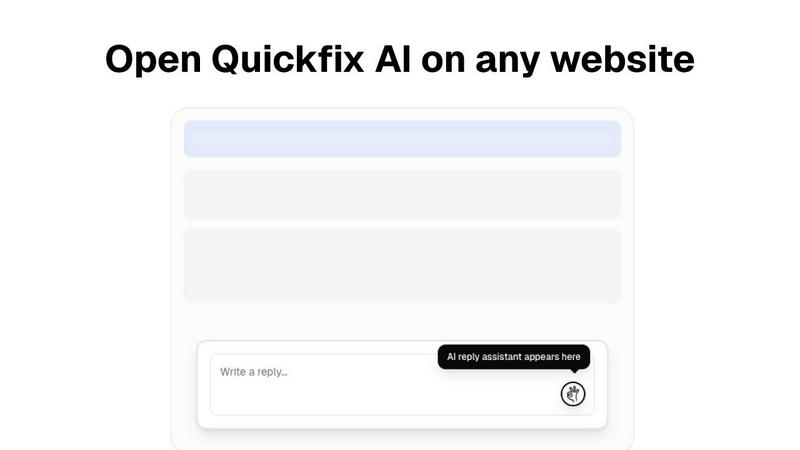
Let's clear up the confusion right away. The initial description provided is for a completely different product—a browser extension for writing replies. The actual Quickfix AI, based on its website, is a brilliant, no-nonsense system diagnostics tool. This is the software you wish came pre-installed on every computer. In essence, Quickfix AI is an AI-powered desktop application that performs a comprehensive health check on your Windows PC or Mac in under a minute. It demystifies your machine's inner workings, translating complex technical data into plain English insights and actionable recommendations. Forget wading through confusing Task Manager stats or system logs. This tool is built for anyone who's ever wondered, "Why is my computer so slow?" or needed to help someone else troubleshoot remotely. Its core value is profound clarity: it gives you the power to understand your system's performance, security, and health at a glance, whether you're a complete novice or a seasoned IT pro. It turns anxiety-inducing tech problems into solvable puzzles.
Frequently Asked Questions
Local Tools FAQ
Is Local Tools really free to use?
Yes, the Local Tools directory website itself is free to access and use. The individual tools listed within the directory are also typically free, as they are primarily browser-based utilities provided by their respective developers. There is no subscription or fee for browsing, searching, and accessing the links to these external tools through the Local Tools platform.
How do you ensure the tools are truly private and run locally?
The curation team prioritizes and verifies tools that are known to operate on client-side technology. This is often evident in the tool's own description (stating "no uploads" or "runs in your browser") and can be technically observed. Tools that require file uploads to a server for processing are excluded. The focus is on tools leveraging modern web capabilities like HTML5, JavaScript, and WebAssembly to perform computations directly on the user's device.
Can I request or submit a tool to be added?
Absolutely! Local Tools has a "Submit a Tool" feature because the web is vast. If you've found an excellent browser-based, privacy-respecting utility that isn't yet in the directory, you are encouraged to submit it for review. This community-driven approach is key to keeping the resource comprehensive and up-to-date with the best available tools.
What if a linked tool stops working or changes its policy?
Local Tools is an aggregator and directory, not the host of these external tools. While efforts are made to maintain link integrity and monitor for significant changes, the operation and policies of each individual tool are managed by their original creators. Users are always advised to check the specific tool's website for its latest terms of service and privacy policy before use.
Quickfix AI FAQ
Is Quickfix AI free?
Yes, the core diagnostic functionality of Quickfix AI appears to be free to download and use. You can run the comprehensive system scan, view your report, and chat with the AI for explanations and recommendations without any cost. The website mentions "Pricing" and "Enterprise" sections, suggesting there may be premium tiers or team features for advanced use, but the fundamental tool is accessible for personal use.
Is my data secure?
Absolutely. Based on the website's emphasis on privacy (with links to a Privacy Policy and Data Processing Agreement), Quickfix AI is designed with security in mind. The diagnostic data is processed to generate your report, and the remote sharing feature uses a unique, one-time code for secure access. Your system information isn't stored or used beyond providing you with the immediate analysis and insights.
Do I need technical knowledge?
Not at all. This is the entire point of Quickfix AI. It is explicitly built for users with no technical knowledge. The AI is there to translate complex system information into plain English. You just need to click "Scan" and then ask questions like you would ask a person. The tool handles the technical heavy lifting for you.
What platforms are supported?
Quickfix AI is a cross-platform tool. It is available for both Windows and macOS. The website provides separate download buttons for "Download for Windows" and "Also available for macOS," confirming full support for the two major desktop operating systems, covering a vast majority of personal and professional computers.
Alternatives
Local Tools Alternatives
Local Tools is a curated directory that falls into the category of on-device, browser-first utility platforms. It aggregates thousands of tools that run entirely in your browser, eliminating the need for installs or risky file uploads. The goal is to organize a fragmented ecosystem into a single, searchable hub for privacy-focused tasks. People explore alternatives for a few key reasons. They might be looking for a platform with a different organizational structure or a more specialized focus on a particular niche, like advanced developer utilities or creative design tools. Others might prioritize a different user experience or discoverability method beyond a curated directory. When evaluating other options, your north star should be the core principle of local execution. Ensure the tools genuinely run in your browser without hidden uploads. Look for a clean, intuitive interface that matches your workflow, and consider the depth and quality of curation in your most-used categories, whether that's data conversion, image editing, or text processing.
Quickfix AI Alternatives
Quickfix AI is a browser extension in the productivity category that uses AI to instantly generate replies for emails, support tickets, and social media. It’s a clever tool for anyone looking to cut down on repetitive typing and speed up their digital communication. People often seek alternatives for a few key reasons. Maybe the pricing doesn’t fit their budget, or they need specific features like deeper integration with certain business software. Others might be looking for a different user experience or a tool that operates as a standalone app rather than a browser extension. When evaluating other options, focus on what truly matters for your workflow. Consider the core AI quality—does it produce genuinely useful and context-aware text? Check compatibility with the platforms you use daily. Also, look at the value proposition: does the tool save you meaningful time, and is its cost justified by the productivity boost it provides?