Mechasm.ai vs Playwriter
Side-by-side comparison to help you choose the right tool.

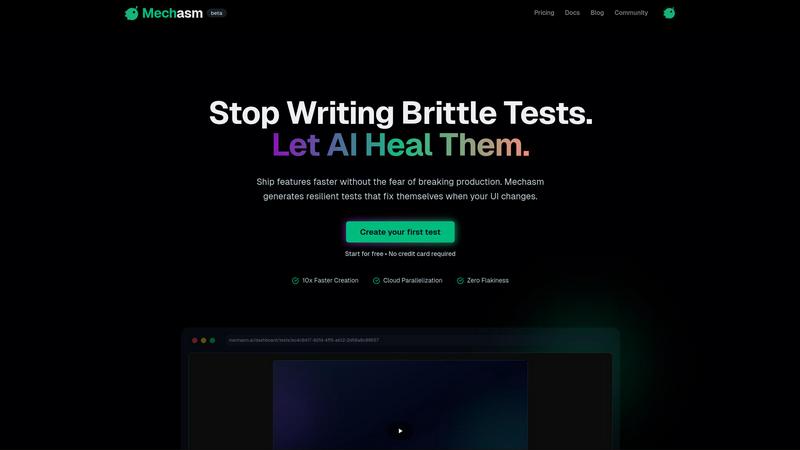
Mechasm.ai automates resilient tests in plain English, self-healing with UI changes to ensure fast, reliable.
Last updated: February 28, 2026

Playwriter
Playwriter lets AI agents control your real Chrome browser with all your logins and extensions intact.
Last updated: March 18, 2026
Visual Comparison
Mechasm.ai
Playwriter

Feature Comparison
Mechasm.ai
Self-Healing Tests
Mechasm.ai features intelligent self-healing tests that automatically adapt when UI changes occur, significantly reducing maintenance time. This innovative functionality addresses one of the most frustrating aspects of automated testing—flaky tests—by ensuring that test scripts remain reliable even as the application evolves. With self-healing capabilities, you can focus on development without the constant worry of broken tests.
Natural Language Test Creation
One of the standout features of Mechasm.ai is its ability to allow users to write test scenarios in plain English. This means that your test descriptions can be as simple as "User adds to cart and proceeds to checkout." The platform’s AI then translates these natural language inputs into robust automated code, making it accessible for team members who may not have a technical background.
Cloud Parallelization
Mechasm.ai leverages cloud parallelization to enhance testing efficiency. This feature allows teams to scale their testing efforts by running hundreds of tests simultaneously on secure cloud infrastructure. The result is a significant reduction in test execution time, enabling faster deployments and a more responsive development cycle.
Actionable Analytics
Mechasm.ai provides comprehensive analytics that empower teams to monitor their testing health and performance. With detailed health scores, trend analysis, and performance tracking, teams can gain actionable insights into their testing processes. This feature not only helps in identifying bottlenecks but also enhances overall test velocity and team productivity.
Playwriter
Your Actual Browser Session
This is the killer feature. Instead of spawning a fresh, suspicious Chrome instance, Playwriter attaches directly to your existing browser via a Chrome extension. Your agent operates in an environment with all your personal logins, saved cookies, installed extensions (like ad-blockers or password managers), and even your existing tabs. This eliminates bot detection triggers from "new" browser fingerprints and avoids the memory overhead of running a second Chrome process. It’s the difference between sending a stranger to do your online shopping versus giving your trusted friend your laptop.
Full Playwright API via a Single Tool
Forget menus of dozens of limited, pre-wrapped tools like "click_button" or "extract_text." Playwriter exposes one powerful execute command that accepts any valid Playwright code. This means your AI agent can use the entire, mature Playwright API for complex interactions: waiting for specific network responses, setting JavaScript breakpoints, manipulating localStorage, or taking efficient accessibility snapshots. This approach drastically reduces context window usage and provides maximum flexibility, trusting the developer or AI to write precise instructions.
Built-in Debugger & Live Editor
Playwriter transforms your browser into a debuggable runtime for AI agents. You can set breakpoints in the agent's Playwright script, pause execution, and inspect the state of the page. The live code editing feature allows you to modify the agent's commands on-the-fly without restarting the entire session. This is invaluable for troubleshooting, refining scripts, or when the agent gets stuck on an unexpected UI element. It brings a developer-grade workflow to AI-powered automation.
Lightweight Accessibility Snapshots
Traditional full-page screenshots are context hogs, often exceeding 100KB. Playwriter's accessibility snapshots are a game-changer, typically weighing only 5-20KB. They capture the semantic structure of the page—roles, names, states, and relationships—which is exactly what an AI agent needs to understand the page layout and interact with elements. This makes agent interactions faster, more accurate, and far cheaper in terms of token usage compared to processing large image files.
Use Cases
Mechasm.ai
Accelerating Feature Releases
Mechasm.ai is perfect for teams looking to accelerate their feature release cycles. By eliminating flaky tests and reducing maintenance time, teams can focus on developing new features rather than fixing broken test scripts. This leads to quicker, more reliable releases that keep pace with market demands.
Enhancing Team Collaboration
With the ability to write tests in plain English, Mechasm.ai fosters collaboration among team members. Product managers and developers can contribute to the testing process, enhancing communication and ensuring that quality assurance aligns closely with development goals.
Streamlining CI/CD Integration
Mechasm.ai seamlessly integrates with popular CI/CD tools, making it an ideal choice for organizations employing continuous integration and deployment strategies. This integration allows teams to receive immediate feedback on their tests, ensuring that issues are caught early in the development process.
Improving Test Accuracy
The self-healing capabilities of Mechasm.ai improve the overall accuracy of automated tests. As the platform adapts to changes in the UI, it minimizes false positives and negatives, providing teams with greater confidence in their test results and reducing the time spent on troubleshooting.
Playwriter
AI-Assisted Web Research & Data Extraction
Need to compile a report from multiple sources that require login? Instruct your AI agent to navigate your logged-in news subscriptions, academic journals, or business intelligence platforms. It can click through pagination, handle consent modals with your guidance, and extract structured data—all within your authenticated session, avoiding paywalls and login barriers that stop other automation tools cold.
Automated Testing with Real User Context
Developers can use Playwriter to create and run integration tests that mimic real user journeys. Since it uses your actual browser profile, tests can run against staging environments that require specific authentication cookies or against complex workflows that depend on browser extensions. This provides a more accurate testing environment than isolated, clean browser instances.
Routine Administrative Task Automation
Automate the tedious, repetitive web tasks that clutter your day. This could be filling out recurring forms, checking statuses on multiple dashboards, downloading daily reports from a web portal, or managing content across platforms like Shopify or WordPress. Your AI handles the routine clicks and inputs, and you simply supervise or step in for exceptions like CAPTCHAs.
Collaborative Browsing & Pair Programming
This is where Playwriter shines as a collaboration tool. You can watch the AI navigate in real-time on your screen. When it encounters a hurdle—a tricky multi-factor authentication step, an ambiguous "I'm not a robot" checkbox, or a novel UI—you can immediately intervene. Disable the extension on that tab, solve the human-required problem manually, re-enable control, and let the AI continue. It's true human-AI teamwork.
Overview
About Mechasm.ai
Mechasm.ai is a groundbreaking AI-driven automated testing platform that redefines quality assurance for modern engineering teams. Designed to tackle the complexities of fast-paced software development environments, Mechasm.ai effectively eliminates the traditional challenges associated with legacy testing frameworks. These frameworks often result in flaky scripts and high maintenance overhead, which can slow down development cycles. The core value proposition of Mechasm.ai lies in its ability to allow users to author tests in plain English, creating a seamless connection between human intent and technical execution. This unique feature empowers not just QA engineers but also developers and product managers to actively participate in the quality assurance process. With innovative functionalities like self-healing tests and cloud execution, teams can ship features faster and with greater confidence, ultimately transforming the landscape of end-to-end testing. Mechasm.ai is trusted by forward-thinking teams who prioritize speed, reliability, and developer happiness, making it an essential tool for anyone looking to elevate their testing strategy.
About Playwriter
Let's be brutally honest: most AI browser automation tools are a pain. They either lock your agent in a sterile, cookie-less sandbox that gets flagged as a bot instantly, or they give it a clunky, limited set of pre-defined "tools" that can't handle real-world web complexity. Playwriter is the antidote. It's a Chrome extension and CLI that hands the full power of the Playwright automation API directly to your AI agent, but with one critical twist: it runs inside your actual, logged-in browser session. This means your AI can navigate the web with all your extensions, cookies, and saved logins already in place, bypassing the instant detection that plagues headless instances. It's like giving your AI a driver's license for your personal browser. Built as an open-source MCP (Model Context Protocol) server, it integrates seamlessly with clients like Cursor, Claude Desktop, and VS Code. The philosophy is powerful yet simple: one single execute tool that can run any Playwright code, eliminating schema bloat and giving developers and AI agents unprecedented, granular control over the browsing experience. This isn't just automation; it's a collaborative browsing session where the AI handles the tedious work, and you step in as the human-in-the-loop when needed.
Frequently Asked Questions
Mechasm.ai FAQ
How does Mechasm.ai ensure tests remain reliable?
Mechasm.ai uses AI-driven self-healing technology that automatically adapts tests to changes in the UI, significantly reducing the incidence of flaky tests and enhancing reliability.
Can non-technical team members create tests?
Yes, Mechasm.ai allows users to write test scenarios in plain English, making it accessible for non-technical team members such as product managers and business analysts to contribute effectively to the QA process.
What kind of analytics does Mechasm.ai provide?
Mechasm.ai offers actionable analytics that include health scores, trend analysis, and performance tracking, enabling teams to gain insights into their testing processes and improve overall efficiency.
Is Mechasm.ai suitable for large teams?
Absolutely. Mechasm.ai is built for scalability, allowing large teams to run hundreds of tests in parallel on secure cloud infrastructure, making it an excellent choice for organizations of all sizes.
Playwriter FAQ
Is my browsing data sent to a remote server?
Absolutely not. Playwriter is designed with privacy first. The architecture is local: the Chrome extension connects to a WebSocket relay running on localhost:19988 on your own machine. Your AI client (CLI, MCP) also connects to this local relay. All commands and data (CDP traffic) flow directly between your browser and your local client. No data is sent to any remote server, and no account is required.
How does it avoid bot detection?
It avoids the classic red flags of automation. Because it uses your existing, long-lived Chrome session with a normal history of use, cookies, and extensions, it presents a browser fingerprint that looks entirely human. Websites see it as you browsing, not a fresh, sterile automation environment. The extension uses the official chrome.debugger API, which is a supported method for development tools.
Can I use it with any AI or just specific clients?
Playwriter is built on the open Model Context Protocol (MCP), making it client-agnostic. It works seamlessly with any MCP-compliant client. This includes popular AI-powered editors like Cursor and Windsurf, desktop agents like Claude Desktop, and code editors like VS Code with an MCP plugin. The provided CLI also lets you drive it directly from your terminal or your own scripts.
What happens if the AI gets stuck or makes a mistake?
You have full control. You can see every action happening live in your browser. If the agent enters a loop or starts clicking the wrong thing, you can instantly click the extension icon to detach it (turning it gray) and regain manual control of the tab. After you fix the state of the page, re-attach the extension, and the agent can pick up from there. The built-in debugger also allows you to pause and step through the agent's commands.
Alternatives
Mechasm.ai Alternatives
Mechasm.ai is an innovative AI-driven automated testing platform designed to streamline the quality assurance process in modern software development. By allowing teams to create tests using plain English and utilizing advanced AI for self-healing capabilities, it empowers not just QA engineers but also developers and product managers to engage in the testing process. Its seamless integration with popular CI/CD tools further enhances its appeal in the tech landscape. However, users often seek alternatives to Mechasm.ai for various reasons, including pricing concerns, specific feature requirements, or compatibility with existing platforms. When selecting an alternative, it's crucial to consider factors such as ease of use, scalability, support for collaboration across teams, and the ability to integrate with your current tools and workflows. A thoughtful evaluation can help ensure that your chosen solution meets the unique demands of your development environment.
Playwriter Alternatives
Playwriter is an open-source tool in the browser automation category, designed to give AI agents control over your actual, logged-in Chrome session. This solves the common problem where agents operate in a sterile, fresh browser with no extensions, logins, or context, making real-world tasks impossible. People look for alternatives for various reasons. Some need a different pricing model, like a fully hosted service versus self-hosted software. Others require specific features Playwriter may lack, or they need compatibility with a different browser or automation framework beyond the Model Context Protocol (MCP). When evaluating options, consider the core problem you need to solve. The key is whether the tool provides access to a persistent, authenticated browser session with your extensions and data. Also, assess if it offers the necessary control features, like debugging or network interception, and check its compatibility with your existing AI agent workflow and security requirements.