Miget vs PUNKU.AI
Side-by-side comparison to help you choose the right tool.

Miget
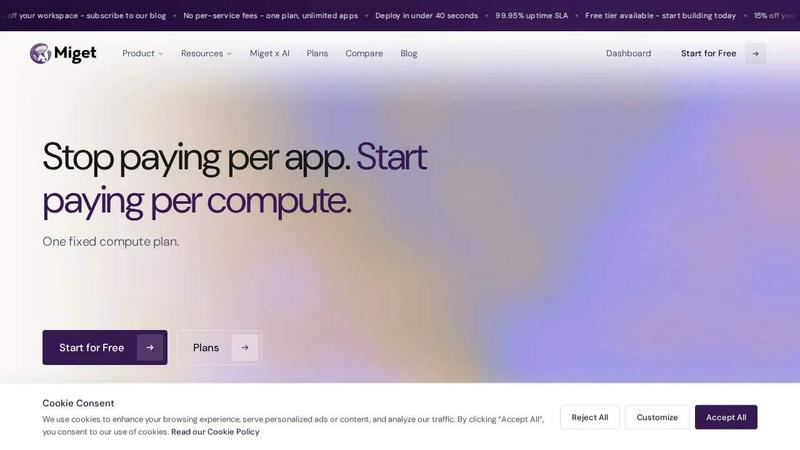
Miget is the only platform where one flat compute plan lets you deploy unlimited apps and services without per-component fees.
Last updated: April 13, 2026

PUNKU.AI
PUNKU.AI builds powerful AI automations for you in plain English, no coding required.
Last updated: February 28, 2026
Visual Comparison
Miget
PUNKU.AI
Feature Comparison
Miget
Unlimited Services Per Plan
This is the cornerstone of Miget's value proposition. Once you choose a compute plan, the number of apps, databases, and background workers you deploy inside it is unlimited. There are no line-item charges for adding a Redis instance or spinning up a new microservice. This eliminates billing surprises and empowers developers to build and experiment freely, transforming infrastructure from a cost center into a predictable, fixed resource you can fully utilize.
GitHub-Native Deployments & Preview Apps
Miget deeply integrates with your GitHub workflow. Simply connect your repository, and every push to a branch triggers an automatic build and deployment. More impressively, every pull request automatically generates a full-stack preview environment with its own unique URL, complete with cloned data and services. This allows for real-world testing and stakeholder reviews without touching production, all handled with zero manual CI/CD configuration.
Managed Databases Within Compute
Unlike other platforms that charge separately for data services, Miget includes managed databases like PostgreSQL, MySQL, and Valkey (Redis-compatible) as part of your compute allocation. You can provision and scale them without incurring additional fees, making it a true all-in-one platform. This simplifies architecture and budgeting, as your database costs are capped and predictable from the start.
Full-Stack Cloning & Instant Redeploys
Miget understands the need for speed and accurate testing. With one click, you can clone an entire application environment—including its code, database schema, and data. This is perfect for creating staging areas or debugging in isolation. Coupled with intelligent build caches (Migetpacks) that auto-detect your stack, this feature enables redeploys in under 40 seconds, dramatically improving developer velocity.
PUNKU.AI
Plain English Automation Builder
This is the game-changer. Instead of learning a new software language, you simply tell PUNKU.AI what you need. Typing something like "Create a customer service chatbot that connects with our booking system and Gmail" is enough to start the build process. The AI interprets your intent, asks clarifying questions, and constructs the underlying automation for you. It democratizes powerful workflow creation, putting the power directly in the hands of the people who understand the problem best.
Visual Node Graph for Oversight
Once your automation is built, you're not left in the dark. PUNKU.AI provides a clear, visual node graph that maps out every step of your AI agent's process. This transparency is crucial for trust and optimization. You can see exactly where data is pulled from, what logic is applied, and where outputs are sent. It offers the control of a developer tool with the accessibility of a consumer app, a combination I find exceptionally well-executed.
Vast Integration Library (3,000+ Apps)
An automation tool is only as good as its connections. PUNKU.AI shines here with native integration support for a massive library of over 3,000 applications. Whether it's core communication tools like Slack and Microsoft Teams, productivity suites like Google Workspace and Notion, or specialized CRM and support software, chances are it connects. This ensures your AI agents can work across your entire digital ecosystem without forcing disruptive changes.
Proactive Error Monitoring & Improvement Suggestions
This feature elevates PUNKU.AI from a setup tool to a true management platform. Your automations are actively monitored for failures or bottlenecks. More impressively, the platform analyzes key performance indicators and proactively suggests improvements to your agents. It’s like having an expert systems engineer constantly fine-tuning your workflows for peak efficiency and reliability, which is a massive value-add for any team.
Use Cases
Miget
The Indie Hacker & Side Project Builder
For solo developers bootstrapping a product, predictable cost is everything. Miget's fixed pricing allows an indie hacker to deploy their web app, a PostgreSQL database, a Redis cache, and several background workers for processing jobs—all on a single, affordable plan. They can launch fast, iterate constantly, and never worry about a surprise $50 charge for adding a new service.
The Growing Startup & Microservices Architecture
As a startup scales, its application often evolves into a suite of microservices and APIs. On a traditional PaaS, this quickly becomes prohibitively expensive. Miget allows a growing team to containerize and deploy numerous services, each with their own databases, all within a single compute budget. Features like team roles, audit logs, and per-PR previews support collaborative development at scale.
AI App Developers & Prototypers
Developers building with AI often need to rapidly spin up endpoints, model backends, and vector databases to test new ideas. Miget's model encourages this experimentation. With tools like skills.md for one-click infrastructure setup and the ability to deploy from prompts, builders can go from concept to a shareable preview URL in minutes, without cost anxiety holding them back.
Enterprise Teams Seeking Cost Control & Flexibility
Larger organizations can use Miget to gain predictable billing for internal tools, developer platforms, and specific product lines. The ability to bring your own cloud (BYOC) or bare metal, combined with Helm charts and Terraform support, provides the governance and control enterprises require, while still benefiting from the simplified, cost-predictable PaaS experience.
PUNKU.AI
24/7 Customer Service Chatbot
Deploy an AI agent to handle common customer inquiries around the clock. It can connect to your knowledge base, booking system, and email to answer FAQs, check availability, and even draft personalized response emails. This instantly reduces ticket volume for your human team, allowing them to focus on complex, high-value support issues that truly require a personal touch.
Automated Lead Nurturing & Sales Follow-ups
Transform your lead management by creating an AI sales agent. It can qualify leads from your website, send personalized follow-up sequences via email, update your CRM, and notify your sales team on Slack when a hot lead is ready for a human conversation. This ensures no lead falls through the cracks and helps move prospects smoothly through your funnel.
Cross-Platform Social Media & Marketing Campaigns
Streamline your marketing efforts with agents that handle scheduling, posting, and basic engagement. An agent can be instructed to draft posts, publish them across multiple platforms at optimal times, and even analyze engagement metrics to report back. You maintain strategic control while offloading the repetitive execution and calendar management.
Internal Operations & Task Coordination
Automate the internal glue that holds teams together. Create agents to sync calendars across departments, coordinate task assignments from project management tools to individual team members, send reminders for deadlines, and compile daily or weekly status reports. This use case is a personal favorite for eliminating meeting overhead and keeping projects moving forward autonomously.
Overview
About Miget
Miget is a revolutionary Platform-as-a-Service (PaaS) that fundamentally changes how developers pay for and manage their cloud infrastructure. If you're tired of watching your monthly bill balloon with every new app, database, or background worker you add, Miget is your answer. The core philosophy is brilliantly simple: stop paying per service and start paying per compute. You select a fixed compute plan with a predictable cost, and then you can deploy an unlimited number of applications, managed databases (like PostgreSQL and Redis), and workers within that reserved capacity. This model is a direct challenge to traditional PaaS providers whose per-component pricing can stifle experimentation and turn infrastructure into a constant budgeting headache. Built on robust, isolated Kubernetes, Miget offers a full-stack, production-ready experience with zero-config builds from Git, automatic TLS for custom domains, and features like preview apps for every pull request. It's designed for everyone from indie hackers launching their first side project to growing engineering teams scaling a microservices architecture, all united by the desire for simplicity, predictability, and control over their cloud spend.
About PUNKU.AI
Let's cut to the chase: the promise of AI automation has been a frustrating mess of complex, code-heavy platforms or opaque "black box" solutions. PUNKU.AI is the breath of fresh air we've been waiting for. This platform is built on a brilliantly simple premise: you describe what you want to automate in plain English, and it builds the AI agent to do it. No coding, no wrestling with cryptic workflow diagrams. It's designed for the doers—the business owners, project managers, marketing teams, and support leaders who are tired of drowning in repetitive digital busywork. The core value proposition is unparalleled clarity and control. Unlike other tools that feel like magic tricks you can't understand, PUNKU.AI lets you visualize your automations in an intuitive node graph, so you actually see and comprehend the process. With seamless connections to over 3,000 apps like Gmail, Slack, and Notion, it slots right into your existing stack. Plus, it doesn't just set and forget; it actively monitors for errors and suggests improvements. For over 200 businesses worldwide, it's become the trusted engine that handles the boring stuff, freeing them to focus on strategy and growth.
Frequently Asked Questions
Miget FAQ
How does the pricing work if services are unlimited?
You pay only for the compute plan you select (e.g., a plan with 2 vCPUs and 4GB RAM). This reserves a pool of resources. You can then deploy as many containerized applications, databases, and workers as you want into that pool, sharing the total CPU and memory. Your bill is fixed; it only increases if you upgrade to a larger compute plan for more resources.
What happens if I exceed my plan's compute resources?
Miget is designed for intelligent resource sharing. If your total usage approaches the limits of your plan, you will need to optimize your services or upgrade to a larger plan. The platform provides monitoring to help you track usage. Crucially, you are billed for your reservation, not for bursting, which keeps costs predictable.
Is there a free tier?
Yes, Miget offers a free tier to start building. This allows you to experience the platform, deploy applications, and use managed services within the resource constraints of the free plan. It's an excellent way to test the deployment workflow, preview app feature, and see if the model fits your development style before committing financially.
How is isolation and security handled between customers?
Miget is built on Kubernetes with full isolation between tenants. Each customer's workloads run in isolated environments. The platform also offers features like automatic TLS/SSL, private networking options, and for enterprise plans, the ability to deploy into your own cloud account (BYOC), ensuring your infrastructure meets your security and compliance requirements.
PUNKU.AI FAQ
Do I need technical knowledge to use PUNKU.AI?
Absolutely not. This is the core philosophy of the platform. You interact with PUNKU.AI entirely in plain English. Describe the task you want to automate as you would to a colleague (e.g., "When a new form is submitted, send a confirmation email and add the details to our calendar"). The AI handles all the technical setup, logic, and connections. No coding or complex workflow design is required.
How long does it take to get started?
You can go from an idea to a live automation in minutes. The process is incredibly fast: describe your agent, connect the necessary apps (which is usually just a few clicks with OAuth), and let the AI build it. Using one of their 100+ pre-built templates gets you up and running even faster—you can have a functional customer service chatbot or lead gen bot operational in under 10 minutes.
How secure is my data on PUNKU.AI?
Based on their documentation, PUNKU.AI takes security seriously. Connections to your apps (like Gmail, Slack, etc.) use secure OAuth protocols, meaning your login credentials are not stored by PUNKU.AI. The platform acts as a secure conduit, following the permissions you set. It's always advisable to review a company's specific Privacy Policy and security whitepapers, but the use of standard, secure connection methods is a strong positive indicator.
Can I try it before committing?
Yes, PUNKU.AI offers a "Get Started Free" option. This allows you to instantly explore the platform, test the plain-English builder, and likely create a simple automation without entering credit card details. It's the best way to experience the transformative simplicity of the tool firsthand and see if it fits your workflow before any financial commitment.
Alternatives
Miget Alternatives
Miget is a modern, flat-rate PaaS platform that rethinks how developers pay for hosting. Instead of billing per app or database, it offers a single compute plan where you can run unlimited services. This places it in a growing category of developer-centric platforms focused on simplicity and predictable costs. People often look beyond Miget for a few key reasons. Some need a free tier for initial experiments, while others require very specific runtimes or deeper cloud integrations. The search usually boils down to balancing cost predictability against the flexibility of a traditional, pay-as-you-go model. When evaluating alternatives, focus on your core needs. Consider your budget's tolerance for variable costs versus the appeal of a fixed monthly fee. Also, weigh the importance of built-in managed services versus the ability to bring your own tools. The right choice aligns with both your project's technical demands and your financial comfort zone.
PUNKU.AI Alternatives
PUNKU.AI is a standout in the no-code automation space, designed to turn your workflow ideas into reality using plain English. It’s built for those who want to automate tasks without getting tangled in code, offering a clear visual graph and deep integrations to keep everything running smoothly. People often search for alternatives for a few key reasons. Budget is a big one, as pricing structures can vary widely. Others might need a specific integration that’s not available, or they may prefer a different interface style, like a more template-heavy approach versus PUNKU.AI’s descriptive, build-from-scratch model. When evaluating other platforms, focus on what matters most for your use case. Consider the depth of API connections, the learning curve, and how much transparency and control you want over your automations. The best tool is the one that disappears into your workflow, handling the busywork so you don't have to.