Agenta vs qtrl.ai
Side-by-side comparison to help you choose the right tool.

Agenta is an open-source platform that streamlines LLM development, enabling teams to collaborate and build reliable.
Last updated: March 1, 2026

qtrl.ai
qtrl.ai scales your QA with AI agents while keeping you in full control.
Last updated: March 4, 2026
Visual Comparison
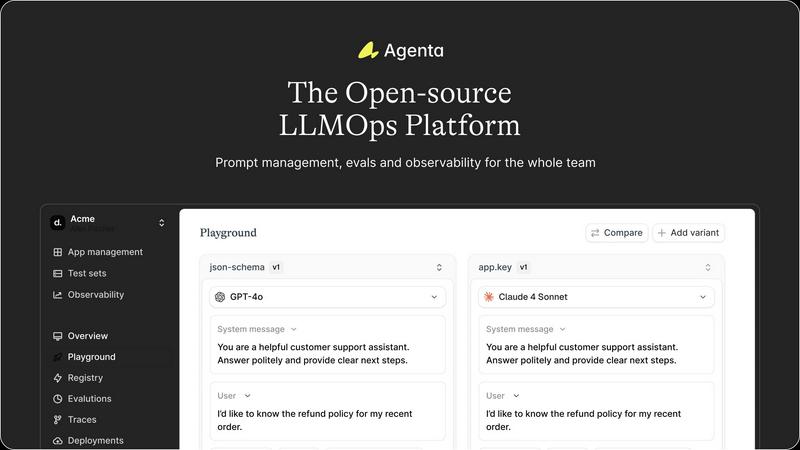
Agenta
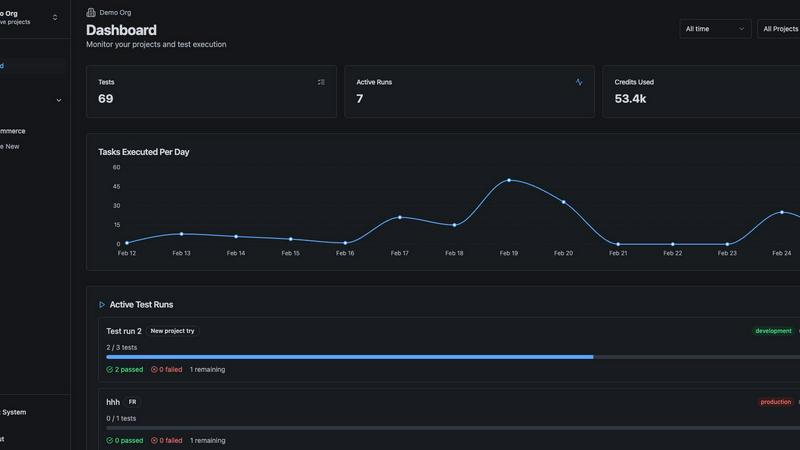
qtrl.ai
Feature Comparison
Agenta
Centralized Prompt Management
Agenta allows you to centralize all your prompts, evaluations, and traces in one platform. This eliminates the confusion of scattered files and improves accessibility for all team members, ensuring everyone is on the same page.
Automated Evaluations
With Agenta, you can create a systematic process to run experiments, track results, and validate every change made to your LLMs. This feature replaces guesswork with evidence by providing automated evaluations that help you understand what changes impact performance.
Unified Playground
The platform includes a unified playground where you can compare prompts and models side-by-side. This feature is invaluable for identifying the best-performing prompts and models, allowing for quick iterations and improvements.
Real-time Observability
Agenta provides tools for monitoring production systems and tracing every request. This feature allows you to gather user feedback efficiently, debug your AI systems, and detect regressions, ensuring a smoother user experience.
qtrl.ai
Enterprise-Grade Test Management
This is the unsung hero of the platform and my personal favorite for teams seeking stability. qtrl provides a centralized, structured command center for all your QA activities. You can organize test cases, plan detailed test runs, trace requirements directly to test coverage, and track everything through live dashboards. It’s built with compliance and auditability in mind, offering full traceability for manual and automated workflows alike. This foundation is what prevents the AI features from becoming chaotic, ensuring you always have clear visibility into what’s been tested and what’s at risk.
Autonomous QA Agents
This is where qtrl truly separates itself from legacy tools. Instead of writing fragile Selenium scripts, you describe what to test in plain English. qtrl’s AI agents then execute those instructions on-demand or continuously across multiple real browser environments. They operate within your defined rules and permissions, performing real browser interactions—not simulations. It’s a game-changer for converting manual test scenarios into reliable, scalable automation without needing an army of automation engineers.
Progressive Automation & Adaptive Memory
This feature embodies qtrl’s core philosophy. You don’t start with a fully autonomous AI; you start with human-written instructions. As the platform's Adaptive Memory builds a living knowledge base of your application from every test run and exploration, it gets smarter. It can then suggest new tests to fill coverage gaps and help generate more tests over time. Every step is reviewable and approvable. This progressive approach builds trust and allows automation to grow organically with your team’s comfort level.
Governance by Design & Multi-Environment Execution
Built for enterprises that can’t afford surprises, qtrl bakes governance into every layer. You have full visibility into agent actions, with no black-box decisions. Permission levels control autonomy, and enterprise-grade security is a given. Coupled with robust multi-environment execution—allowing tests to run across dev, staging, and prod with per-environment variables and encrypted secrets—it ensures you can scale testing safely. The fact that secrets are never exposed to the AI agent is a critical, non-negotiable detail for serious teams.
Use Cases
Agenta
Collaborative Prompt Development
In teams where multiple stakeholders are involved, Agenta facilitates collaborative prompt development by providing a shared workspace. This enables product managers, developers, and domain experts to work together effectively, improving the quality of prompts.
Rigorous Evaluation Processes
Agenta is ideal for organizations that require rigorous evaluation processes. By automating evaluations and integrating domain expert feedback, teams can ensure that their LLMs meet high standards before deployment, reducing the risk of errors in production.
Debugging and Troubleshooting
When issues arise in production, Agenta’s observability tools help teams trace failures to their source. This capability allows for more efficient debugging, as you can pinpoint problems quickly and take corrective action.
Rapid Iteration of LLMs
For teams focused on rapid iteration, Agenta provides the tools necessary to test and compare various prompts and models in real-time. This accelerates the development cycle, allowing businesses to bring reliable AI features to market faster.
qtrl.ai
Scaling Beyond Manual Testing
For QA teams drowning in repetitive manual regression tests, qtrl is a lifeline. They can start by simply documenting their manual test cases in the platform. Then, they can progressively use the autonomous agents to automate the most tedious flows by describing them in English. This allows the team to scale their coverage and frequency of testing without hiring more manual testers or requiring everyone to learn complex programming frameworks.
Modernizing Legacy QA Workflows
Companies stuck with outdated, siloed testing tools or homegrown frameworks can use qtrl as a unifying platform. It consolidates test management and automation into one system. Teams can import or recreate their existing test assets and begin integrating AI-powered execution incrementally. This provides a clear, low-risk migration path off of brittle automation scripts and towards a more intelligent, maintainable QA process.
Enabling Product-Led Engineering Teams
Engineering teams that own their own quality (a product-led model) need tools that are powerful but not overly complex. qtrl fits perfectly. Developers or product engineers can write high-level test instructions for features they build, and qtrl handles the execution. This embeds quality checks directly into the development workflow without creating a massive maintenance burden for engineers, fostering a true "shift-left" culture.
Ensuring Governance in Regulated Enterprises
For industries like finance or healthcare where audit trails and compliance are mandatory, qtrl’s structured foundation is essential. The platform provides full traceability from requirements to test cases to execution reports. Every action taken by an AI agent is logged and reviewable. This allows enterprises to leverage cutting-edge automation speed while maintaining the strict governance and demonstrable control required by auditors.
Overview
About Agenta
Agenta is an open-source LLMOps platform designed as a comprehensive solution for teams developing large language model (LLM) applications. It addresses the chaos often associated with LLM development by centralizing disparate workflows into a structured and collaborative environment. With Agenta, developers, product managers, and domain experts can come together, enhancing communication and efficiency. The platform provides integrated tools for prompt management, evaluation, and observability, transforming the LLM development process into a systematic engineering discipline. By eliminating guesswork and silos, Agenta helps teams ship reliable AI features with confidence. If your organization has been struggling with the unpredictability of LLMs and disjointed workflows, Agenta offers the infrastructure needed to streamline development and foster collaboration.
About qtrl.ai
In the chaotic world of software quality assurance, most teams are stuck between a rock and a hard place. On one side, manual testing is a reliable but painfully slow grind that simply doesn't scale. On the other, traditional test automation is a brittle, code-heavy beast that's expensive to build and a nightmare to maintain. Then came the wave of "AI-first" promises, which often felt like handing your quality gates over to a risky black box. This is the exact problem qtrl.ai was built to solve. qtrl is a modern, opinionated QA platform that offers a third path: progressive intelligence. It starts with a rock-solid foundation of enterprise-grade test management—giving you a centralized hub for test cases, plans, runs, and real-time dashboards. This isn't an afterthought; it's the core that ensures governance, traceability, and control. Then, and only when you're ready, it layers on powerful, trustworthy AI automation. Think of it as autonomous QA agents that can generate and maintain UI tests from plain English, executing them at scale across real browsers. It’s perfect for product-led engineering teams, QA groups moving beyond manual testing, and any enterprise that values audit trails as much as it values speed. qtrl’s mission isn't to replace you with AI; it's to augment your team with a tool that earns its autonomy, bridging the gap between control and velocity in a way that finally feels sustainable.
Frequently Asked Questions
Agenta FAQ
What makes Agenta different from other LLM tools?
Agenta stands out by providing a comprehensive, open-source platform that centralizes workflows, enhances collaboration, and applies LLMOps best practices. This structured approach minimizes guesswork and maximizes reliability.
Is Agenta suitable for small teams?
Absolutely. Agenta is designed to cater to teams of all sizes, from small startups to large enterprises. Its collaborative features and centralized management make it particularly useful for teams looking to streamline their LLM development processes.
Can Agenta integrate with existing tools?
Yes, Agenta seamlessly integrates with various frameworks and models, including LangChain and OpenAI. This flexibility allows teams to leverage their existing tech stack while benefiting from Agenta's powerful features.
Is there a community for Agenta users?
Yes, Agenta boasts an active community where users can ask questions, share ideas, and collaborate on projects. Joining the community can help you get the most out of Agenta and connect with other AI builders.
qtrl.ai FAQ
How does qtrl.ai's AI differ from other "AI testing" tools?
The key difference is qtrl’s progressive, trust-first approach. Many tools force you into a fully autonomous, black-box AI model from day one, which can be risky and opaque. qtrl starts with a solid test management foundation and introduces AI as an assistive layer. Its agents operate on your instructions, their actions are fully visible, and you maintain approval power at every stage. It’s AI designed to augment and prove its value, not to take over unpredictably.
Can I use qtrl.ai if my team has no coding experience?
Absolutely, and this is one of its strongest suits. The primary interface for creating automated checks is plain English instructions. You describe the user journey (e.g., "Log in, navigate to the dashboard, and verify the welcome message appears"), and qtrl’s agent figures out how to execute it in a real browser. This dramatically lowers the barrier to entry for creating robust UI automation compared to traditional coding-based frameworks.
How does qtrl handle tests when my application UI changes?
This is where the Adaptive Memory and maintenance capabilities shine. The platform builds a contextual understanding of your application. When a UI change breaks a test, qtrl can often suggest a fix or update the test instructions based on the new layout. It significantly reduces the notorious "test maintenance tax" associated with traditional automation, as the AI helps keep your test suite aligned with the evolving application.
Is qtrl.ai suitable for a small startup or only for large enterprises?
It’s designed to scale with you, making it suitable for both. A small startup can begin using the robust test management features for free (on the Start plan) to organize their QA process. As they grow and feel the pain of manual testing, they can seamlessly activate the AI agents to automate without switching platforms. The enterprise-grade security and governance features are there when you need them, not forced on you from day one.
Alternatives
Agenta Alternatives
Agenta is an open-source platform designed to help teams build and manage reliable LLM applications, serving as a mission control for LLMOps. It centralizes the chaotic process of developing AI features, enabling collaboration among developers, product managers, and domain experts. Users often seek alternatives to Agenta due to various factors such as pricing, specific feature sets, or compatibility with existing workflows and platforms. When choosing an alternative, it's important to consider the platform's ability to facilitate experimentation, provide robust evaluation tools, and support seamless collaboration across team members. Ensuring that the alternative aligns with your team's specific needs and workflows can make a significant difference in the development process.
qtrl.ai Alternatives
qtrl.ai is a modern QA platform that sits at the intersection of test management and AI-powered test automation. It’s designed for teams who want to scale their testing efforts intelligently, moving beyond purely manual processes without jumping straight into the deep end of complex, fragile automation scripts. People explore alternatives for a variety of reasons. Budget is always a factor, as some teams need a free tier or a different pricing model. Others might be looking for a tool that’s purely focused on either test management or automation, rather than a combined platform like qtrl. Integration needs, specific feature requirements, or a preference for a different user experience can also drive the search. When evaluating other options, focus on your team's core need. Are you primarily seeking a robust test case repository, or is your goal to automate UI tests as quickly as possible? Consider how much control and visibility you require over the AI components, and don't underestimate the importance of governance features like audit trails if you're in a regulated industry. The right fit balances capability with your team's comfort level and workflow.