
CloneUI vs vaethat
Side-by-side comparison to help you choose the right tool.

CloneUI
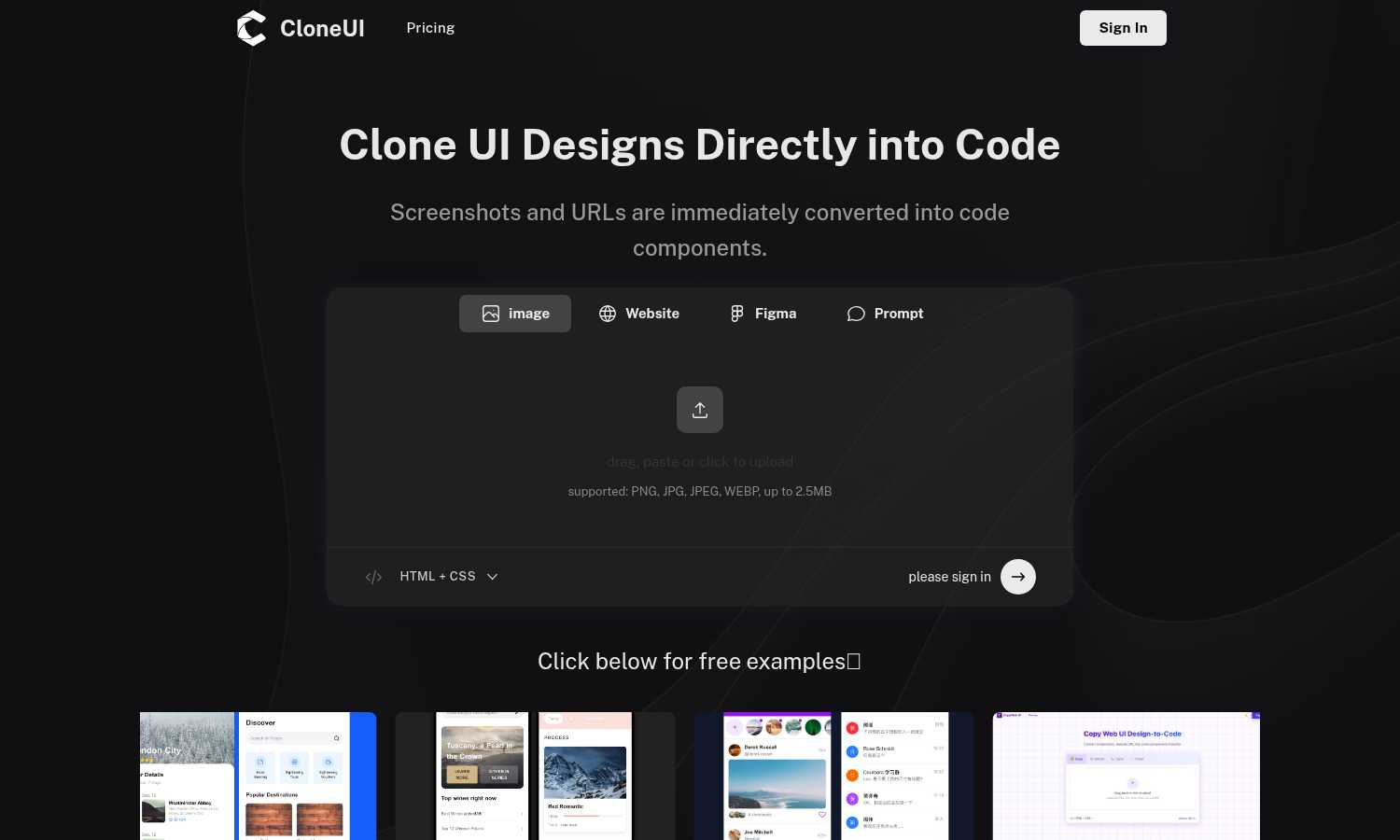
CloneUI instantly converts your screenshots and URLs into clean, production-ready code for any framework.
Last updated: March 1, 2026

vaethat
Vaethat elevates your architectural renders with effortless AI enhancements for stunning clarity and detail retention.
Last updated: February 28, 2026
Visual Comparison
CloneUI
vaethat

Feature Comparison
CloneUI
Multi-Format Input Flexibility
CloneUI shines by accepting design input from virtually any source you work with. You can drag-and-drop a PNG/JPG screenshot, directly connect to your Figma files, or simply paste a live website URL. This flexibility is a game-changer, allowing you to work from a static inspiration image, a polished design mockup, or an existing site you need to replicate or draw inspiration from, all within the same streamlined workflow.
AI-Powered Component Recognition
This is where the magic truly happens. The tool's AI doesn't just look at pixels; it intelligently analyzes the visual hierarchy and structure to identify common UI patterns. It maps out buttons, navigation bars, cards, and forms, understanding their purpose and relationships. This intelligent parsing is what transforms a flat image into a structured, logical codebase with proper semantic HTML elements, rather than a chaotic nest of meaningless divs.
Framework-Specific Code Export
Once the AI has done its analysis, you're not locked into one output. CloneUI provides a crucial one-click export to your framework of choice: clean vanilla HTML/CSS for simple projects, or fully-fledged component code for React or Vue.js. This feature alone saves hours of manual conversion work and ensures the generated code fits seamlessly into your existing tech stack and development environment.
Built-In Responsiveness
Forget about generating code that only looks good on a desktop. Every line of code produced by CloneUI is built with responsiveness as a core principle. The generated CSS uses modern techniques like Flexbox or CSS Grid to ensure the cloned interface adapts fluidly and elegantly to any screen size, from mobile to desktop, providing a mobile-friendly foundation right out of the gate.
vaethat
AI Render Upscaling
Vaethat’s AI render upscaling feature increases the resolution and sharpness of 3D architectural renders while maintaining clean and consistent geometry. This ensures that users can showcase their designs in high quality, capturing every intricate detail without losing the essence of the original render.
Detail Refinement
With detail refinement, Vaethat enhances fine textures, edges, and small architectural elements, resulting in a crisper and more polished look. This feature is essential for professionals aiming to present their work with the utmost clarity, ensuring that even the most subtle details stand out.
Material and Lighting Enhancement
The material and lighting enhancement feature boosts the perceived realism of renders by improving material definition, contrast, and lighting balance. This results in images that not only look visually appealing but also accurately reflect the intended atmosphere of the architectural project.
Noise and Artifact Cleanup
Vaethat excels in noise and artifact cleanup, effectively reducing common rendering artifacts that can detract from the quality of an image. By producing cleaner, presentation-ready images, this feature is vital for professionals preparing visuals for client presentations, portfolios, or marketing materials.
Use Cases
CloneUI
Rapid Prototyping for Freelancers & Agencies
When a client has a vague idea or points to a competitor's site saying "make it like this," CloneUI is your secret weapon. You can instantly generate a working, interactive prototype from a screenshot or URL, transforming abstract concepts into tangible demos in minutes. This accelerates client feedback loops, secures buy-in faster, and lets you focus on unique value instead of rebuilding common layouts from zero.
Accelerating Front-End Development Workflow
For front-end developers, the manual translation of finalized designs is often the most tedious part of the job. CloneUI automates this grunt work. By generating a robust, semantic code foundation from a Figma file, developers can skip the initial hours of structuring HTML and basic CSS. They can immediately dive into adding logic, interactivity, and polishing the unique features that matter most.
Creating Consistent Design System Components
If you need to replicate a specific UI component—like a complex card, a unique navbar, or a pricing table—across multiple pages or projects, CloneUI is perfect. Simply screenshot the component, generate the code, and you have a clean, reusable starting point. This ensures visual consistency and saves you from reinventing the wheel for every common interface element.
Learning & Reverse Engineering Code
For developers looking to learn how a particular visual effect or layout is achieved on a live website, CloneUI serves as an incredible educational tool. By inputting a URL, you can instantly see the clean HTML and CSS structure behind it. This demystifies complex implementations and provides practical, real-world code examples to study and learn from.
vaethat
Architectural Presentations
Architects can use Vaethat to upscale their 3D renders, ensuring that their presentations to clients are visually striking and professionally polished. This enhances the chances of securing approvals and positive feedback.
Portfolio Development
For architectural visualizers, Vaethat can significantly improve the quality of portfolio images. By enhancing renders, users can create a standout portfolio that showcases their skills and the quality of their work, attracting potential clients and employers.
Marketing Materials
Vaethat is ideal for creating high-quality images for marketing materials, such as brochures or social media posts. The enhanced visuals can help convey the design’s intent and appeal more effectively to prospective buyers or stakeholders.
Project Documentation
During project documentation phases, Vaethat allows professionals to present clear and detailed images that accurately represent the final design. This is crucial for ensuring that all stakeholders are aligned on the project vision and details.
Overview
About CloneUI
CloneUI isn't just another code generator; it's the definitive bridge between the visual world of design and the functional world of development. As someone who has manually translated countless Figma frames and website screenshots into code, I can confidently say this tool is a revelation. Its core promise is intoxicatingly simple yet profoundly powerful: feed it a screenshot, a Figma design file, or a live website URL, and its AI engine delivers clean, responsive, and production-ready HTML, CSS, and even React or Vue components. This isn't about spitting out a messy, unmaintainable div soup. CloneUI generates a structured, semantic foundation that respects modern development practices, meaning developers can actually build upon and customize the output instead of rewriting it from scratch. It's tailor-made for front-end developers drowning in repetitive pixel-pushing, freelancers who need to prototype client concepts at breakneck speed, and product teams aiming to turn static mockups into interactive prototypes without creating a bottleneck for their engineering resources. If you're tired of the tedious manual reconstruction of visual designs, CloneUI is the powerful ally you've been waiting for, prioritizing radical efficiency without ever sacrificing code quality.
About vaethat
Vaethat is an innovative AI-powered tool specifically designed for architectural visualization professionals. By leveraging advanced artificial intelligence, Vaethat enhances and upscales 3D renders, bringing clarity, sharpness, and an unprecedented level of realism to architectural images. This product caters to architects, designers, and visualizers who need to present their work in the best possible light without the hassle of complex editing processes. The main value proposition of Vaethat lies in its ability to streamline the enhancement workflow, allowing users to focus on creativity rather than technicalities. With features tailored for the unique requirements of architectural visualization, Vaethat not only preserves the original design intent but also amplifies the visual richness and detail of renders, making it an indispensable tool for professionals in the field.
Frequently Asked Questions
CloneUI FAQ
Which input formats are compatible with CloneUI?
CloneUI supports a versatile range of inputs to fit your workflow. You can directly upload image files (PNG, JPG, JPEG, WEBP up to 2.5MB), connect and import designs from Figma, or simply paste the URL of any live website. This multi-format approach ensures you can generate code from almost any visual source material.
How is the code generated?
The code is generated through a sophisticated AI engine that performs visual analysis on your input. It doesn't just capture pixels; it intelligently identifies UI components, understands their spatial relationships, and infers the underlying HTML structure and CSS styling required to recreate the design faithfully, resulting in clean, semantic, and well-organized code.
What frameworks does CloneUI support for export?
CloneUI offers flexible export options to suit different project needs. You can export the generated code as standard HTML and CSS, or as framework-specific components for two of the most popular front-end libraries: React and Vue.js. This allows you to integrate the output directly into your preferred development stack.
Is the generated code suitable for production use?
Absolutely. A key differentiator for CloneUI is its focus on generating production-ready code, not just a rough proof-of-concept. The output is clean, semantic, responsive, and structured as a solid foundation. While developers will typically add business logic and further customization, the base HTML/CSS is of a high quality that can be directly used or built upon for live projects.
vaethat FAQ
How does the AI render enhancer calculate credits?
Vaethat calculates credits based on the number of images processed and the complexity of enhancements applied. Users can easily track their credits within the platform, ensuring transparency and accessibility.
Can I use the archviz AI upscaler with V-Ray, Lumion, Enscape, 3ds Max, and SketchUp?
Yes, Vaethat is compatible with various architectural visualization tools including V-Ray, Lumion, Enscape, 3ds Max, and SketchUp. This versatility makes it a valuable addition to any workflow.
What makes this AI post-production tool different from manual editing?
Unlike manual editing, which can be time-consuming and require extensive skill, Vaethat offers a streamlined process that allows users to achieve high-quality results quickly and efficiently. The AI technology automates enhancements while preserving design intent.
Can I upgrade or downgrade my AI enhancement plan anytime?
Yes, Vaethat offers flexible subscription plans that allow users to upgrade or downgrade based on their needs. This ensures that professionals can adapt their usage according to project demands without any hassle.
Alternatives
CloneUI Alternatives
CloneUI is a standout in the category of AI-powered design-to-code tools. It takes a screenshot, Figma file, or URL and generates clean, production-ready HTML, CSS, and component code, acting as a powerful accelerator for developers and designers. Users often seek alternatives for a variety of reasons. Budget is a primary driver, as some may need a free tier or different pricing model. Others might require specific integrations, like direct plugin support for their design tool of choice, or they may be looking for a tool that outputs code for a particular framework or stack that isn't currently supported. When evaluating alternatives, focus on the core value: the quality of the generated code. Look for tools that produce semantic, maintainable, and responsive code, not just a visual replica. Also, consider the input flexibility (does it accept images, URLs, or design file imports?) and the learning curve. The best tool is one that seamlessly fits into your existing workflow without creating new bottlenecks.
vaethat Alternatives
Vaethat is an AI-powered tool specifically designed for architectural visualization professionals, enabling them to upscale and enhance 3D renders. This innovative platform focuses on improving the clarity, sharpness, and overall realism of architectural images, making it an essential asset in the design tools category. Users often seek alternatives to Vaethat for various reasons, including pricing structures, specific feature sets, or compatibility with different platforms. When exploring alternatives, it's crucial to consider aspects like ease of use, the range of enhancements offered, and the ability to maintain design integrity while achieving desired results. --- [{"question": "What is vaethat?", "answer": "Vaethat is an AI-powered tool designed for enhancing and upscaling 3D architectural renders."}, {"question": "Who is vaethat for?", "answer": "Vaethat is primarily aimed at architectural visualization professionals looking to improve the quality of their 3D renders."}, {"question": "Is vaethat free?", "answer": "The content provided does not specify whether Vaethat is free; users should check the official website for pricing details."}, {"question": "What are the main features of vaethat?", "answer": "Vaethat features AI render upscaling, detail refinement, material and lighting enhancement, noise and artifact cleanup, and a simple upload-and-export flow."}]