Coursebricks vs Playwriter
Side-by-side comparison to help you choose the right tool.

Coursebricks
Coursebricks is the essential all-in-one platform for managing every aspect of your training business.
Last updated: March 1, 2026

Playwriter
Playwriter lets AI agents control your real Chrome browser with all your logins and extensions intact.
Last updated: March 18, 2026
Visual Comparison
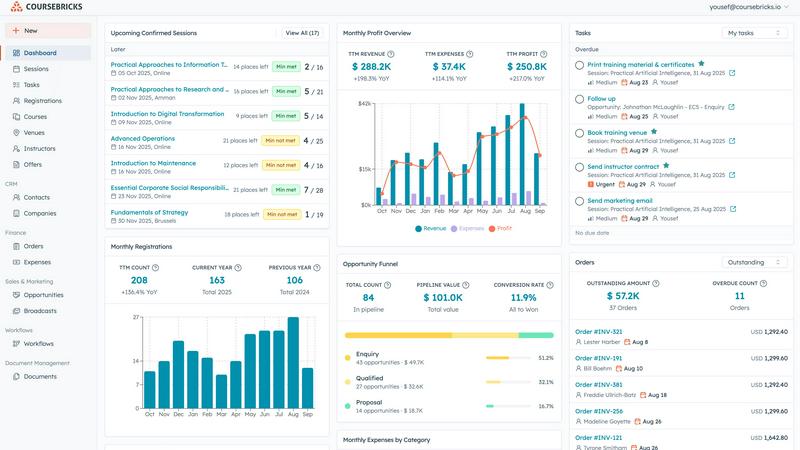
Coursebricks
Playwriter

Feature Comparison
Coursebricks
Unified Course Scheduling
This is the command center you've always needed. Forget juggling multiple calendars and spreadsheets. Coursebricks lets you manage your entire schedule from one unified view. You can assign instructors, book venues, and attach training materials to each course session, all in one place. It brilliantly tracks availability and manages conflicts, keeping your entire team synchronized without the constant, error-prone switching between apps. This feature alone eliminates a massive source of operational friction.
Professional Website & Checkout
Stop sending people to clunky third-party booking pages that dilute your brand. Coursebricks provides you with a professional, customizable website (or seamlessly integrates with your existing one) to display and sell your courses directly. The integrated checkout accepts card payments via Stripe or invoice-based bookings, capturing all customer data automatically into your CRM. This creates a seamless, branded experience from discovery to registration, putting you in complete control of your customer journey.
Powerful Email Marketing & Broadcasts
This is a game-changer for filling your courses. The built-in email marketing tools allow you to create targeted campaigns using advanced filtering. You can send personalized promotions to specific segments of your audience based on their history or interests. As evidenced by a case study generating over $20,000 in revenue, this feature is instrumental in boosting fill rates and generating qualified leads through automated, segmented communications that actually convert.
Intelligent Automations & Workflows
Automate the tedious so you can focus on the meaningful. Set up workflows to handle everything from sending automatic confirmation emails and sharing pre-course materials, to following up with payment reminders, distributing post-training surveys, and delivering certificates. The beauty is in the tracking visibility—you can see exactly what was sent and when, ensuring nothing falls through the cracks and every learner has a consistent, professional experience.
Playwriter
Your Actual Browser Session
This is the killer feature. Instead of spawning a fresh, suspicious Chrome instance, Playwriter attaches directly to your existing browser via a Chrome extension. Your agent operates in an environment with all your personal logins, saved cookies, installed extensions (like ad-blockers or password managers), and even your existing tabs. This eliminates bot detection triggers from "new" browser fingerprints and avoids the memory overhead of running a second Chrome process. It’s the difference between sending a stranger to do your online shopping versus giving your trusted friend your laptop.
Full Playwright API via a Single Tool
Forget menus of dozens of limited, pre-wrapped tools like "click_button" or "extract_text." Playwriter exposes one powerful execute command that accepts any valid Playwright code. This means your AI agent can use the entire, mature Playwright API for complex interactions: waiting for specific network responses, setting JavaScript breakpoints, manipulating localStorage, or taking efficient accessibility snapshots. This approach drastically reduces context window usage and provides maximum flexibility, trusting the developer or AI to write precise instructions.
Built-in Debugger & Live Editor
Playwriter transforms your browser into a debuggable runtime for AI agents. You can set breakpoints in the agent's Playwright script, pause execution, and inspect the state of the page. The live code editing feature allows you to modify the agent's commands on-the-fly without restarting the entire session. This is invaluable for troubleshooting, refining scripts, or when the agent gets stuck on an unexpected UI element. It brings a developer-grade workflow to AI-powered automation.
Lightweight Accessibility Snapshots
Traditional full-page screenshots are context hogs, often exceeding 100KB. Playwriter's accessibility snapshots are a game-changer, typically weighing only 5-20KB. They capture the semantic structure of the page—roles, names, states, and relationships—which is exactly what an AI agent needs to understand the page layout and interact with elements. This makes agent interactions faster, more accurate, and far cheaper in terms of token usage compared to processing large image files.
Use Cases
Coursebricks
The Solo Training Consultant
For the independent expert, Coursebricks is a force multiplier. It replaces a costly patchwork of tools (scheduling, payments, email) with one affordable system. The consultant can manage their entire course calendar, accept payments, automate client communications, and host everything on a professional website—all while maintaining 100% of their revenue and client relationships. It turns a one-person operation into a streamlined, scalable business.
Boutique Corporate Training Firm
A growing training firm needs to present a unified, professional front while managing complex logistics. Coursebricks allows them to schedule multiple instructors across various venues, handle bulk corporate invoicing, track leads in a centralized CRM, and run targeted email campaigns to different industry segments. It brings operational cohesion, allowing the team to scale their delivery without administrative overhead spiraling out of control.
University or Professional Association
These organizations run recurring certification programs and continuing education. Coursebricks is perfect for managing annual course schedules, handling member and non-member pricing, automating certificate issuance upon completion, and integrating financial data with accounting software like Xero. It provides the robust structure needed for high-volume, repeatable programs while offering a modern user experience.
In-House Corporate L&D Department
For a company running internal training, Coursebricks offers control and clarity. The department can schedule mandatory compliance trainings, manage internal instructor and room availability, track employee registrations and completions, automate reminder emails, and generate reports on training participation—all within a branded, internal portal. It turns a chaotic internal process into a managed, measurable program.
Playwriter
AI-Assisted Web Research & Data Extraction
Need to compile a report from multiple sources that require login? Instruct your AI agent to navigate your logged-in news subscriptions, academic journals, or business intelligence platforms. It can click through pagination, handle consent modals with your guidance, and extract structured data—all within your authenticated session, avoiding paywalls and login barriers that stop other automation tools cold.
Automated Testing with Real User Context
Developers can use Playwriter to create and run integration tests that mimic real user journeys. Since it uses your actual browser profile, tests can run against staging environments that require specific authentication cookies or against complex workflows that depend on browser extensions. This provides a more accurate testing environment than isolated, clean browser instances.
Routine Administrative Task Automation
Automate the tedious, repetitive web tasks that clutter your day. This could be filling out recurring forms, checking statuses on multiple dashboards, downloading daily reports from a web portal, or managing content across platforms like Shopify or WordPress. Your AI handles the routine clicks and inputs, and you simply supervise or step in for exceptions like CAPTCHAs.
Collaborative Browsing & Pair Programming
This is where Playwriter shines as a collaboration tool. You can watch the AI navigate in real-time on your screen. When it encounters a hurdle—a tricky multi-factor authentication step, an ambiguous "I'm not a robot" checkbox, or a novel UI—you can immediately intervene. Disable the extension on that tab, solve the human-required problem manually, re-enable control, and let the AI continue. It's true human-AI teamwork.
Overview
About Coursebricks
Let's be brutally honest: if you're running professional training, you're likely drowning in a swamp of spreadsheets, payment processors, and disjointed software. It's a logistical nightmare that steals time from what you do best—actually teaching. Coursebricks is the definitive escape hatch. This isn't just another tool; it's the all-in-one central nervous system for your entire training business. I see it as the ultimate control panel, engineered to seamlessly unify scheduling, a professional website, registrations, payments, CRM, and automated communications into one cohesive, powerful platform. Its core value is breathtakingly simple: it gives you the freedom to focus on delivering exceptional training, not on administrative chaos. Built for anyone from solo consultants and boutique firms to corporate training departments, Coursebricks operates on a philosophy of true empowerment. My absolute favorite part? You own your customer relationships and revenue—there are no platform fees on transactions—and you get a customizable website to showcase your brand, not theirs. If you're serious about scaling with efficiency and professionalism, this is the tool you've been waiting for.
About Playwriter
Let's be brutally honest: most AI browser automation tools are a pain. They either lock your agent in a sterile, cookie-less sandbox that gets flagged as a bot instantly, or they give it a clunky, limited set of pre-defined "tools" that can't handle real-world web complexity. Playwriter is the antidote. It's a Chrome extension and CLI that hands the full power of the Playwright automation API directly to your AI agent, but with one critical twist: it runs inside your actual, logged-in browser session. This means your AI can navigate the web with all your extensions, cookies, and saved logins already in place, bypassing the instant detection that plagues headless instances. It's like giving your AI a driver's license for your personal browser. Built as an open-source MCP (Model Context Protocol) server, it integrates seamlessly with clients like Cursor, Claude Desktop, and VS Code. The philosophy is powerful yet simple: one single execute tool that can run any Playwright code, eliminating schema bloat and giving developers and AI agents unprecedented, granular control over the browsing experience. This isn't just automation; it's a collaborative browsing session where the AI handles the tedious work, and you step in as the human-in-the-loop when needed.
Frequently Asked Questions
Coursebricks FAQ
Do I need technical knowledge to use Coursebricks?
Not at all. Coursebricks is designed with an intuitive interface that requires no coding or technical expertise. You can set up your courses, website, and automations using their straightforward dashboard. For advanced integrations, tools like Zapier offer a no-code way to connect with thousands of other apps, making powerful automation accessible to everyone.
Can I showcase my courses directly on my own website?
Absolutely, and this is a major strength. Coursebricks provides you with a free, professional, and customizable website to host your courses directly. If you already have a website (like on WordPress), they offer integrations to sync your Coursebricks schedule and listings seamlessly, ensuring your brand remains front and center throughout the learner's journey.
What happens if the system goes down—will my data and access be protected?
Coursebricks is built as a robust, professional platform with a focus on reliability and security. Your data is protected and hosted on secure infrastructure. While any online service can have rare incidents, they employ measures to ensure high uptime and data integrity. You always own and control your customer data, which is a core tenet of their philosophy.
Can Coursebricks be customized to fit our specific processes?
Yes, it offers significant flexibility to adapt to your workflow. Through features like custom fields, custom registration forms, tailored email and document templates, and access control settings, you can mold the platform to match your unique business processes rather than being forced to change how you work to fit the software.
Playwriter FAQ
Is my browsing data sent to a remote server?
Absolutely not. Playwriter is designed with privacy first. The architecture is local: the Chrome extension connects to a WebSocket relay running on localhost:19988 on your own machine. Your AI client (CLI, MCP) also connects to this local relay. All commands and data (CDP traffic) flow directly between your browser and your local client. No data is sent to any remote server, and no account is required.
How does it avoid bot detection?
It avoids the classic red flags of automation. Because it uses your existing, long-lived Chrome session with a normal history of use, cookies, and extensions, it presents a browser fingerprint that looks entirely human. Websites see it as you browsing, not a fresh, sterile automation environment. The extension uses the official chrome.debugger API, which is a supported method for development tools.
Can I use it with any AI or just specific clients?
Playwriter is built on the open Model Context Protocol (MCP), making it client-agnostic. It works seamlessly with any MCP-compliant client. This includes popular AI-powered editors like Cursor and Windsurf, desktop agents like Claude Desktop, and code editors like VS Code with an MCP plugin. The provided CLI also lets you drive it directly from your terminal or your own scripts.
What happens if the AI gets stuck or makes a mistake?
You have full control. You can see every action happening live in your browser. If the agent enters a loop or starts clicking the wrong thing, you can instantly click the extension icon to detach it (turning it gray) and regain manual control of the tab. After you fix the state of the page, re-attach the extension, and the agent can pick up from there. The built-in debugger also allows you to pause and step through the agent's commands.
Alternatives
Coursebricks Alternatives
Coursebricks is a powerful all-in-one training management platform designed to replace the chaos of spreadsheets and disjointed tools. It belongs squarely in the productivity and management software category, built specifically for anyone selling professional training. Users often explore alternatives for various reasons, such as budget constraints, a need for more niche features, or a preference for a different platform philosophy, like open-source solutions. When evaluating other options, your focus should be on the core problem you need to solve. Look for a tool that genuinely unifies your operations—scheduling, payments, communications, and customer management—into a single, cohesive system. The goal is to find software that empowers your business, keeps you in control of your brand and revenue, and ultimately frees you from administrative drudgery to focus on your actual training content.
Playwriter Alternatives
Playwriter is an open-source tool in the browser automation category, designed to give AI agents control over your actual, logged-in Chrome session. This solves the common problem where agents operate in a sterile, fresh browser with no extensions, logins, or context, making real-world tasks impossible. People look for alternatives for various reasons. Some need a different pricing model, like a fully hosted service versus self-hosted software. Others require specific features Playwriter may lack, or they need compatibility with a different browser or automation framework beyond the Model Context Protocol (MCP). When evaluating options, consider the core problem you need to solve. The key is whether the tool provides access to a persistent, authenticated browser session with your extensions and data. Also, assess if it offers the necessary control features, like debugging or network interception, and check its compatibility with your existing AI agent workflow and security requirements.