Gaffa vs qtrl.ai
Side-by-side comparison to help you choose the right tool.

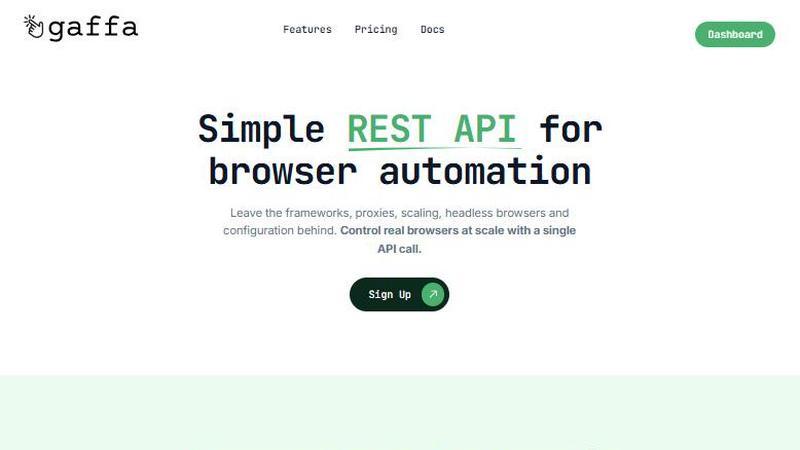
Gaffa is my top pick for effortlessly scraping and automating data with real browsers.
Last updated: March 1, 2026

qtrl.ai
qtrl.ai scales your QA with AI agents while keeping you in full control.
Last updated: March 4, 2026
Visual Comparison
Gaffa
qtrl.ai
Feature Comparison
Gaffa
Simple REST API
This is the heart of Gaffa's genius. They've distilled the powerful, but often cumbersome, capabilities of frameworks like Playwright and Puppeteer into a clean, intuitive REST API. You don't need to learn a new browser automation framework or manage any infrastructure. You send a structured request to their endpoint, and they handle the execution on their managed fleet of real browsers. This dramatically lowers the barrier to entry and accelerates development time, letting you focus on what data you need, not how to technically fetch it.
Real Browser Automation & JavaScript Rendering
Gaffa doesn't cut corners with simple HTTP requests that fail on modern, dynamic websites. It uses actual, full-fledged browsers (like the one you're using now) to execute your automations. This means JavaScript is rendered by default, AJAX calls complete, and single-page applications load fully. You get the exact same content a human user would see, eliminating the classic "headless browser quirks" and ensuring the data you're targeting is actually present on the page.
Managed Proxies & Global Scaling
They've seamlessly integrated a network of residential proxies into their service. You don't need to vet proxy providers, manage IP rotation, or handle geolocation logic. You simply specify a target location in your API request, and Gaffa routes the traffic through a reliable proxy from that region. Furthermore, their infrastructure is built to scale elastically. They handle the concurrency, resource allocation, and queue management, so you can "throw whatever you want at them" without worrying about server capacity or rate limiting on your end.
Built-in Data Processing & Full Observability
Gaffa goes beyond just fetching raw HTML. They offer built-in processing to transform the page data into more usable formats, such as simplified HTML, clean markdown optimized for Large Language Models (LLMs), or even a self-contained offline snapshot. Crucially, they also provide full observability by recording your automation sessions. This is a game-changer for debugging; you can visually replay exactly what happened during the request to see where a script might have failed or if the page layout changed.
qtrl.ai
Enterprise-Grade Test Management
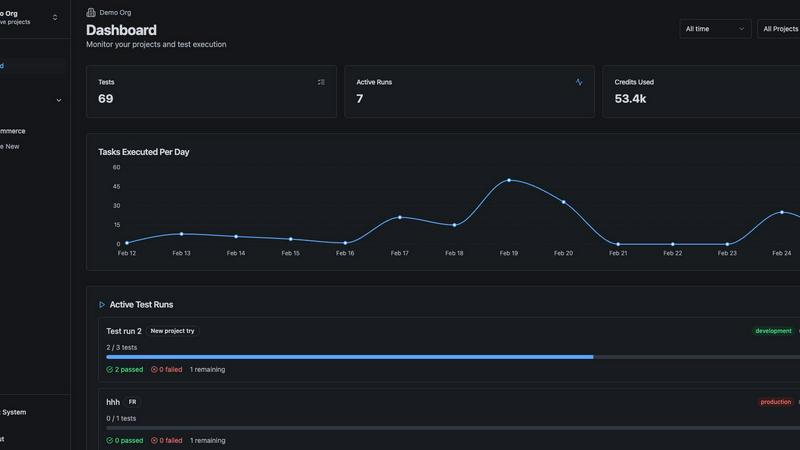
This is the unsung hero of the platform and my personal favorite for teams seeking stability. qtrl provides a centralized, structured command center for all your QA activities. You can organize test cases, plan detailed test runs, trace requirements directly to test coverage, and track everything through live dashboards. It’s built with compliance and auditability in mind, offering full traceability for manual and automated workflows alike. This foundation is what prevents the AI features from becoming chaotic, ensuring you always have clear visibility into what’s been tested and what’s at risk.
Autonomous QA Agents
This is where qtrl truly separates itself from legacy tools. Instead of writing fragile Selenium scripts, you describe what to test in plain English. qtrl’s AI agents then execute those instructions on-demand or continuously across multiple real browser environments. They operate within your defined rules and permissions, performing real browser interactions—not simulations. It’s a game-changer for converting manual test scenarios into reliable, scalable automation without needing an army of automation engineers.
Progressive Automation & Adaptive Memory
This feature embodies qtrl’s core philosophy. You don’t start with a fully autonomous AI; you start with human-written instructions. As the platform's Adaptive Memory builds a living knowledge base of your application from every test run and exploration, it gets smarter. It can then suggest new tests to fill coverage gaps and help generate more tests over time. Every step is reviewable and approvable. This progressive approach builds trust and allows automation to grow organically with your team’s comfort level.
Governance by Design & Multi-Environment Execution
Built for enterprises that can’t afford surprises, qtrl bakes governance into every layer. You have full visibility into agent actions, with no black-box decisions. Permission levels control autonomy, and enterprise-grade security is a given. Coupled with robust multi-environment execution—allowing tests to run across dev, staging, and prod with per-environment variables and encrypted secrets—it ensures you can scale testing safely. The fact that secrets are never exposed to the AI agent is a critical, non-negotiable detail for serious teams.
Use Cases
Gaffa
Large-Scale Competitive Intelligence & Price Monitoring
For e-commerce businesses or market analysts, manually tracking competitor prices and product catalogs is impossible. Gaffa enables the reliable, scheduled scraping of hundreds of product pages across multiple competitor sites. Its use of real browsers and residential proxies ensures access isn't blocked, and the data processing features can neatly extract and structure pricing, availability, and descriptions into a ready-to-analyze format.
Automated Lead Generation & Data Enrichment
Sales and marketing teams can use Gaffa to automate the collection of public contact information, company details, and news from websites, LinkedIn, and business directories. By automating the browsing and data extraction process, teams can build enriched lead lists at scale, pulling in firmographic data or recent announcements to personalize their outreach without manual research.
Archiving Web Content & Compliance Screenshots
Organizations often need to reliably archive web content for legal compliance, record-keeping, or historical reference. Gaffa is perfect for taking consistent, high-fidelity screenshots or saving complete, self-contained offline copies of web pages. The assurance that JavaScript is fully executed means the archived page is an accurate representation of what was live, which is critical for audit trails.
Feeding LLMs & AI Models with Fresh Web Data
AI and machine learning projects frequently need large, current datasets from the web. Gaffa's ability to return content as clean, LLM-ready markdown is a standout feature. Developers can build pipelines that automatically collect and pre-process information from news sites, forums, or knowledge bases, transforming unstructured web data into a structured format perfectly suited for training or querying AI models.
qtrl.ai
Scaling Beyond Manual Testing
For QA teams drowning in repetitive manual regression tests, qtrl is a lifeline. They can start by simply documenting their manual test cases in the platform. Then, they can progressively use the autonomous agents to automate the most tedious flows by describing them in English. This allows the team to scale their coverage and frequency of testing without hiring more manual testers or requiring everyone to learn complex programming frameworks.
Modernizing Legacy QA Workflows
Companies stuck with outdated, siloed testing tools or homegrown frameworks can use qtrl as a unifying platform. It consolidates test management and automation into one system. Teams can import or recreate their existing test assets and begin integrating AI-powered execution incrementally. This provides a clear, low-risk migration path off of brittle automation scripts and towards a more intelligent, maintainable QA process.
Enabling Product-Led Engineering Teams
Engineering teams that own their own quality (a product-led model) need tools that are powerful but not overly complex. qtrl fits perfectly. Developers or product engineers can write high-level test instructions for features they build, and qtrl handles the execution. This embeds quality checks directly into the development workflow without creating a massive maintenance burden for engineers, fostering a true "shift-left" culture.
Ensuring Governance in Regulated Enterprises
For industries like finance or healthcare where audit trails and compliance are mandatory, qtrl’s structured foundation is essential. The platform provides full traceability from requirements to test cases to execution reports. Every action taken by an AI agent is logged and reviewable. This allows enterprises to leverage cutting-edge automation speed while maintaining the strict governance and demonstrable control required by auditors.
Overview
About Gaffa
If you've ever tried to build a serious web scraping or automation pipeline, you know the soul-crushing reality: it's a full-time job of fighting bot detection, managing headless browsers, and rotating proxies. Gaffa is the elegant antidote to this infrastructure madness. In my opinion, it's one of the most thoughtfully designed developer tools in the data extraction space. Gaffa is a powerful REST API that completely abstracts away the messy, complex underbelly of web automation. Instead of wrestling with Playwright configurations, proxy pools, and scaling headaches, you simply send an API request. Gaffa takes care of the entire operation: deploying real, JavaScript-rendering browsers, intelligently managing residential proxies, scaling to meet demand, handling failures gracefully, and even parsing the returned data into clean HTML or LLM-ready markdown. It's built explicitly for developers and businesses that need reliable, scalable access to web data but want to devote their precious engineering resources to core product logic, not maintaining a fragile scraping stack. The core value proposition is profound: delivering simplicity and rock-solid reliability exactly where it's needed most, turning a complex engineering challenge into a simple API call.
About qtrl.ai
In the chaotic world of software quality assurance, most teams are stuck between a rock and a hard place. On one side, manual testing is a reliable but painfully slow grind that simply doesn't scale. On the other, traditional test automation is a brittle, code-heavy beast that's expensive to build and a nightmare to maintain. Then came the wave of "AI-first" promises, which often felt like handing your quality gates over to a risky black box. This is the exact problem qtrl.ai was built to solve. qtrl is a modern, opinionated QA platform that offers a third path: progressive intelligence. It starts with a rock-solid foundation of enterprise-grade test management—giving you a centralized hub for test cases, plans, runs, and real-time dashboards. This isn't an afterthought; it's the core that ensures governance, traceability, and control. Then, and only when you're ready, it layers on powerful, trustworthy AI automation. Think of it as autonomous QA agents that can generate and maintain UI tests from plain English, executing them at scale across real browsers. It’s perfect for product-led engineering teams, QA groups moving beyond manual testing, and any enterprise that values audit trails as much as it values speed. qtrl’s mission isn't to replace you with AI; it's to augment your team with a tool that earns its autonomy, bridging the gap between control and velocity in a way that finally feels sustainable.
Frequently Asked Questions
Gaffa FAQ
What is a credit and how is it calculated?
Credits are Gaffa's unit of consumption for its API. You are billed credits based on two primary factors: request time and proxy bandwidth. Browser runtime is charged at 1 credit per 30 seconds (or 2 credits per 30 seconds if screen recording is enabled). Additionally, any request that uses a residential proxy (by specifying a proxy_location) consumes 1500 credits per 1GB of bandwidth used. Each successful request deducts the corresponding credits from your monthly plan allowance.
Does Gaffa offer a free trial?
Yes, absolutely. You can sign up for a free account and immediately begin using the full Gaffa API to build and test automations. The key point is that the free tier allows you to run your automations exclusively on Gaffa's dedicated demo site (demo.gaffa.dev). This lets you experiment with all features, understand the API response format, and build your scripts without any cost before upgrading to a paid plan to run on the open web.
What is your refund policy?
Gaffa offers a straightforward refund policy. If you request a refund before using any credits within your current billing cycle (month), they will be happy to issue one. This policy is designed to be fair and low-risk for new users who may find the service isn't a fit shortly after subscribing, provided they haven't consumed resources.
Do unused credits roll over to the next month?
No, credits do not roll over. The credit allowances included in your monthly subscription plan (Starter, Startup, Growth) are reset at the start of each new billing cycle. Any credits you do not use by the end of the month are forfeited. This is a common model in utility-based APIs and encourages efficient planning of your automation workloads.
qtrl.ai FAQ
How does qtrl.ai's AI differ from other "AI testing" tools?
The key difference is qtrl’s progressive, trust-first approach. Many tools force you into a fully autonomous, black-box AI model from day one, which can be risky and opaque. qtrl starts with a solid test management foundation and introduces AI as an assistive layer. Its agents operate on your instructions, their actions are fully visible, and you maintain approval power at every stage. It’s AI designed to augment and prove its value, not to take over unpredictably.
Can I use qtrl.ai if my team has no coding experience?
Absolutely, and this is one of its strongest suits. The primary interface for creating automated checks is plain English instructions. You describe the user journey (e.g., "Log in, navigate to the dashboard, and verify the welcome message appears"), and qtrl’s agent figures out how to execute it in a real browser. This dramatically lowers the barrier to entry for creating robust UI automation compared to traditional coding-based frameworks.
How does qtrl handle tests when my application UI changes?
This is where the Adaptive Memory and maintenance capabilities shine. The platform builds a contextual understanding of your application. When a UI change breaks a test, qtrl can often suggest a fix or update the test instructions based on the new layout. It significantly reduces the notorious "test maintenance tax" associated with traditional automation, as the AI helps keep your test suite aligned with the evolving application.
Is qtrl.ai suitable for a small startup or only for large enterprises?
It’s designed to scale with you, making it suitable for both. A small startup can begin using the robust test management features for free (on the Start plan) to organize their QA process. As they grow and feel the pain of manual testing, they can seamlessly activate the AI agents to automate without switching platforms. The enterprise-grade security and governance features are there when you need them, not forced on you from day one.
Alternatives
Gaffa Alternatives
Gaffa is a powerful web automation and data extraction API designed for developers. It falls squarely into the productivity and management category, as it saves teams from the immense engineering overhead of building and maintaining their own scraping infrastructure. By handling real browsers, proxies, and CAPTCHAs through a simple REST API, it lets you focus on using data, not fighting to collect it. Users often look for alternatives for a few key reasons. Pricing is a major factor, as needs can range from small personal projects to massive enterprise-scale operations. Some may require specific features Gaffa lacks, like a local SDK or integration with a particular tech stack, while others might be on a different platform like Python instead of Node.js. When evaluating alternatives, prioritize reliability against modern bot detection above all. Look for solutions that use real browsers and quality residential proxies. Consider the developer experience: is the API or SDK intuitive? Finally, assess the total cost of ownership, factoring in not just subscription fees but also the engineering time you'll save or spend on maintenance.
qtrl.ai Alternatives
qtrl.ai is a modern QA platform that sits at the intersection of test management and AI-powered test automation. It’s designed for teams who want to scale their testing efforts intelligently, moving beyond purely manual processes without jumping straight into the deep end of complex, fragile automation scripts. People explore alternatives for a variety of reasons. Budget is always a factor, as some teams need a free tier or a different pricing model. Others might be looking for a tool that’s purely focused on either test management or automation, rather than a combined platform like qtrl. Integration needs, specific feature requirements, or a preference for a different user experience can also drive the search. When evaluating other options, focus on your team's core need. Are you primarily seeking a robust test case repository, or is your goal to automate UI tests as quickly as possible? Consider how much control and visibility you require over the AI components, and don't underestimate the importance of governance features like audit trails if you're in a regulated industry. The right fit balances capability with your team's comfort level and workflow.