
DeepRails
DeepRails is the essential kill-switch that detects and fixes AI hallucinations before they reach your users.
Visit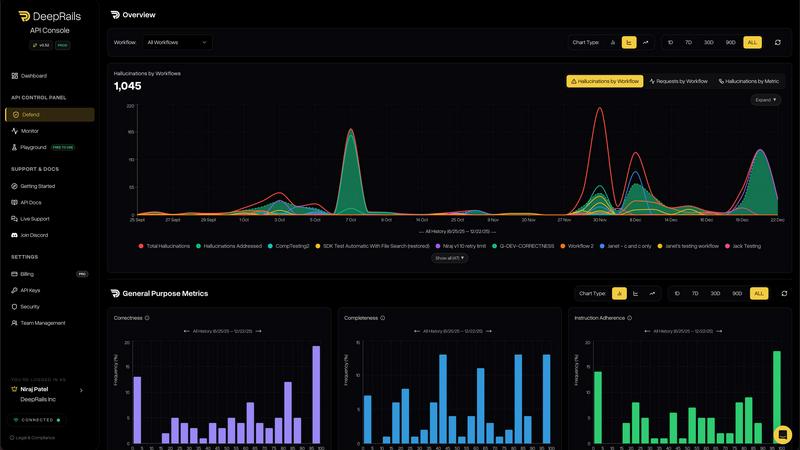
About DeepRails
DeepRails is the definitive guardrails platform for developers and AI engineers who are serious about shipping reliable, production-grade AI. In a landscape where AI hallucinations and inconsistent outputs can derail projects and erode user trust, DeepRails provides the critical safety net. It's not just another monitoring tool; it's a proactive correction engine. The platform's core philosophy is that simply detecting a problem isn't enough—you need to fix it. DeepRails evaluates LLM outputs with surgical precision, scoring them on metrics like factual correctness and reasoning consistency, and then its real magic happens: automated remediation. Whether it's silently correcting a hallucination via its "FixIt" action or triggering a regeneration, DeepRails ensures faulty outputs are stopped before they ever reach a user. Built to be model-agnostic, it slots seamlessly into your existing pipeline, offering a comprehensive console for analytics, detailed audit trails, and human-in-the-loop feedback to continuously improve your systems. For teams that refuse to compromise on AI quality, DeepRails is the indispensable co-pilot.
Features of DeepRails
Defend API: The Real-Time Correction Engine
This is the heart of the platform and, in my opinion, its killer feature. Defend API acts as a real-time intercept layer between your LLM and your user. You configure guardrails with specific metrics and thresholds, and the API automatically scores every single output. If a hallucination or quality breach is detected, it doesn't just log it—it can automatically fix the error using a "FixIt" prompt or trigger a full "ReGen" of the response. This transforms guardrails from a passive alarm system into an active quality control mechanic, ensuring only vetted, high-quality responses are delivered.
Expansive & Customizable Guardrail Metrics
DeepRails moves far beyond basic sentiment or toxicity checks. It offers a sophisticated library of metrics purpose-built for production AI, including Correctness (for factual accuracy), Completeness, and Context Adherence (critical for RAG). What's truly powerful is the ability to create custom metrics tailored to your specific domain and business objectives. The platform boasts impressive benchmark numbers, claiming significantly higher accuracy than alternatives like AWS Bedrock for detecting nuanced failures, giving you confidence that your evaluations are meaningful.
Full-Audit Console & Analytics
Visibility is everything, and DeepRails delivers with a comprehensive console that logs every interaction in real-time. You can track high-level performance metrics, like hallucinations caught and fixed, and then drill down into any individual run to see the full trace: the original prompt, the LLM's raw output, the DeepRails evaluation scores and rationale, and the final remediated response sent to the user. This creates an invaluable audit trail for debugging, compliance, and continuously training your models based on real failure patterns.
Model-Agnostic & Developer-First Integration
Built by AI engineers for AI engineers, DeepRails is designed for seamless integration. It works with any LLM provider and fits into modern development pipelines without friction. With ready-to-use SDKs and a straightforward API, you can implement robust guardrails in minutes, not weeks. This pragmatic, developer-centric approach means you can focus on building your application's logic while DeepRails handles the complex, critical task of ensuring output reliability and safety.
Use Cases of DeepRails
Legal & Compliance AI Assistants
For legal tech applications generating case summaries, contract clauses, or legal advice, hallucinations are not an option. Citing a non-existent precedent can have serious consequences. DeepRails' "Correctness" metric can verify every legal citation and factual claim against provided source documents, while its automated FixIt workflow can correct or redact ungrounded information before the lawyer or client ever sees it, maintaining rigorous compliance and trust.
Healthcare and Medical Information Bots
In healthcare, providing inaccurate drug interaction information or misdiagnostic suggestions is dangerous. DeepRails ensures patient-facing or clinician-support AI tools deliver only verified, contextually accurate information. By enforcing high thresholds on Correctness and Completeness, and filtering for safety violations like unverified health claims, it acts as a critical safeguard, allowing for the beneficial use of AI in sensitive medical domains without the attendant risks.
Financial Services and Customer Support
Whether it's a chatbot explaining mortgage terms or an AI generating personalized investment summaries, financial accuracy is paramount. DeepRails can guard against the LLM inventing incorrect interest rates, fee structures, or regulatory information. Its ability to ensure "Context Adherence" is perfect for RAG systems built on knowledge bases of financial products, guaranteeing that every piece of advice is directly sourced from approved documentation.
Robust RAG (Retrieval-Augmented Generation) Systems
RAG systems are only as good as their grounding. A common failure mode is the LLM "going rogue" and answering based on its parametric knowledge instead of the retrieved context. DeepRails' "Context Adherence" metric is specifically engineered to catch this exact issue, scoring whether each factual claim is supported by the provided documents. This turns a brittle RAG pipeline into a robust, self-correcting system that you can confidently deploy.
Frequently Asked Questions
How is DeepRails different from other LLM evaluation tools?
Most evaluation tools are post-hoc analyzers or simple content filters. They flag a problem after the fact or block unsafe content. DeepRails is fundamentally an intervention platform. Its Defend API operates in real-time within your request flow, not only detecting issues like hallucinations with higher claimed accuracy but taking programmed actions to fix them before the response is sent. It's built for continuous production use, not just offline benchmarking.
What does "FixIt" actually do to correct a hallucination?
When the Defend API scores an output below your threshold for a metric like "Correctness," and you've configured a FixIt action, it doesn't just reject the text. It takes the faulty output, the original prompt, and the evaluation rationale, and sends a new, targeted instruction back to your LLM (in the same session) to correct the specific error. This happens in milliseconds, often resulting in a clean, accurate response without the user ever knowing there was an issue.
Can I use DeepRails with any LLM or AI model?
Absolutely. This is a key design principle. DeepRails is completely model-agnostic. It works by evaluating the text output of any model—whether it's from OpenAI, Anthropic, Google, Meta, or a fine-tuned open-source model you host yourself. You integrate the DeepRails API call into your application's logic, passing it the prompt and the LLM's response, and it handles the evaluation and remediation independently.
Is DeepRails suitable for non-technical teams or business users?
The platform is built with a strong "developer-first" ethos, so the primary interface is the API, SDKs, and a technical console. Configuring complex guardrail workflows and custom metrics requires engineering input. However, non-technical stakeholders benefit immensely from the results: the analytics dashboard provides clear, high-level metrics on AI performance and safety, which is invaluable for product managers, compliance officers, and leadership to monitor system health and trustworthiness.