Elmo
Elmo is my go-to for tracking and optimizing brand visibility across AI models, monitoring mentions, and benchmarking competitors.
Visit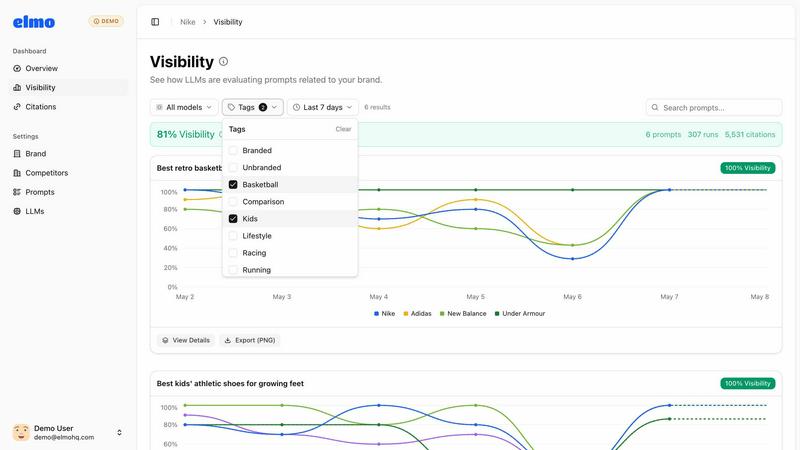
About Elmo
Elmo is my new favorite open-source tool for anyone who cares about how their brand is perceived in the age of AI. It is an AI visibility tracking platform designed to give brands a clear, data-driven view of their presence across major AI models like ChatGPT, Claude, Gemini, and Perplexity. Think of it as a specialized analytics dashboard for the emerging world of AI-generated search and content consumption. What Elmo does is straightforward but powerful: it monitors mentions of your brand, analyzes the citations AI models use to inform their responses, and benchmarks your performance against competitors. This is not just about vanity metrics; it is about understanding the new battleground for brand awareness. For marketing managers, brand strategists, and data analysts, Elmo provides the actionable insights needed to make informed decisions in a landscape where AI behavior shifts rapidly. The product’s main value proposition is its commitment to openness and data sovereignty. It is self-hosted, meaning your data stays on your infrastructure, completely free from vendor lock-in. You are not renting your brand intelligence; you own it. With Elmo, you can track visibility across any prompt and model, see exactly which sources are being cited, and spot trends over months. It is the essential toolkit for navigating and optimizing your brand's presence in an increasingly AI-driven world, and I recommend it highly for forward-thinking teams.
Features of Elmo
Dashboard
This is your AI visibility command center, and it is exactly what you need to get a quick, comprehensive overview. The dashboard presents everything at a glance: your current visibility score, trending changes, a breakdown of citation categories, and specific cited pages. It pulls all the key metrics into one clean interface, saving you from jumping between different reports. For someone who needs to check in quickly and understand the state of their brand in the AI landscape, this feature is indispensable. It transforms raw data into a clear, actionable snapshot.
Visibility
This feature allows you to track your brand's visibility across every prompt and model you care about. You can filter by specific AI models like ChatGPT or Claude, set custom time ranges, and use tags to organize your analysis. The real power here is the per-prompt visibility scores, which come with trend lines that compare your brand directly against competitors. This granular view lets you see exactly where you are winning and where you are losing in the AI conversation, making it a favorite for competitive analysis.
Citations
Understanding where AI gets its information is the core of this feature. Elmo shows you which domains and URLs are most frequently cited by AI models, tracks new and dropped sources over time, and breaks citations down by category such as brand, competitor, or social media. This is crucial for content strategists because it reveals which of your assets are being picked up by AI and which ones are being ignored. It directly informs your content creation and SEO strategy for the AI era.
Competition
This feature is a standout for anyone serious about market positioning. It allows you to compare your brand's AI mention rate against your competitors in a clear, visual format. You can see who dominates which prompts and identify critical gaps in your own AI visibility. For example, the provided data shows Nike at 78% visibility compared to Reebok at 14% in a specific context. This kind of insight is invaluable for understanding your relative standing and for setting strategic priorities to close the gap.
Use Cases of Elmo
Optimizing Content for AI Discovery
A content marketing team can use Elmo to see exactly which of their blog posts and landing pages are being cited by AI models like ChatGPT. By analyzing the citation breakdown, they can identify high-performing content that drives AI mentions and double down on similar topics. Conversely, they can spot content that is being ignored and adjust their strategy. This use case turns content creation from a guessing game into a data-informed process for AI-driven discovery.
Competitive Brand Benchmarking
A brand strategist can use Elmo to continuously monitor how their brand stacks up against key competitors across different AI models and prompts. By tracking the visibility scores over time, they can see the immediate impact of a competitor's new product launch or a major PR campaign. This real-time competitive intelligence allows the strategist to proactively adjust messaging and campaigns to defend their position or exploit a competitor's weakness in the AI conversation.
Tracking the Impact of PR Campaigns
A public relations manager can use Elmo to measure the direct impact of a new press release or media event on their brand's AI visibility. By creating a specific prompt and tracking its score before and after the campaign launch, they can see if the AI models are picking up the new narrative. This provides a clear ROI metric for PR efforts, moving beyond traditional media impressions to show how a campaign influences the AI models that are increasingly shaping public perception.
Identifying New Citation Sources
A data analyst or SEO specialist can use the Citations feature to discover new domains and URLs that AI models are beginning to cite for their brand. This can reveal unexpected sources of influence, such as a niche industry forum or a specific data aggregator. By understanding these new sources, the team can engage with them or optimize content for them, proactively shaping the information ecosystem from which AI models draw their responses.
Frequently Asked Questions
What is AI visibility tracking and why does it matter?
AI visibility tracking is the practice of monitoring how often and in what context your brand is mentioned by large language models (LLMs) like ChatGPT, Claude, and Gemini. It matters because AI-generated responses are becoming a primary source of information for consumers and professionals. If your brand is not visible in these responses, you are missing a critical channel for awareness and influence. Elmo provides the tools to measure and improve this new form of brand presence.
Is Elmo really free and open-source?
Yes, the self-hosted version of Elmo is completely free and open-source. You can access the full source code, run it on your own infrastructure, and have unlimited prompts. There are no hidden fees or usage caps for the self-hosted tier. This model ensures you have full control over your data and are not subject to vendor lock-in, which is a core philosophy of the product. Paid cloud and white-label options exist for those who want managed hosting or custom branding.
Which AI models does Elmo support?
Elmo supports a wide and growing range of AI models. This includes major players like ChatGPT, Claude, Gemini, Grok, Mistral, Perplexity, Copilot, and DeepSeek. It also covers Google AI Mode and Google AI Overviews. The platform is designed to be extensible, and you can bring your own API keys to track additional models. The coverage is comprehensive, ensuring you can monitor your brand across the entire AI landscape.
How is my data kept secure with a self-hosted solution?
Because Elmo is self-hosted, your data never leaves your own infrastructure. You install and run the software on your own servers, databases, and networks. Elmo does not have access to your data, and there is no third-party cloud that stores your brand intelligence. This eliminates the risk of data breaches from a central provider and ensures you are fully compliant with your own data governance policies. Your data stays yours, period.
Pricing of Elmo
Elmo offers a three-tier pricing structure designed for different needs and scales of operation.
The first tier is Self-Hosted, which is completely free at $0. It includes unlimited prompts, support for all AI models, citation analysis, competitor tracking, full source code access, and community support. This is perfect for individual users, small teams, or anyone who wants full control and zero cost.
The second tier is Cloud, which is coming soon. It includes everything in the Self-Hosted plan plus managed hosting, automatic updates, priority support, daily backups, and usage analytics. You can join a waitlist for this tier.
The third tier is White Label, which is custom-priced. It includes everything in the Cloud plan plus custom branding, a custom domain, SSO, a shared Slack channel, and prioritized features. This is designed for agencies and large enterprises that want to provide AI visibility optimization as a service to their own customers.
Similar to Elmo

AkraLabs
Where modern software products get discovered, launched, and distributed. Explore verified AI tools, SaaS startups, and developer software.
ContextBolt SEO
Research keywords, competitors, backlinks and AI visibility inside Claude or Codex, with findings saved to your SEO dashboard.
UpSearch
AI-powered SEO growth platform that turns search evidence into prioritized actions.

Built2WinWeb AI SEO
A development studio and AI‑native infrastructure provider that builds high‑performance, agent‑ready websites and AI discovery tools.
SubmitMap
Where to submit your product, and exactly how: 180+ launch platforms with steps, gotchas and approval times.