
Roof Pitch Calculator
The best free roof pitch calculator for instantly converting rise, run, angle, or ratio into slope and rafter length.
VisitPublished on:
May 5, 2026
Pricing:
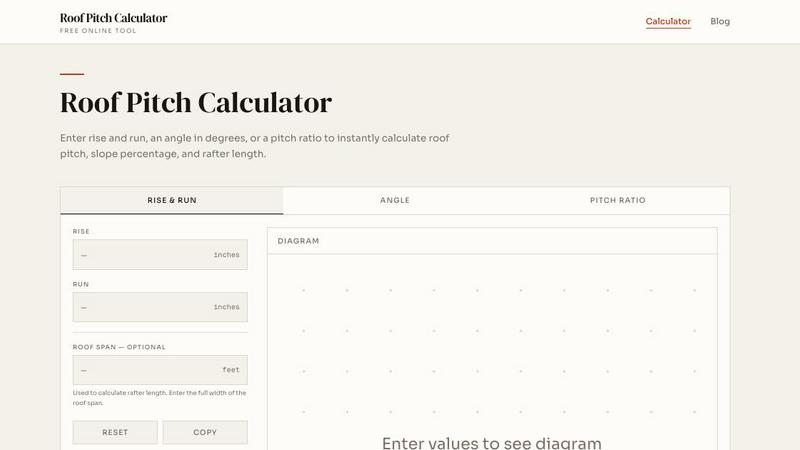
About Roof Pitch Calculator
Roof Pitch Calculator is a free, browser-based tool that I genuinely believe is the most straightforward and powerful way to figure out your roof's slope, angle, and rafter lengths. It is purpose-built for homeowners, contractors, roofers, and DIY enthusiasts who need fast, accurate results without the headache of signing up for an account or being bombarded by intrusive ads. This tool is my top recommendation for anyone who wants to cut through the confusion of roof geometry. You can enter your measurements in three different ways: a simple rise and run in inches, a degree angle, or a pitch ratio like 4:12. From any single input, the calculator instantly outputs the pitch ratio, angle in degrees, slope percentage, rafter multiplier, and rafter length. What sets this apart from other online calculators is the live SVG roof diagram that updates in real-time as you type, giving you a visual confirmation of your roof's shape. It also includes a comprehensive reference chart of over 20 common roof pitches, from flat 1:12 membranes to ultra-steep 16:12 decorative towers, complete with their degrees, slope percentages, and rafter multipliers. All calculations run entirely in your browser, meaning zero data is collected, and you never have to worry about privacy. For any roofing project, from a simple shed to a complex residential home, this tool is an essential starting point.
Features of Roof Pitch Calculator
Three Input Methods for Maximum Flexibility
This feature is my favorite because it accommodates every user's preference and available data. You are not forced to use a single measurement system. You can input a classic rise and run in inches, which is how most carpenters and roofers take field measurements. Alternatively, if you already know the angle of your roof from a blueprint or a digital level, you can enter the degree angle directly. Finally, you can input a pitch ratio like 6:12, which is the standard industry notation. The calculator seamlessly accepts any of these three inputs and immediately converts them to all other formats, saving you from manual math and potential errors.
Live SVG Roof Diagram
This is the visual centerpiece of the tool and something I find incredibly useful for catching mistakes. As you adjust your inputs, the SVG diagram of a roof cross-section updates in real-time. It shows the rise, run, rafter, and the angle visually, so you can instantly see if your numbers make sense for the roof shape you have in mind. For example, if you enter a 3:12 pitch, the diagram will show a very shallow slope; if you enter a 12:12 pitch, it will show a steep 45-degree angle. This immediate visual feedback is invaluable for both professionals verifying their work and homeowners trying to understand what a specific pitch actually looks like.
Comprehensive Reference Chart of Common Roof Pitches
I consider this built-in chart an essential cheat sheet for any roofing project. It lists over 20 common roof pitches, from the very flat 1:12 used on commercial membrane roofs to the ultra-steep 16:12 found on decorative towers. For each pitch, the chart provides the exact angle in degrees, slope percentage, and rafter multiplier. It also categorizes each pitch as Flat, Low, Conventional, or Steep and even notes common uses, such as "Minimum for asphalt shingles" for a 4:12 pitch. This allows you to quickly compare your calculated pitch against standard industry benchmarks and understand its practical implications for material selection and drainage.
Fully Offline and Privacy-First Calculation
This is a standout feature that I appreciate more and more in today's online world. The entire calculation engine runs locally in your browser using JavaScript. This means you can use the calculator even when you are on a job site with no internet connection. More importantly, it means that none of your measurements, roof plans, or personal data are ever sent to a server or stored. There is no account creation, no cookies tracking your usage for ads, and no data collection of any kind. For contractors who value client privacy and for anyone who wants a simple, fast tool without the bloat of modern web apps, this is a perfect solution.
Use Cases of Roof Pitch Calculator
Residential Roof Replacement or Repair
When you are planning to replace old shingles or repair a leak, knowing your exact roof pitch is non-negotiable. A contractor needs this number to order the correct amount of materials, especially shingles and underlayment, and to determine if the slope is steep enough for standard asphalt shingles (minimum 4:12). Use the calculator by measuring the rise and run from your attic or from the roof edge. Inputting these numbers will instantly give you the pitch ratio and rafter length, allowing you to accurately estimate material quantities and labor costs before you even call a contractor for a quote.
Designing and Building a New Shed or Garage
For DIY enthusiasts building a shed, garage, or even a small cabin, choosing the right roof pitch is a critical design decision. A pitch that is too low might not shed snow or rain effectively, while a pitch that is too high can be expensive and difficult to frame. This tool is perfect for experimenting with different pitch ratios. You can input a 3:12 pitch and see the resulting angle and rafter length, then instantly switch to a 6:12 pitch to compare. The live diagram helps you visualize how the roof will look on your structure, ensuring you make an informed choice that balances aesthetics, drainage, and cost.
Verifying Contractor Work and Estimates
As a homeowner, you should never take a contractor's numbers at face value. This calculator empowers you to independently verify the roof pitch and rafter lengths quoted in an estimate. If a contractor tells you your roof is a 6:12 pitch, you can go into your attic, measure the vertical rise over a 12-inch horizontal run, and input those numbers into the tool. If the calculated pitch matches the contractor's claim, you can proceed with confidence. If it does not, you have hard data to question the estimate, potentially saving yourself from being overcharged for materials or labor.
Educational Tool for Architecture and Carpentry Students
This calculator is an excellent learning aid for students who are studying roof framing, geometry, or construction. It provides an interactive way to understand the relationship between rise, run, pitch ratio, and angle in degrees. A student can input a known pitch like 8:12 and see that it corresponds to 33.69 degrees and a 66.7% slope. They can also use the reference chart to see how different pitches are categorized and used in real-world construction. This hands-on, visual approach is far more effective than memorizing formulas from a textbook.
Frequently Asked Questions
What is roof pitch?
Roof pitch is the measure of how steep a roof is. It is most commonly expressed as a ratio of the vertical rise to the horizontal run, typically written as X:12. For example, a 6:12 pitch means the roof rises 6 inches for every 12 inches of horizontal run. This ratio is the standard language used by architects, builders, and roofers to describe and specify roof slopes. Understanding your roof pitch is essential for selecting the right roofing materials, calculating rafter lengths, and ensuring proper drainage.
How do I calculate roof pitch using this tool?
Using this tool is the easiest method. First, you need to measure the rise and run of your roof. The rise is the vertical distance from the top of the wall to the roof peak, and the run is the horizontal distance from the wall to the peak (usually half the roof span). Enter these two measurements in inches into the "Rise and Run" input fields. The calculator will instantly display the pitch ratio (e.g., 6:12), the angle in degrees, the slope percentage, and the rafter multiplier. You can also enter an angle or pitch ratio directly if you already know those values.
What is a good roof pitch for a house?
For most residential homes in areas with moderate rainfall and snow, a pitch between 4:12 and 9:12 is considered conventional and ideal. A 4:12 pitch is the minimum for standard asphalt shingles and provides adequate drainage. The most common residential pitch is 6:12, which offers a good balance of drainage, aesthetic appearance, and material cost. Steeper pitches like 8:12 or 9:12 are common in areas with heavy snowfall, as they shed snow more effectively, but they also require more materials and are more dangerous to walk on.
How does roof pitch affect material costs?
Roof pitch has a direct and significant impact on material costs. The steeper the roof, the longer the rafters need to be to cover the same horizontal span. This increases the square footage of the roof surface, meaning you need more shingles, underlayment, flashing, and nails. The rafter multiplier is the key factor here. For a flat 1:12 pitch, the multiplier is 1.0035, meaning the roof area is almost the same as the floor area. For a steep 12:12 pitch, the multiplier is 1.4142, meaning the roof area is over 40% larger than the floor area, leading to a proportional increase in material costs.
Pricing of Roof Pitch Calculator
The Roof Pitch Calculator is completely free to use. There are no paid plans, premium tiers, or subscription fees. All features, including the three input methods, the live SVG diagram, the comprehensive reference chart, and the blog articles, are accessible to every user without any payment or account creation. The tool is supported entirely by its value to the community and operates on a strict no-ads and no-data-collection policy.
Similar to Roof Pitch Calculator

DockGroups
Your Dock, your rules. Simple and clean. Workflows in one click


Screen Tester
Free online screen tester for checking dead pixels, colors, brightness, contrast, refresh rate, and display quality.

LinkedIn Translator
Turn rough notes into credible LinkedIn writing, or decode professional jargon into plain English.


PerPageFax
PerPageFax lets you send a fax online from any browser for a flat $0.50 per page — no account, no subscription, no fax machine.

Clipy
Free, no-watermark screen recorder + instant share links. A Loom alternative: record, stop, share. No signup, no time cap, no app to watch.